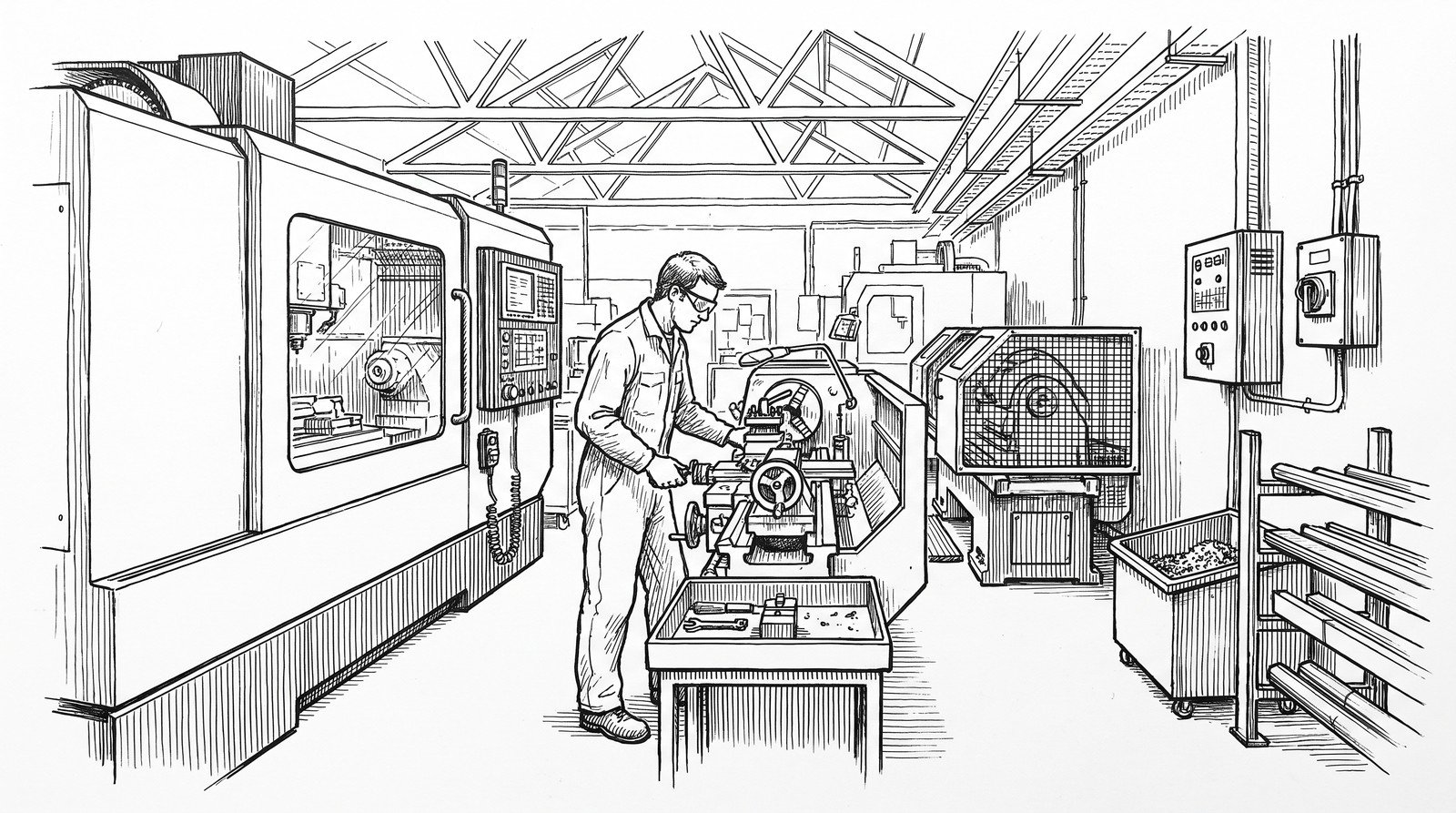
Every note on this page concerns fixed machinery and the shop it stands in. Conveyors and sortation in a distribution setting, order pickers and racking belong to Warehouse and Logistics, and the two link to each other where they meet. Five safeguarding standards were added to the standards library alongside these notes — EN ISO 14120 for guards, EN ISO 14119 for interlocks, EN ISO 13857 for reach distances, EN ISO 13850 for emergency stop and EN ISO 13855 for safeguard positioning — joining ISO 12100 and ISO 13849, which were already indexed.
Frequently asked questions
What comes before guarding a machine?
Designing the hazard out: enclosing a drive within the casing, automating a feed, moving a nip point out of reach, or lightening a component. Guards are the second answer, and information and protective equipment are the third.
Does an emergency stop make a machine safe to work on?
No. It halts the machine but does not isolate it. Raised parts stay raised, accumulators stay charged, springs stay compressed, flywheels coast and capacitors hold charge. Working on a machine requires isolation, proving and releasing the stored energy.
Why do interlocks get defeated?
Almost always because the guard obstructs a task that has to be done. A defeated interlock is evidence about the machine rather than about the person, and the useful response is to ask what they needed to reach and why.
Why are maintainers and setters injured more often than operators?
Because safeguards are designed around production. Setting, fault-finding and cleaning all require the guards off, the interlocks bypassed or a person inside the machine, so each needs its own arrangement rather than an exception to the normal one.
Which standards cover machine safeguarding?
ISO 12100 provides the risk assessment framework and ISO 13849 the reliability of safety functions. Guards fall under EN ISO 14120, interlocks under EN ISO 14119, reach distances under EN ISO 13857, emergency stop under EN ISO 13850, and safeguard positioning under EN ISO 13855.
Where does this activity stop and Warehouse & Logistics begin?
This activity covers fixed machinery and the shop it stands in. Conveyors and sortation systems in a distribution setting, order pickers and racking belong to Warehouse and Logistics, and the two link to each other where they meet.