Safety / Tips and Tricks / Machinery and manufacturing
Activity 12 · Machinery
Safety Distances: Why Reach Decides the Guard
Every guard is a compromise between keeping people out and letting work happen, and the number that settles the argument is how far a person can reach.
Reach is measured, not estimated
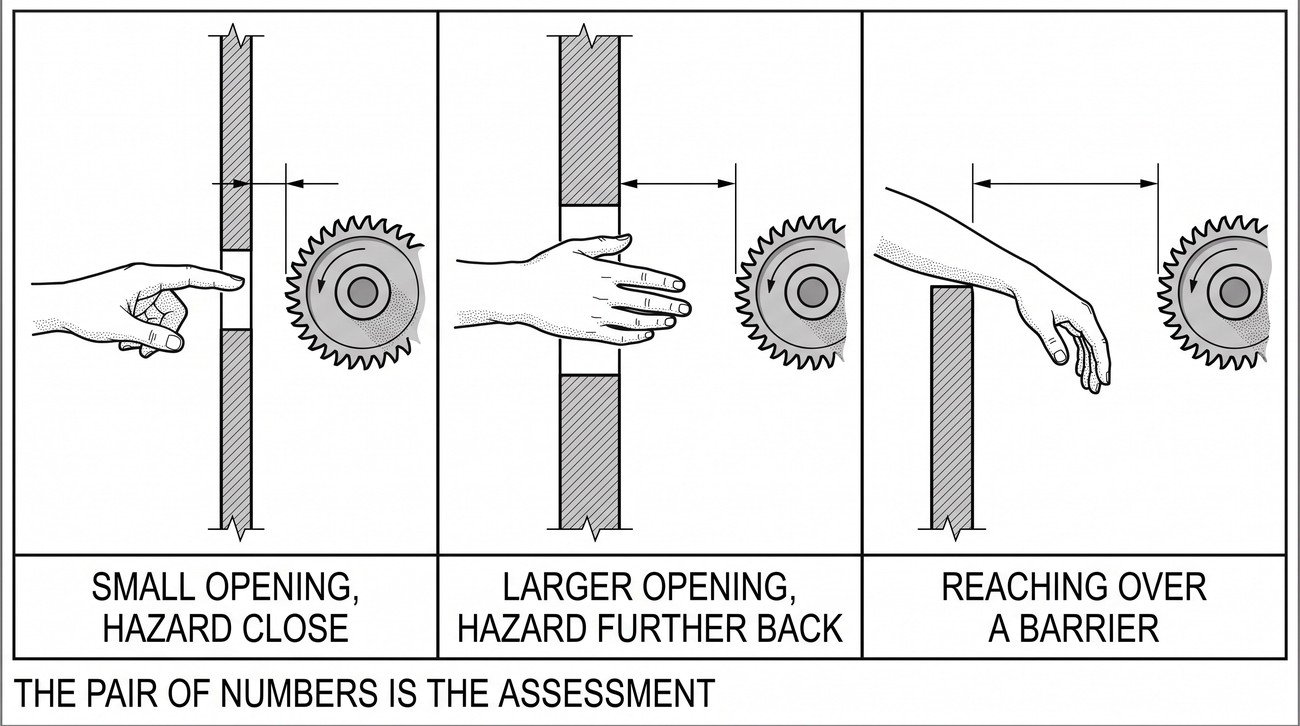
Safety distance standards are built on measured reach: how far an adult can extend a finger, a hand, an arm or their whole upper body through an opening of a given size, over a barrier of a given height, or around an edge. Those figures are the basis of the tables, and they are not intuitive — people consistently underestimate how far someone determined can get through a modest gap.
Opening size and distance work together
A larger opening admits more of the limb, so the hazard has to be further away. A small opening admits only a fingertip, so it can sit closer. This relationship is why a guard cannot be assessed by looking at its mesh alone, and why the same mesh is adequate on one machine and not on another. The pair of numbers — how big the opening is and how far the hazard sits behind it — is the assessment.
Over, under, around and through
Reaching through an opening is only one route. People reach over the top of a low barrier, under the bottom edge where there is a floor gap, and around the side of a guard that does not extend far enough. A guard assessed only for reaching through can leave any of those three open, and the one most often missed is the gap at the bottom, because it is hidden behind machine plinths and cable trays.
Where the person can stand changes everything
All of these distances assume a starting position. A step, a platform, a stack of pallets, a pipe run used as a foothold, or simply a taller person alters the reach that was designed for. This is why a guard that was adequate at installation can be inadequate after the area around it is rearranged, and why changes to the floor around a machine are changes to its safeguarding.
Distance as a safeguard in its own right
Where a hazard cannot reasonably be enclosed, distance itself can be the control: a perimeter fence far enough back that reaching the hazard is impossible, or a layout that keeps the walkway outside the reach envelope. This is often more robust than a close-fitting guard because there is nothing to open, and it also solves the ejection problem that a mesh guard does not.
For the measured distances themselves, see EN ISO 13857. For applying them to guards, see fixed guards.
Related standards
The standards below set the design requirements, classification and test methods behind the safeguards and equipment referenced in this note.
- EN ISO 13857 — Safety Distances and Reach
- EN ISO 14120 — Guards: Design and Construction
- EN ISO 13855 — Positioning of Safeguards
Common errors
1Judging a guard by its mesh size without the distance behind it.
2Assessing reach through an opening and missing the gap under the guard.
3Leaving a guard short at the side so a person can reach around the end.
4Ignoring steps, platforms and stacked material that change the standing position.
5Rearranging the area around a machine without reassessing its safeguarding.
Frequently asked questions
What are safety distances based on?
Measured reach: how far an adult can extend a finger, hand, arm or upper body through an opening, over a barrier or around an edge. The figures are not intuitive and people underestimate them.
Why can a guard not be judged by its mesh alone?
Because opening size and distance to the hazard work together. A small opening admits only a fingertip and can sit close; a larger one admits more of the limb and needs the hazard further away.
Which reach route is most often missed?
Under the guard. The gap at the bottom is usually hidden behind machine plinths and cable trays, while reaching through the mesh is the route everyone assesses.
How does the standing position affect the assessment?
All the distances assume where a person starts from. A step, platform, stack of pallets or pipe run used as a foothold changes the reach that was designed for.
Can distance alone be a safeguard?
Yes. A perimeter fence far enough back, or a layout keeping walkways outside the reach envelope, is often more robust than a close-fitting guard because there is nothing to open.
Need this as a document you can issue? The template library gives you the risk assessments, permits and inspection logs in editable form — and employer plans cover a whole team with completion records.