Safety / Tips and Tricks / Machinery and manufacturing
Activity 12 · Machinery
Trapping Points: Nip, Shear and Crush
Machines injure hands in three distinct ways, and knowing which one you are looking at tells you what the guard has to do — because the three do not respond to the same protection.
Nip points draw you in
A nip forms where two surfaces move together and at least one of them is rotating: a belt onto a pulley, a chain onto a sprocket, two rollers running against each other, a rotating shaft against a fixed housing. The defining feature is that the motion pulls material inward, so contact is not a single event. A glove touching a roller is drawn in with the hand following it, and the force available is far greater than a person can resist. This is why nips need enclosure rather than distance: there is no safe brief contact.
Shear points cut across
A shear forms where one part passes close by another with a small clearance, like a moving table passing a fixed frame or a guillotine blade meeting its bed. The injury happens across the gap rather than by being drawn in, and it happens at the moment the clearance closes. Shear points are frequently created by accident when a machine is modified or when an attachment is fitted, because the new part sweeps past something that was previously in open space.
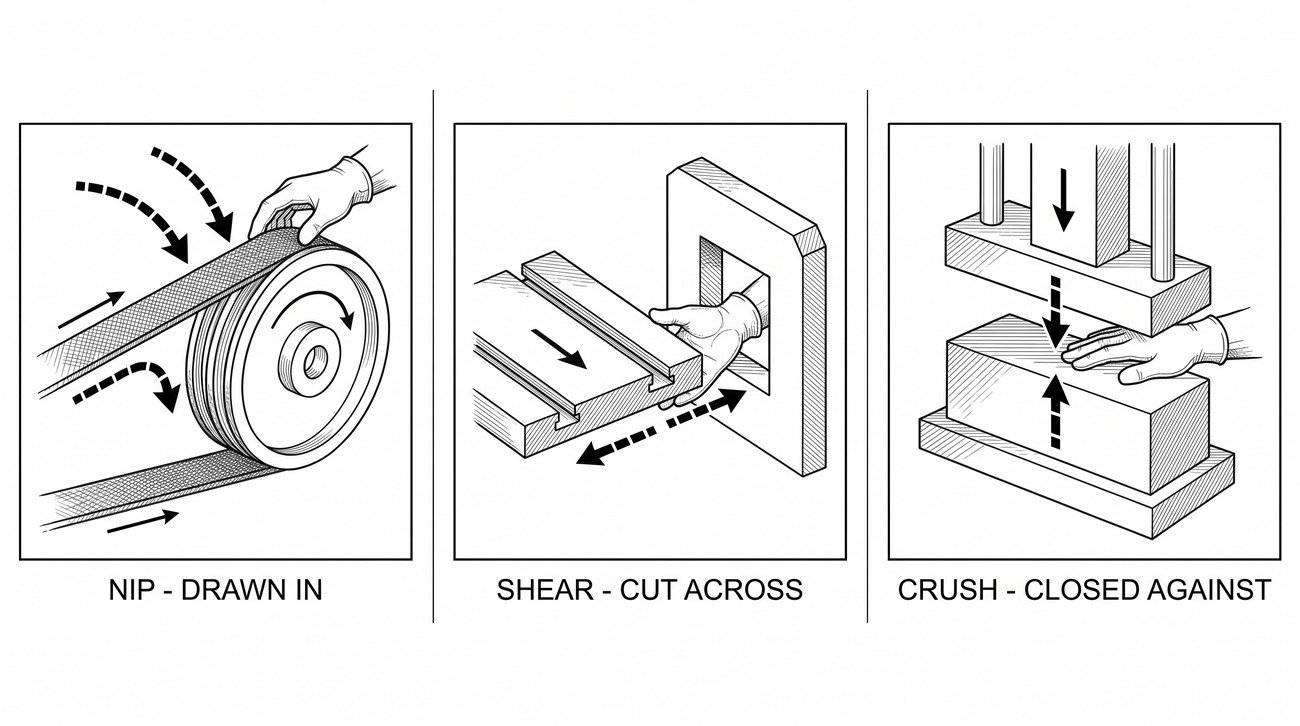
Crush points close a gap
A crush occurs where a moving part closes against a fixed one, or two moving parts close together, with enough force to trap. Unlike a nip there is no drawing-in and unlike a shear there is no cutting action, but the gap that remains at the end determines the injury. Where a crush point cannot be removed, the residual gap can sometimes be made large enough that a body part is not trapped, which is why minimum gap figures exist.
Where they hide
The dangerous trapping points are rarely the obvious ones at the working head of the machine, because those are usually guarded. They are on the drive side, behind an access panel, under the machine bed, at the return end of a conveyor, at the point where a chain leaves a sprocket, and wherever an accessory has been added since the machine was assessed. A walk around a machine looking specifically for surfaces moving relative to each other finds more than a document review does.
Speed does not make it safe
A slow-moving trapping point is not a safe one. Slow motion carries very high force in a geared drive, gives no useful reaction time once contact is made, and is more likely to tempt someone into intervening because it looks manageable. Some of the worst machine injuries come from slow, powerful movements that the person believed they could get clear of.
For the gaps that avoid crushing, see EN ISO 13857. For what draws people into contact in the first place, see entanglement risks.
Related standards
The standards below set the design requirements, classification and test methods behind the safeguards and equipment referenced in this note.
- ISO 12100 — Safety of Machinery: General Principles
- EN ISO 13857 — Safety Distances and Reach
- EN ISO 14120 — Guards: Design and Construction
Common errors
1Guarding the working point of a machine and leaving the drive side open.
2Creating a new shear point by fitting an attachment past an existing fixed part.
3Assuming brief contact with a nip is survivable, when the motion draws material in.
4Treating slow movement as low risk when the force behind it is very high.
5Assessing trapping points from a drawing rather than by walking round the machine.
Frequently asked questions
What is a nip point?
Where two surfaces move together with at least one rotating, such as a belt onto a pulley or two rollers running against each other. The motion pulls material inward, so contact is not a single event.
How does a shear point differ from a nip?
A shear happens where one part passes close by another with a small clearance, injuring across the gap rather than drawing material in. They are often created accidentally when a machine is modified.
What determines the severity of a crush point?
The gap that remains when the movement completes. Where the crush point cannot be removed, the residual gap can sometimes be made large enough that a body part is not trapped.
Where are trapping points usually found?
Not at the working head, which is normally guarded, but on the drive side, behind access panels, under the bed, at conveyor return ends, and wherever an accessory has been added since the assessment.
Is a slow-moving machine safer?
No. Slow motion in a geared drive carries very high force, gives no reaction time once contact is made, and tempts people to intervene because it looks manageable.
Need this as a document you can issue? The template library gives you the risk assessments, permits and inspection logs in editable form — and employer plans cover a whole team with completion records.