Safety / Tips and Tricks / Machinery and manufacturing
Activity 12 · Machinery
Emergency Stop: What It Does and What It Does Not
An emergency stop is the most visible safety device on a machine and the most widely misunderstood. It is a complement to the safeguards, not one of them, and it is not a way of making a machine safe to work on.
What it is for
An emergency stop exists to avert or limit harm once something has already gone wrong. It is a last resort operated by a person who has seen a problem, and its whole design follows from that: a single obvious control, reachable from wherever a person might need it, that requires no thought to identify and no decision about which one to press.
It does not remove energy
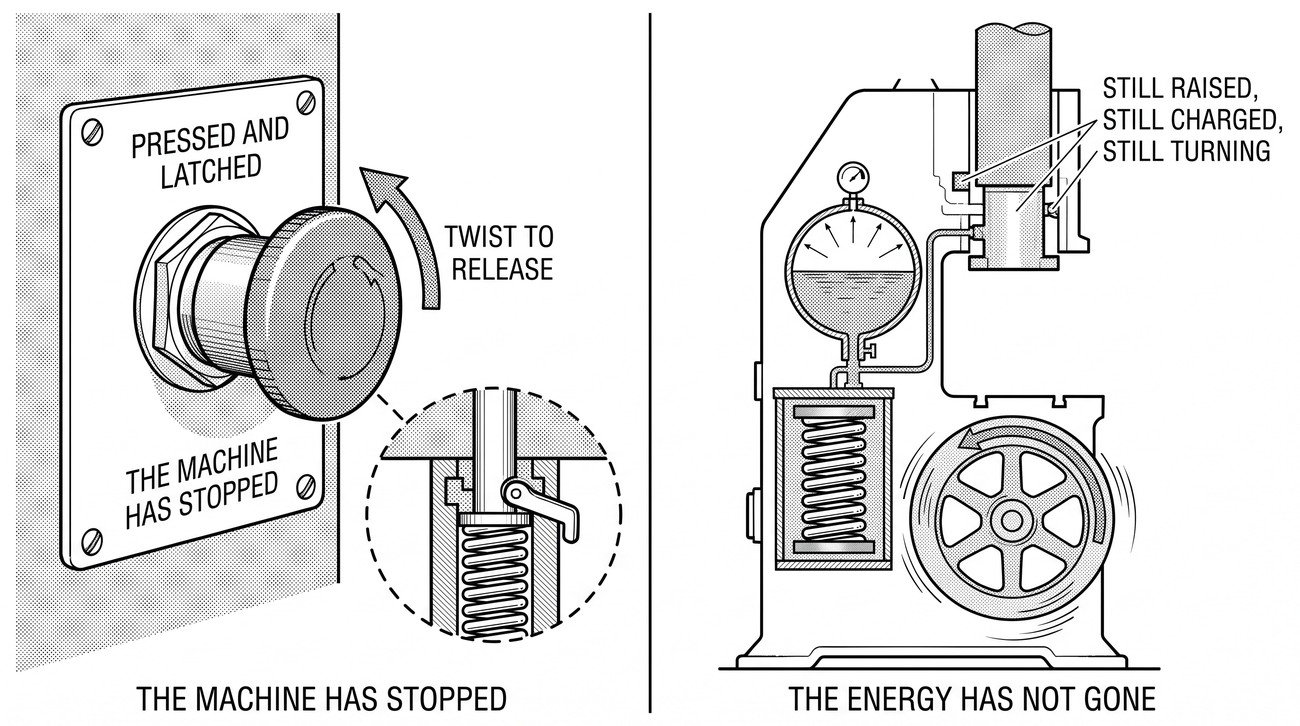
This is the misunderstanding that gets people hurt. Pressing the emergency stop brings the machine to a halt; it does not isolate it. Pneumatic pressure may remain in the system, hydraulic accumulators stay charged, capacitors hold their charge, raised parts stay raised, and rotating masses coast. A machine that has been emergency stopped is a stopped machine that is still full of energy, which is a different thing from a machine that is safe to put your hands into.
Latching and reset are deliberate
An emergency stop latches when operated and has to be released by hand, and releasing it must not restart the machine. That two-step arrangement is deliberate: it forces someone to go to the device, which means going to the place where the problem was, before the machine can run again. A device that springs back or a reset that restarts the machine removes the pause that the design depends on.
It has to be reachable from where you are
A device on the control panel is no use to someone at the discharge end of a twenty-metre machine. Emergency stops belong wherever a person might be when they need one, which usually means several devices, plus pull cords along a conveyor run so the whole length is covered. Reachability is assessed from the operating positions people actually use, including the awkward ones during setting and clearing.
Not a substitute for anything
An emergency stop cannot be counted as the safeguard for a hazard, because it depends on someone recognising the danger and reacting in time — neither of which is reliable at the moment a hand is being drawn into a nip. It is what you have left when the guarding has been defeated, bypassed or was never adequate, and treating it as a control in its own right is how a machine ends up with no real safeguard at all.
For the device requirements, see EN ISO 13850. For actually making a machine safe to work on, see locking off every energy source.
Related standards
The standards below set the design requirements, classification and test methods behind the safeguards and equipment referenced in this note.
- EN ISO 13850 — Emergency Stop Function
- ISO 13849 — Safety-Related Parts of Control Systems
- ISO 12100 — Safety of Machinery: General Principles
Common errors
1Treating an emergency stop as isolation and working on a machine that has only been stopped.
2Counting the emergency stop as the safeguard for a hazard that needs a guard.
3Fitting devices only at the control panel, out of reach of other working positions.
4Arranging the reset so that releasing the device restarts the machine.
5Assuming an emergency stop works, when it is never exercised during normal running.
Frequently asked questions
Does an emergency stop make a machine safe to work on?
No. It halts the machine but does not isolate it. Pneumatic pressure remains, accumulators stay charged, capacitors hold charge, raised parts stay raised and rotating masses coast.
Why must an emergency stop latch?
So that it has to be released by hand at the device itself, which means going to where the problem was before the machine can run again. Releasing it must not restart the machine.
How many emergency stops does a machine need?
Enough that one is reachable from every position a person might be in when they need it, assessed from the operating positions actually used, including awkward ones during setting and clearing.
Can an emergency stop count as a safeguard?
No. It depends on someone recognising the danger and reacting in time, neither of which is reliable while a hand is being drawn into a nip. It is a complement to safeguarding, not a substitute.
Why do emergency stops need testing?
Because normal running never exercises them, so a failed device gives no indication until the moment it is needed.
Need this as a document you can issue? The template library gives you the risk assessments, permits and inspection logs in editable form — and employer plans cover a whole team with completion records.