Safety / Tips and Tricks / Machinery and manufacturing
Activity 12 · Machinery
Light Curtains and Presence-Sensing Safeguards
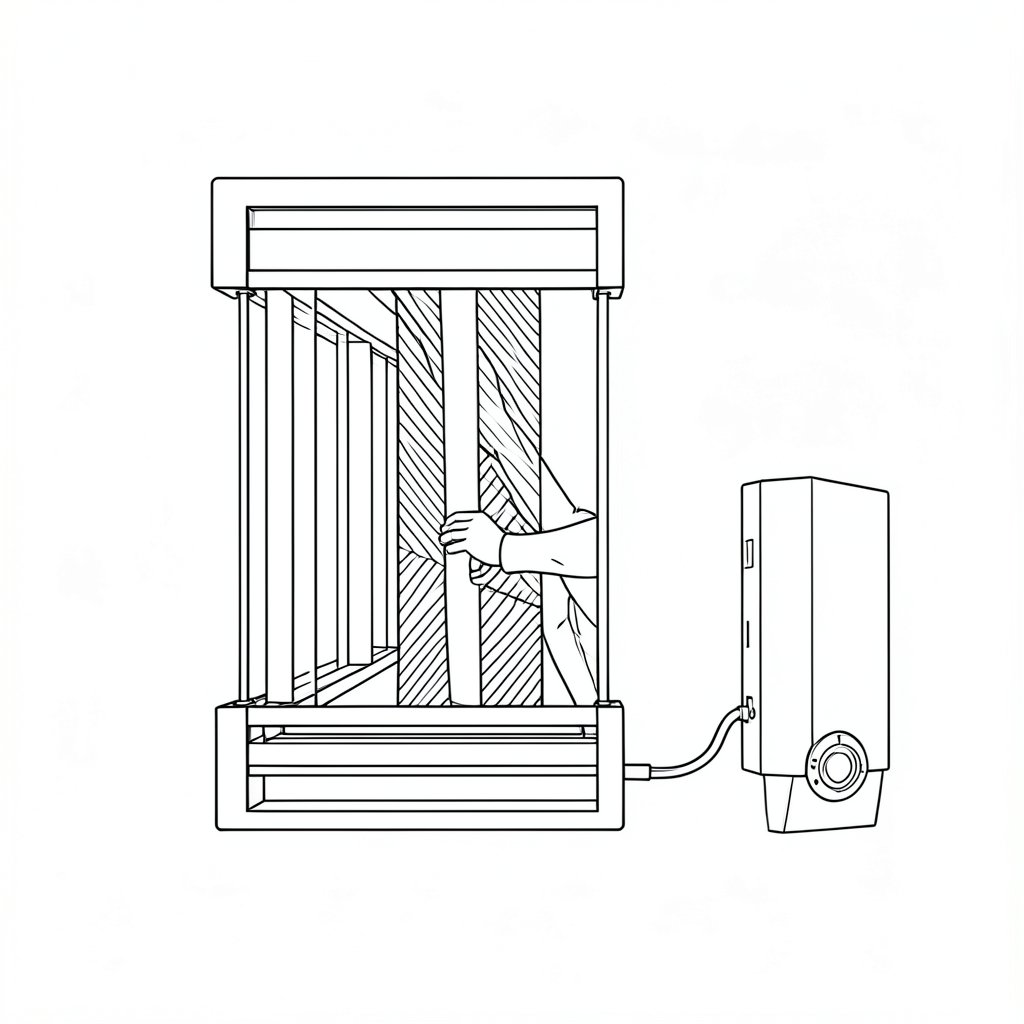
A light curtain lets someone reach into a machine without opening anything, which is exactly why its position is calculated rather than chosen.
Sensing instead of blocking
A presence-sensing device detects a person entering a defined area and commands the machine to a safe state. Nothing physically prevents entry, which makes it ideal where frequent access is needed and useless where the hazard cannot be stopped quickly. The trade is straightforward: convenience of access in exchange for depending entirely on detection and on the machine actually stopping.
The distance is a calculation, not a preference
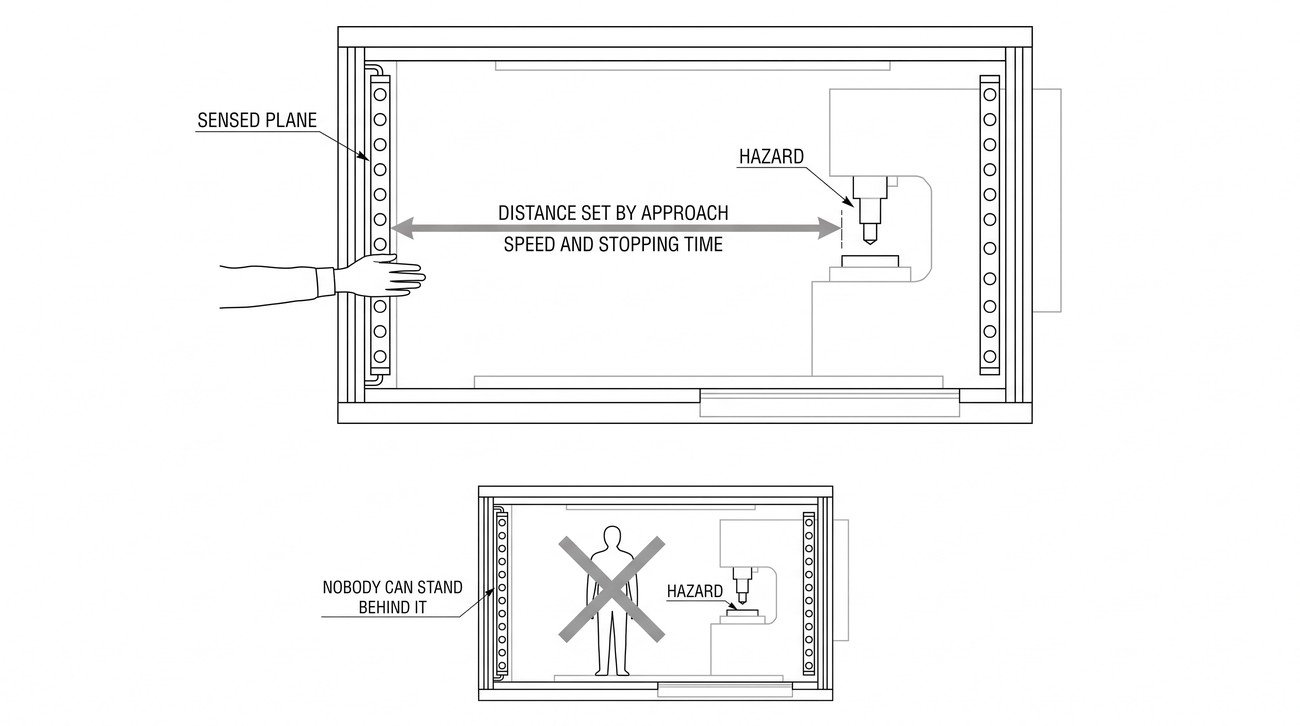
The device has to sit far enough from the hazard that a person cannot reach the danger before the machine stops. That distance depends on how fast a hand approaches, how long the machine takes to reach a safe state including the response of the whole safety chain, and how much of a hand or arm the device can resolve. Move a curtain closer for convenience and the calculation is invalidated, even though the device still functions perfectly.
Standing behind it is the classic failure
A curtain detects something crossing its plane. Once a person is past that plane, they are no longer detected, and the machine can be restarted with them inside. This is why access guarded by presence sensing needs either a device that also detects presence in the area, or a layout where nobody can stand between the curtain and the hazard, or a reset positioned so it cannot be operated from inside the danger area.
Resolution decides what it sees
Curtains are specified by the smallest object they reliably detect. A device that resolves an arm will not detect a finger, so a fine-resolution device is needed close to a hazard where a hand can enter, and a coarser one is acceptable further back where the whole body has to pass. Fitting a coarse device where fingers can reach leaves a gap the device is not designed to close.
Muting and blanking are where it goes wrong
Production often needs material to pass through the sensed area without stopping the machine, which is done by muting the device briefly or by blanking part of its field. Both are legitimate and both are frequently the point of failure: a muted period that is too long, a blanked channel that a hand fits through, or a mute that stays active because a sensor is dirty. Any muting or blanking arrangement is part of the safety function and has to be assessed as one.
For the positioning calculation, see EN ISO 13855, and for the reliability of the chain behind it see ISO 13849.
Related standards
The standards below set the design requirements, classification and test methods behind the safeguards and equipment referenced in this note.
- EN ISO 13855 — Positioning of Safeguards
- ISO 13849 — Safety-Related Parts of Control Systems
- EN ISO 13857 — Safety Distances and Reach
Common errors
1Using presence sensing on a machine that cannot be stopped quickly enough.
2Moving a curtain closer to the hazard for convenience, invalidating the calculation.
3Leaving space for a person to stand between the curtain and the hazard.
4Fitting a coarse-resolution device where fingers and hands can enter.
5Treating muting or blanking as a production setting rather than part of the safety function.
Frequently asked questions
When is a light curtain the right choice?
Where frequent access is needed and the machine can be brought to a safe state quickly. It is useless where the hazard cannot be stopped fast, because nothing physically prevents entry.
What sets the distance between the curtain and the hazard?
How fast a hand approaches, how long the whole safety chain takes to bring the machine to a safe state, and the resolution of the device. It is a calculation, not a matter of convenience.
What happens if someone stands past the curtain?
They are no longer detected, and the machine can be restarted with them inside. That is why the layout, an area-sensing device or a reset that cannot be reached from inside is needed.
What does resolution mean on a light curtain?
The smallest object the device reliably detects. A device that resolves an arm will not detect a finger, so fine resolution is needed wherever a hand can enter.
Are muting and blanking acceptable?
Yes, and both are frequent points of failure: an over-long mute, a blanked channel a hand fits through, or a mute stuck active by a dirty sensor. They are part of the safety function and assessed as such.
Need this as a document you can issue? The template library gives you the risk assessments, permits and inspection logs in editable form — and employer plans cover a whole team with completion records.