Safety / Tips and Tricks / Machinery and manufacturing
Activity 12 · Machinery
Maintenance, Setting and the Guards That Come Off
Machines are designed to be safe while running normally. Maintenance and setting are the tasks that require the guards off, the interlocks bypassed and a person inside the machine — which is why a disproportionate share of serious machine injuries happen to maintainers and setters.
Why normal safeguarding does not cover these tasks
Safeguards are designed around production: the machine runs, the operator loads and unloads, and everything dangerous is enclosed. Setting requires watching the mechanism move to adjust it. Fault-finding requires the machine energised so the fault can be reproduced. Cleaning requires access to exactly the surfaces the guards protect. None of these can be done with the machine in its normal safe state, so each needs its own arrangement rather than an exception to the usual one.
Special modes exist for this
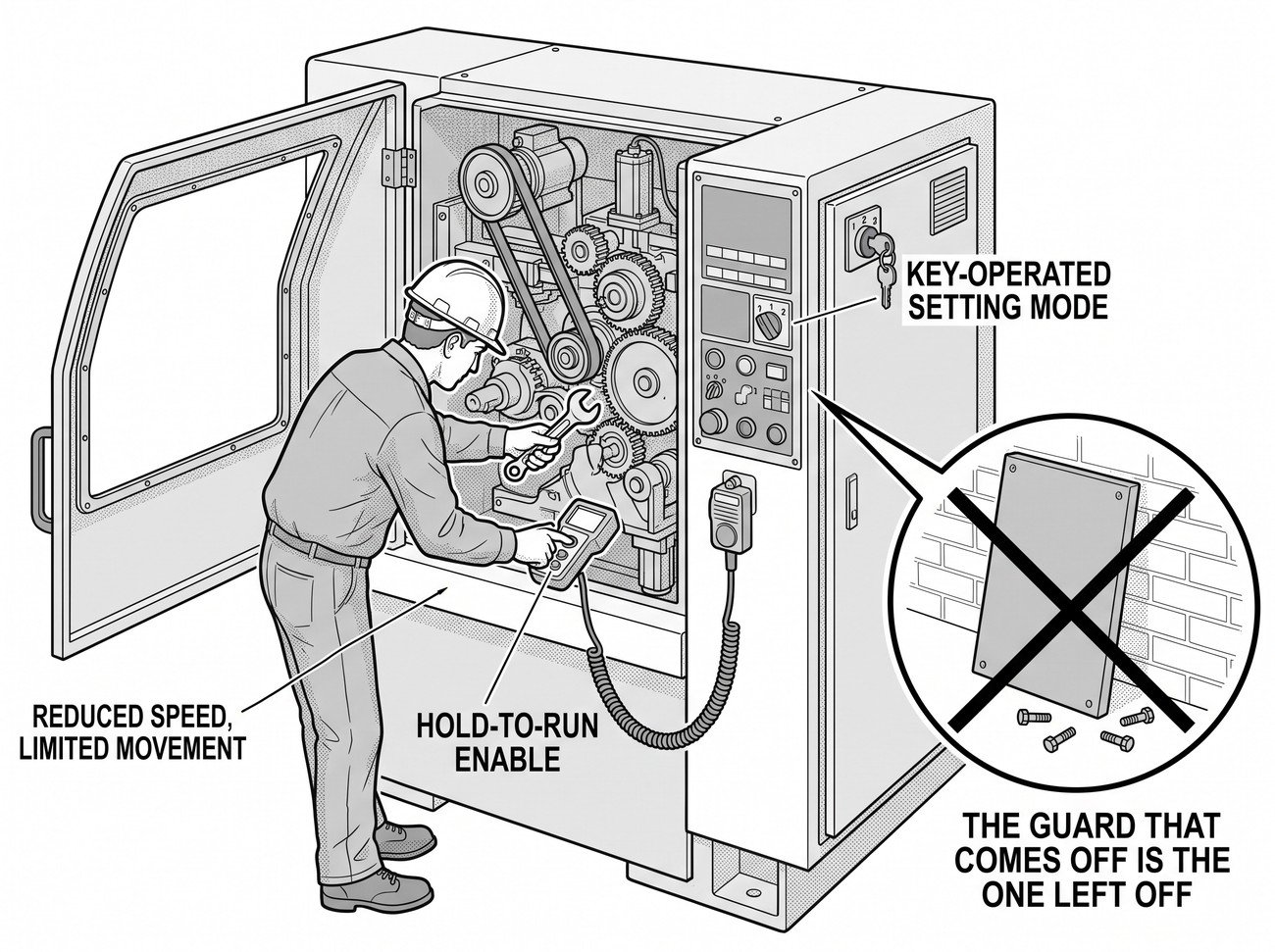
Where a task genuinely needs motion with a guard open, the answer is a designed mode rather than a defeated interlock: reduced speed, limited movement, hold-to-run controls that stop the instant they are released, an enable device that has to be held in a middle position, and a key-operated selector so the mode cannot be entered casually. That is a controlled arrangement with its own protection; taping an actuator into a switch is the same access with none of it.
Guards left off after the job
The guard that comes off for maintenance is the one that gets left off, and it usually happens for practical reasons: fasteners lost, the shift ended, the machine was needed urgently, or the person refitting it was not the person who removed it. Captive fasteners, a formal check before handing the machine back, and treating guard refitting as part of the job rather than as tidying afterwards are what close it. A guard leaning against a wall beside a running machine is a documented failure waiting to be found.
Handover is where information gets lost
A machine part-stripped at the end of a shift, a fault half-diagnosed, a guard temporarily removed, a valve left closed — all of these are safe while the person who did them is present and dangerous once they leave. A physical marker on the machine, not just a note in a book, is what tells the next person the machine is not in its normal state. Handover between maintenance and production is the specific moment this fails.
Contractors and unfamiliar machines
A visiting engineer knows their equipment and not your isolation points, your permit arrangements, or which supply feeds what. A resident fitter knows the plant and may not know a machine that arrived last month. Both cases need the same thing: someone who knows the machine present at the start, and an isolation carried out and proved rather than described.
For making the machine safe first, see locking off every energy source and stored energy. Record guard condition on the machinery guarding checklist.
Related standards
The standards below set the design requirements, classification and test methods behind the safeguards and equipment referenced in this note.
- EN ISO 14119 — Interlocking Devices Associated With Guards
- EN ISO 14120 — Guards: Design and Construction
- ISO 13849 — Safety-Related Parts of Control Systems
Common errors
1Defeating an interlock for setting instead of using a designed setting mode.
2Leaving guards off after maintenance because fasteners were lost or the shift ended.
3Recording a part-stripped machine in a book rather than marking the machine itself.
4Letting a contractor isolate a machine they have never seen without support.
5Treating guard refitting as tidying up rather than as part of the task.
Frequently asked questions
Why are maintainers and setters disproportionately injured?
Because safeguards are designed around production, and their tasks require the guards off, the interlocks bypassed and a person inside the machine. None of it can be done in the machine's normal safe state.
What is a designed setting mode?
Reduced speed, limited movement, hold-to-run controls that stop when released, an enable device held in a middle position, and a key-operated selector so the mode cannot be entered casually.
Why do guards get left off after maintenance?
Fasteners lost, the shift ended, the machine was needed urgently, or the person refitting was not the person who removed it. Captive fasteners and a formal check before handback close it.
How should a part-stripped machine be marked?
Physically on the machine, not only in a book. A machine left in an abnormal state is safe while the person who did it is present and dangerous once they leave.
What do contractors and resident fitters have in common?
Both may be unfamiliar with the specific machine or the specific plant. Both need someone who knows the machine present at the start, and an isolation carried out and proved rather than described.
Need this as a document you can issue? The template library gives you the risk assessments, permits and inspection logs in editable form — and employer plans cover a whole team with completion records.