Safety / Tips and Tricks / Machinery and manufacturing
Activity 12 · Machinery
Stored Energy: The Hazard That Survives Isolation
A machine that has been isolated can still hurt you, because isolation removes the supply of energy and not the energy already in the system.
Gravity is the one people forget
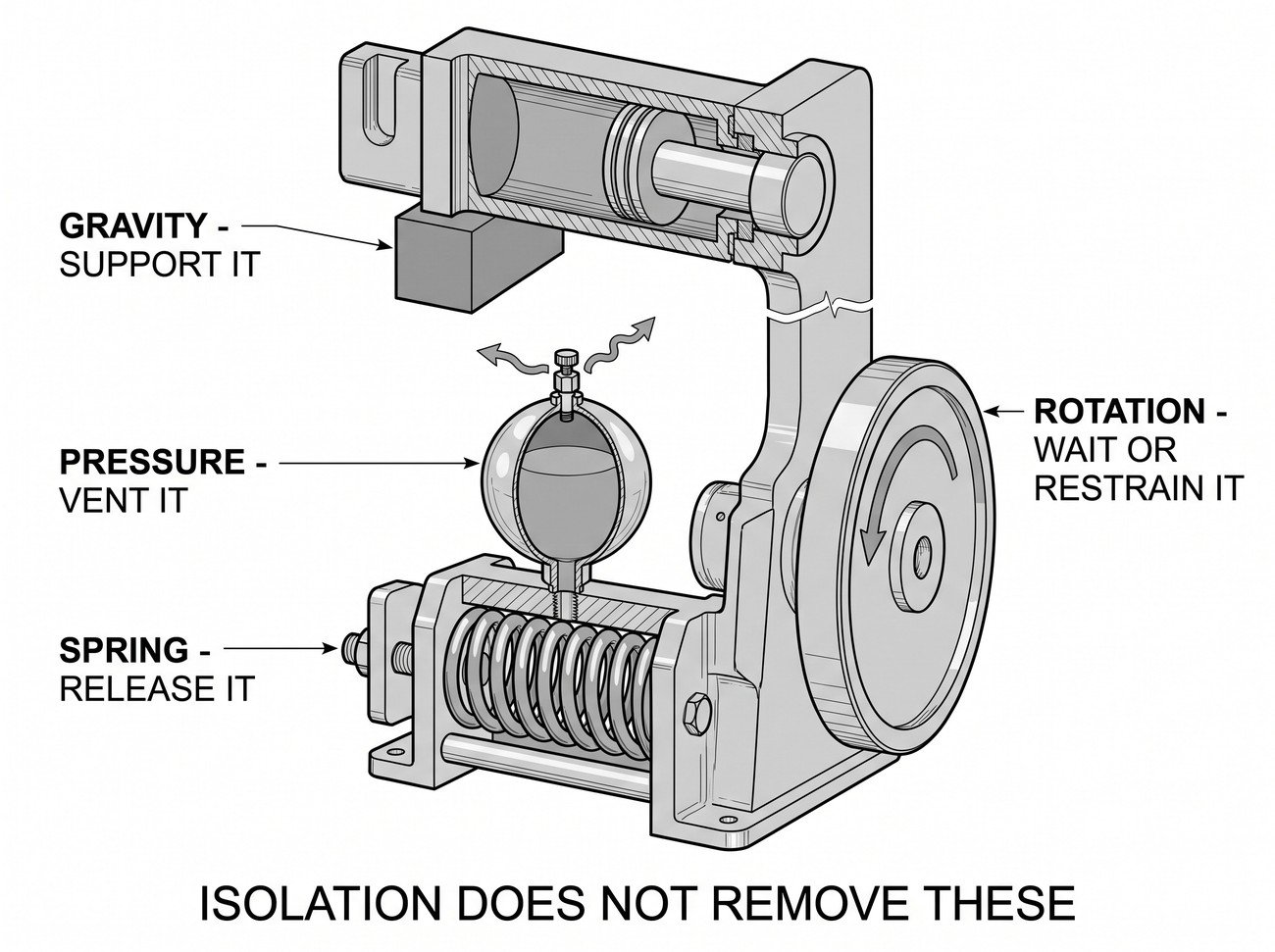
A raised ram, a lifted table, a counterweight, a tool held up on a slide, a hopper full of material — all of these fall when whatever was holding them is released, and releasing it is often exactly what a maintainer does first. Gravity does not need a supply, so no amount of locking off affects it. The control is a physical support placed under the load or a mechanical scotch fitted into the mechanism, not a valve position or a control setting.
Pressure stays in the circuit
Closing a valve traps pressure downstream of it rather than removing it. Pneumatic circuits hold air in cylinders and reservoirs; hydraulic systems hold pressure in accumulators that are specifically designed to store it, and an accumulator can drive a substantial movement long after the pump has stopped. Both need venting to atmosphere and confirming at a gauge, and the vent has to be somewhere that actually connects to the trapped volume.
Springs are stored energy in a solid form
Compressed or extended springs release suddenly when a retaining component is removed, and they are frequently hidden inside a mechanism where nobody expects them: clamp assemblies, tensioners, spring-applied brakes, and return mechanisms on guards and doors. A spring-applied brake in particular is designed to be held off by pressure or current, so isolating the machine applies it — which is the safe direction, but it also means removing a component can release a large stored force.
Rotation carries on
A large rotating mass keeps turning after the drive is removed, sometimes for a long time on good bearings. Flywheels, fans, grinding wheels and centrifuges all coast, and a coasting part gives no indication that it is still dangerous because it is quiet and may look stationary from an angle. Waiting, or fitting a mechanical restraint, is the control; assuming it has stopped because the machine is isolated is not.
Electrical charge after the supply is gone
Capacitors in drives and power supplies hold charge after isolation, sometimes for minutes, and the equipment usually states a wait time for that reason. Opening an enclosure inside that period is opening a live enclosure. This is the one form of stored energy that is completely invisible, has no moving part to watch, and gives no warning at all before contact.
For the isolation this follows, see locking off every energy source. For the tasks where it matters most, see maintenance and setting.
Related standards
The standards below set the design requirements, classification and test methods behind the safeguards and equipment referenced in this note.
Common errors
1Working under a raised part without a mechanical support or scotch in place.
2Closing a valve and treating the trapped pressure downstream as removed.
3Dismantling a mechanism containing a compressed spring without releasing it first.
4Assuming a rotating mass has stopped because the machine has been isolated.
5Opening a drive enclosure before the stated capacitor discharge time has passed.
Frequently asked questions
What is the most commonly forgotten stored energy?
Gravity. A raised ram, lifted table, counterweight or full hopper falls when whatever was holding it is released, and gravity needs no supply so isolation does not affect it.
Does closing a valve remove pressure?
No, it traps it downstream. Pneumatic circuits hold air in cylinders and reservoirs, and hydraulic accumulators are specifically designed to store pressure and can drive movement long after the pump stops.
Why are springs a particular problem?
They release suddenly when a retaining component is removed and are often hidden inside mechanisms: clamps, tensioners, spring-applied brakes and guard return mechanisms.
How long does a rotating mass stay dangerous?
Until it actually stops, which on good bearings can be a long time. A coasting flywheel or fan is quiet and may look stationary, so waiting or fitting a restraint is the control.
What makes stored electrical charge different?
It is completely invisible, has no moving part to watch, and gives no warning before contact. Drives and power supplies state a wait time for exactly this reason.
Need this as a document you can issue? The template library gives you the risk assessments, permits and inspection logs in editable form — and employer plans cover a whole team with completion records.