Safety / Tips and Tricks / Machinery and manufacturing
Activity 12 · Machinery
Noise and Vibration in a Machine Shop
Noise and vibration are the two machine shop hazards that produce no incident, no near miss and no obvious moment of harm — which is precisely why they are the ones most often left uncontrolled.
Noise is cumulative and permanent
Hearing damage builds from total daily dose rather than from any single loud event, so a shop that never sounds dangerous can still be doing harm across a shift. The early sign is difficulty following conversation in a noisy room while hearing seems fine elsewhere, and tinnitus after a shift that fades by morning. Both are warnings, and neither reverses once established.
Control at the machine before the ear
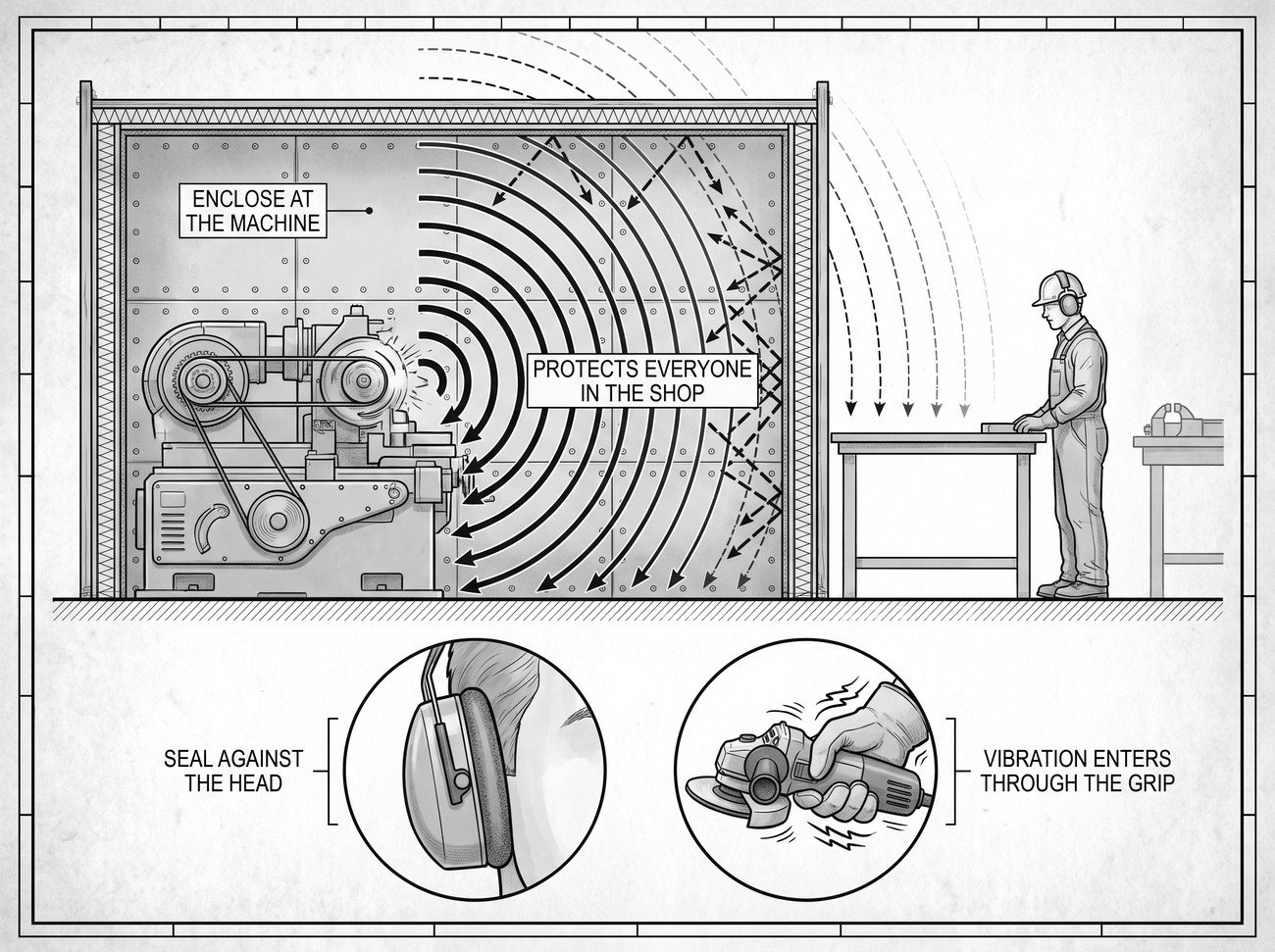
Damping a resonant panel, fitting a quieter tool or feed rate, enclosing a noisy operation, replacing an impact process with a continuous one, and separating the noisiest machines from the working positions all reduce the dose for everyone in the shop. Hearing protectors reduce it for one person, only while worn, and only if they seal — which is why the order matters here as much as anywhere.
Protectors that are too strong are their own problem
Over-protection makes it hard to hear speech, warning signals and the change in a machine’s sound that tells an experienced operator something is wrong. That leads to protectors being lifted at exactly the moments they are needed, and it removes a genuine source of information about the process. Selecting attenuation to bring exposure to a safe level, rather than to the lowest possible number, is what produces protection that is actually worn.
Vibration arrives through the hands
Hand-held grinders, die grinders, needle scalers, impact wrenches and long spells holding work against a machine all transmit vibration into the hands, and the damage is cumulative, painless while it happens and permanent once established. The early signs are tingling and numbness that come and go and blanching of the fingertips in the cold, all easy to dismiss after a hard day.
The controls that work
Sharp consumables cut quickly and vibrate less, which makes them a health control as much as a productivity one. Beyond that: choosing lower-vibration tools, letting the tool take the weight rather than forcing it, rotating the task between people, breaking exposure into shorter periods, and keeping hands warm because cold hands grip harder and circulate less. Anti-vibration gloves are the weakest measure and can increase exposure by encouraging a firmer grip.
For the exposure arithmetic, see managing daily vibration exposure, and use the noise exposure calculator. Background is in the noise and hearing conservation lecture.
Related standards
The standards below set the design requirements, classification and test methods behind the safeguards and equipment referenced in this note.
- EN 352 — Hearing Protectors
- EN 458 — Hearing Protector Selection and Use Guidance
- EN 388 — Protective Gloves Against Mechanical Risks
Common errors
1Judging noise risk by whether the shop sounds dangerous rather than by daily dose.
2Issuing hearing protection instead of reducing noise at the machine.
3Over-protecting, so protectors are lifted when speech or warnings matter.
4Dismissing tingling and numbness that pass overnight as ordinary tiredness.
5Running blunt consumables, which raises both vibration and exposure time.
Frequently asked questions
Why is a shop that does not sound dangerous still a risk?
Because hearing damage builds from total daily dose rather than from any single loud event, so a moderate level sustained across a shift still causes harm.
What are the early signs of hearing damage?
Difficulty following conversation in a noisy room while hearing seems fine elsewhere, and tinnitus after a shift that fades by morning. Both are warnings and neither reverses once established.
Can hearing protection be too strong?
Yes. Over-protection makes speech, warning signals and the change in a machine's sound hard to hear, so protectors get lifted at exactly the moments they are needed.
What are the early signs of vibration damage?
Tingling and numbness in the fingers that come and go, and blanching of the fingertips in the cold. Both are easy to dismiss as ordinary tiredness after a hard day.
Why are sharp consumables a health control?
Because a sharp tool cuts quickly and vibrates less, reducing both the vibration magnitude and the time the hands are exposed to it.
Need this as a document you can issue? The template library gives you the risk assessments, permits and inspection logs in editable form — and employer plans cover a whole team with completion records.