Safety / Tips and Tricks / Machinery and manufacturing
Activity 12 · Machinery
Why Hands Enter Machines, and How to Stop Needing To
People do not put their hands into machines because they are careless. They do it because the machine has left them no other way to do something the job requires.
The four reasons
Hands enter machines to feed material, to remove finished work, to clear a blockage, and to adjust or measure something. Each of those is a legitimate requirement rather than a lapse, and each has an engineering answer. Treating hand entry as a behavioural problem misses that the machine is asking for it, and instructing people not to do it leaves them with a task and no means of completing it.
Feeding and removing
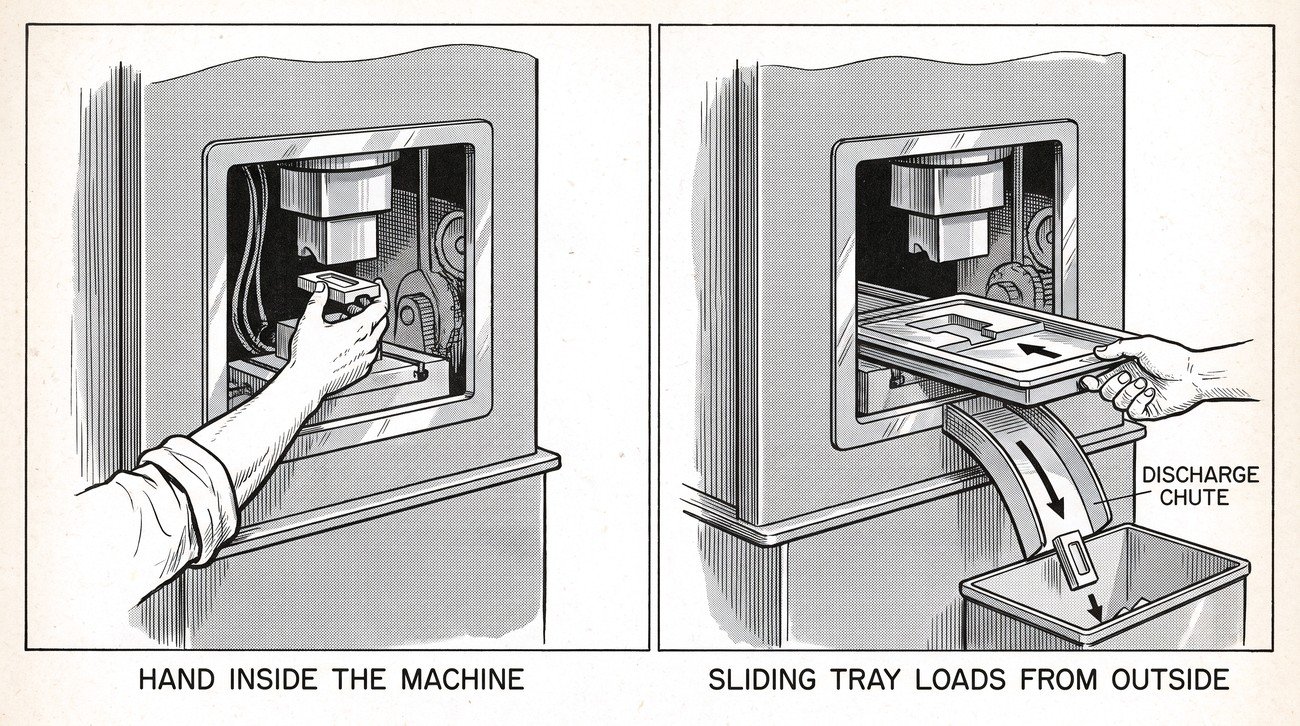
Where the hazard cannot be enclosed at the point of operation, the material is fed and removed without hands entering: a chute, a magazine, a slide, a rotating table that presents one station to the operator while the other is being worked, a push stick or a jig that holds the workpiece. Two-hand controls are sometimes used, and they protect only the operator’s own hands — not the second person’s, which is why they are a limited answer on a machine two people work at.
Clearing blockages is where people get hurt
A blockage is unplanned, it stops production, and the machine is often still running or still energised. That combination produces exactly the decision people are told not to make. The answers are practical rather than exhortative: designing out the blockage, providing a tool that reaches, fitting an access point that is interlocked, and above all making it faster to isolate the machine properly than to reach in. If isolation takes five minutes and reaching in takes five seconds, the instruction will lose.
Adjustment and measurement during running
Measuring a dimension, checking a finish or adjusting a setting while the machine runs is common because stopping costs time and because the adjustment is often only meaningful under load. Where a measurement genuinely has to be taken during motion, it needs a means of taking it from outside — a gauge, a probe, a viewing port — rather than a rule about being careful.
Make the safe way the fast way
This is the whole of it. Every time the safe method is slower, more awkward or harder to reach than the unsafe one, the unsafe one wins eventually, regardless of training or intent. Improving the safe method — a nearer isolator, a tool kept at the machine, a hatch that opens without tools, a jig that is quicker than hand loading — changes behaviour far more reliably than any instruction about it.
For the sensing that allows frequent access, see light curtains and presence sensing. For the tasks where guards come off entirely, see maintenance and setting.
Related standards
The standards below set the design requirements, classification and test methods behind the safeguards and equipment referenced in this note.
- EN ISO 13855 — Positioning of Safeguards
- EN ISO 14119 — Interlocking Devices Associated With Guards
- ISO 12100 — Safety of Machinery: General Principles
Common errors
1Treating hand entry as carelessness rather than as the machine leaving no alternative.
2Prohibiting reaching in without providing a tool or access that does the job.
3Relying on two-hand controls on a machine where a second person also works.
4Making proper isolation slower than reaching in, so the instruction is always lost.
5Requiring in-process measurement without a means of taking it from outside.
Frequently asked questions
Why do people put hands into machines?
To feed material, remove finished work, clear a blockage, or adjust and measure something. All four are legitimate requirements of the job rather than lapses, and each has an engineering answer.
What removes the need to reach in when loading?
A chute, magazine, slide, rotating table, push stick or jig that presents the work without a hand entering. Two-hand controls help but protect only the operator's own hands.
Why are blockages so dangerous?
They are unplanned, they stop production, and the machine is often still running or energised. That combination produces exactly the decision people are told not to make.
How do you stop people reaching in to clear blockages?
Design the blockage out, provide a tool that reaches, fit an interlocked access point, and make isolating faster than reaching in. If isolation takes five minutes and reaching in takes five seconds, the instruction loses.
What is the single most effective principle?
Make the safe way the fast way. Whenever the safe method is slower or more awkward, the unsafe one eventually wins regardless of training.
Need this as a document you can issue? The template library gives you the risk assessments, permits and inspection logs in editable form — and employer plans cover a whole team with completion records.