Safety / Tips and Tricks / Road and highway works
Activity 11 · Road
The Safety Zone: Working Clearance From Live Traffic
The safety zone is the part of a layout that assumes the driver gets it wrong. Everything else assumes they get it right, which is why this is the one that has to be defended.
What the space is for
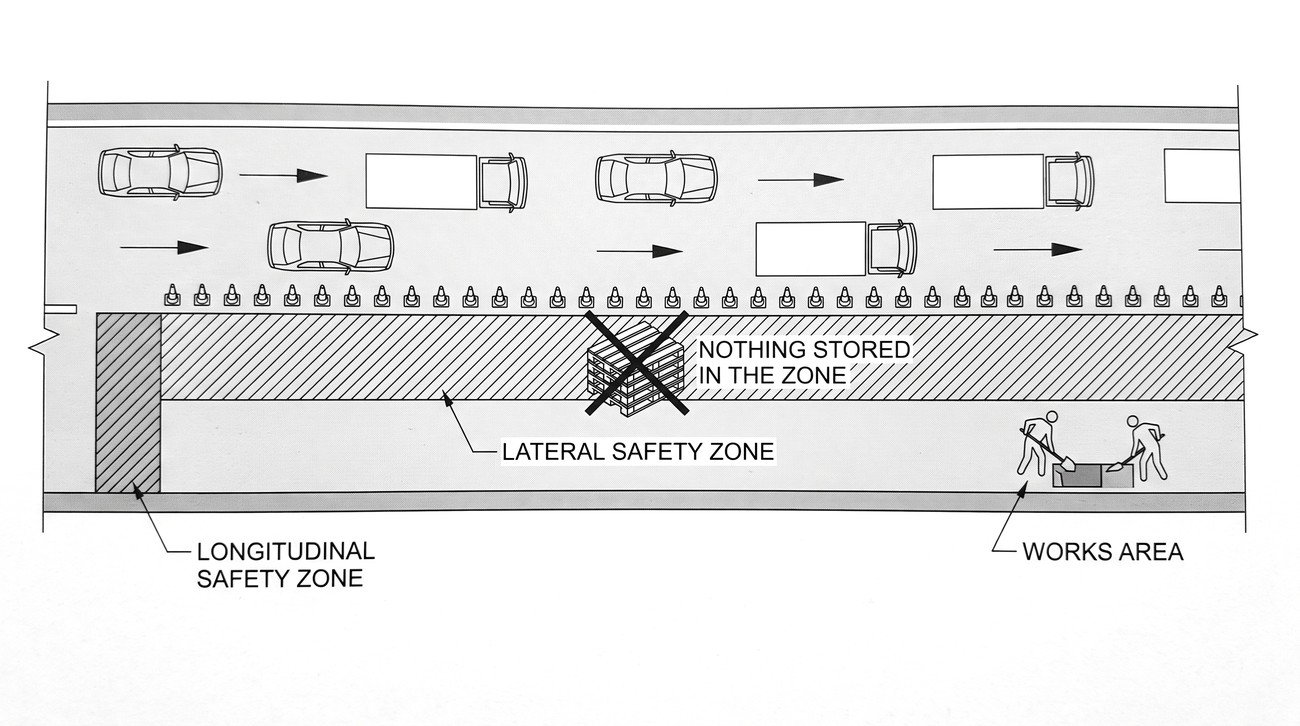
Between the line of cones and the people there is an area in which nobody works, nothing is stored and no vehicle parks. It exists to absorb the ordinary errors traffic produces: a driver who clips the taper, drifts wide on a bend, brakes late, or swerves to avoid the vehicle in front. None of these are exceptional events on a busy road, and the zone is sized so that the common ones stop short of people.
Longitudinal and lateral are different problems
The lateral zone separates the works from traffic passing alongside, and it deals with vehicles drifting sideways. The longitudinal zone sits at the upstream end and deals with a vehicle arriving along the closure — the one that has already entered the closed lane and is travelling down it. That second case is the one people underestimate, and it is why the end of a closure carries more separation than the side of it.
How it gets eaten
Nobody decides to remove the safety zone. It disappears gradually: a pallet of materials set down at the edge because it was convenient, a van parked just inside the cones out of the rain, a generator positioned for its cable run, a spoil heap that grew. Each one is small and reasonable on its own, and together they leave people working at the cone line. Treating the zone as a physical area with a marked boundary, rather than as a distance in a document, is what stops this.
It is not storage and it is not parking
The zone protects people, and anything left in it both defeats that and becomes a hazard itself. A struck vehicle or a struck material stack throws debris into the works area, so an object in the safety zone converts a near miss into an injury. Where there is genuinely nowhere else to put things, the layout is too small for the job and needs extending rather than compressing.
Stepping out of it is the common exposure
Most of the time people are struck, they were outside the works area rather than inside it: retrieving a cone that has been knocked over, walking the layout, crossing to the other side, reaching for something just beyond the line. Those movements are foreseeable and are best planned rather than prohibited — a route that stays inside the closure, a rule about who replaces displaced cones and when, and an agreement that nothing is retrieved from a live lane at all.
For where the zone sits in the arrangement, see the anatomy of a layout. For what happens when a vehicle enters it, see planning for vehicle incursion.
Related standards
The standards below set the classification, testing and performance requirements behind the equipment used for this work.
Common errors
1Treating the safety zone as a number in a plan rather than as a marked area on the ground.
2Providing lateral separation and forgetting the longitudinal zone at the upstream end.
3Letting materials, plant, spoil or vehicles occupy the zone one item at a time.
4Retrieving cones or tools from a live lane.
5Compressing the layout to fit the space instead of recognising the space is insufficient.
Frequently asked questions
What is the safety zone for?
To absorb the ordinary errors traffic produces: a driver who clips the taper, drifts wide, brakes late or swerves. It is the only part of the layout that assumes the driver gets it wrong.
What is the difference between the lateral and longitudinal zones?
The lateral zone separates the works from traffic passing alongside and deals with sideways drift. The longitudinal zone sits at the upstream end and deals with a vehicle already travelling down the closed lane.
How does a safety zone disappear?
Gradually and reasonably: a pallet set down at the edge, a van parked out of the rain, a generator placed for its cable run, a spoil heap that grew. Each is small; together they leave people at the cone line.
Why can materials not be stored in the safety zone?
Because a struck vehicle or material stack throws debris into the works area, so an object in the zone converts a near miss into an injury.
When are people most often struck?
While outside the works area: retrieving a displaced cone, walking the layout, or crossing to the other side. Those movements are foreseeable and should be planned rather than simply prohibited.
Need this as a document you can issue? The template library gives you the risk assessments, permits and inspection logs in editable form — and employer plans cover a whole team with completion records.