Safety / Tips and Tricks / Road and highway works
Activity 11 · Road
Lamps, Beacons and Warning Lights on a Works Layout
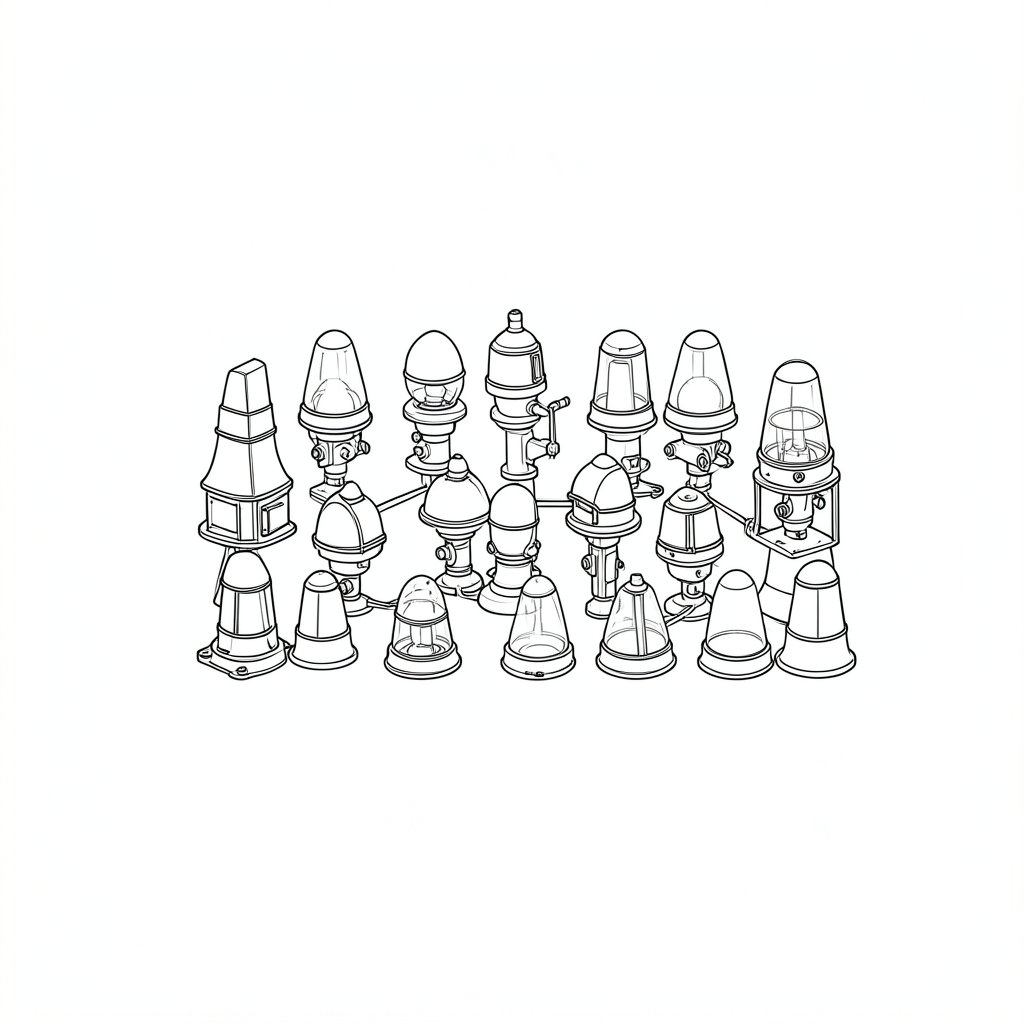
Lights on a layout do a job that reflective material cannot: they announce the works from further away, in fog, and to a driver whose headlights are not yet pointing at anything.
Why lit devices are not optional at night
Retroreflective cones and signs depend entirely on a driver’s headlights reaching them at a usable angle. In fog, in heavy spray, on a curve, or over a crest, that condition frequently is not met, and the first thing a driver can detect is something that emits its own light. Lamps on the taper and along the closure give the layout a presence that does not depend on the approaching vehicle, which is why they are the part of the layout that survives bad conditions.
Steady and flashing say different things
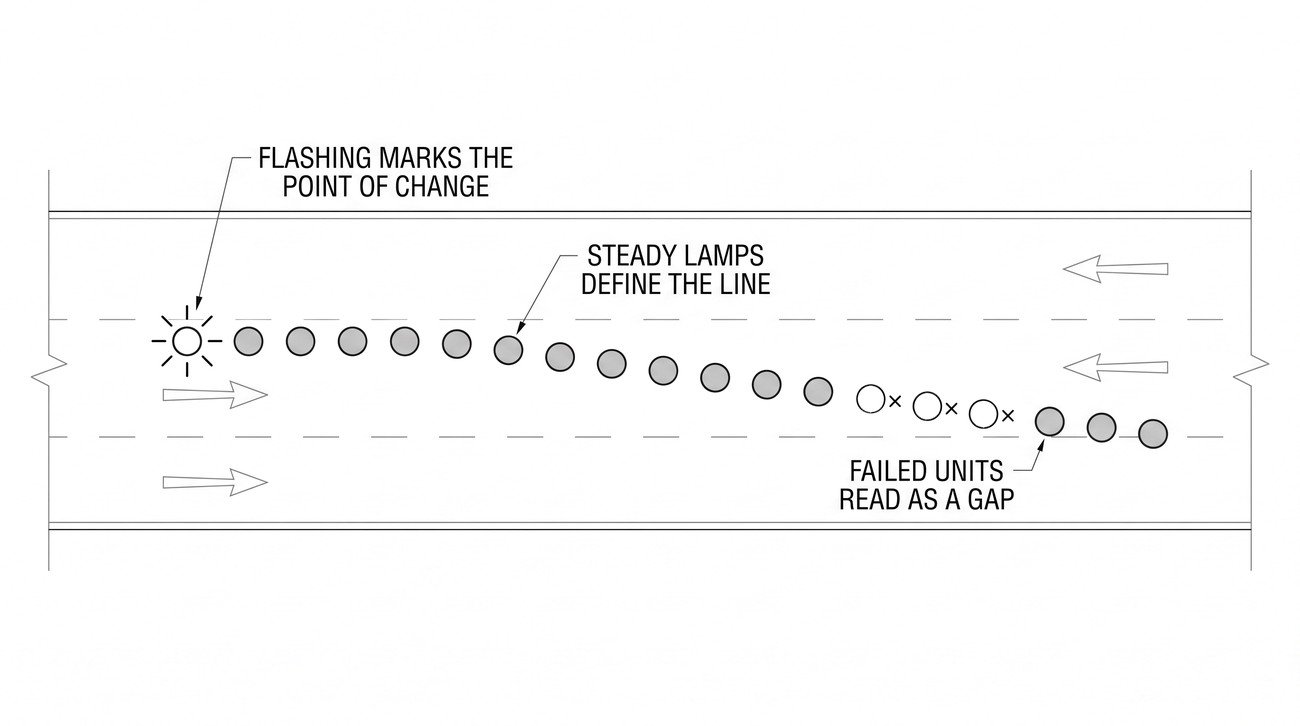
A steady lamp defines a line, and a row of them reads as an edge to be followed. A flashing lamp draws the eye and says something is happening here, which is why flashing is used at the point of change — the start of a taper, a lead vehicle, a sudden lane shift — rather than along the whole run. Making everything flash removes the distinction and produces a wall of movement in which the point of change is no longer identifiable.
Too much light is its own hazard
A layout so brightly lit that it dominates the scene reduces a driver’s ability to see anything outside it, including the worker who steps beyond the lit area. Bright, glaring or badly aimed lights also cause drivers to look away at exactly the moment they should be looking at the closure. The aim is a legible layout, not the brightest one, and a driver who can read the arrangement in a glance is better served than one who is being flooded with light.
The maintenance nobody does
Lamps are the component most likely to have failed since the layout went out. Batteries flatten, lenses fog and yellow, sensors that switch them on at dusk get covered, and units get knocked over and left. A run with several dead lamps in the middle reads as a gap in the line rather than as a few failed units, and it does so at exactly the point a driver needs the line to be continuous. Checking them means walking the run in the dark, not counting them from the van.
Lights on vehicles are part of the layout
Beacons and directional arrows on works vehicles carry the same logic. A beacon left on a parked van in a lay-by dilutes the meaning of beacons everywhere on that road, and an arrow board pointing the wrong way or left displaying after the manoeuvre has finished actively misdirects. Vehicle lighting is a signal to drivers and belongs under the same discipline as the signs.
For the requirements behind warning and safety light devices, see EN 12352. For lighting the working area itself, see lighting night works.
Related standards
The standards below set the classification, testing and performance requirements behind the equipment used for this work.
Common errors
1Relying on retroreflective devices alone in fog, spray or over a crest.
2Making the whole run flash, so the point of change is no longer distinguishable.
3Over-lighting the layout so drivers cannot see anything outside it.
4Counting lamps rather than walking the run after dark to find the dead ones.
5Leaving beacons or arrow boards displaying when they no longer mean anything.
Frequently asked questions
Why are lit devices needed when cones are already retroreflective?
Retroreflective devices need a driver's headlights to reach them at a usable angle. In fog, heavy spray, on a curve or over a crest that often does not happen, and only something emitting its own light is detectable.
What is the difference between steady and flashing lamps?
A row of steady lamps reads as an edge to follow. A flashing lamp draws the eye and marks a point of change, such as the start of a taper. Making everything flash removes that distinction.
Can a layout be too brightly lit?
Yes. A layout that dominates the scene reduces a driver's ability to see anything outside it, including a worker who steps beyond the lit area, and glare causes drivers to look away.
How should lamps be checked?
By walking the run after dark. Batteries flatten, lenses fog, dusk sensors get covered and units get knocked over, and several dead lamps in a row read as a gap in the line.
Do vehicle beacons matter?
Yes. A beacon left running on a parked van dilutes the meaning of beacons on that road, and an arrow board pointing the wrong way or left on after a manoeuvre actively misdirects drivers.
Need this as a document you can issue? The template library gives you the risk assessments, permits and inspection logs in editable form — and employer plans cover a whole team with completion records.