Safety / Tips and Tricks / Road and highway works
Activity 11 · Road
Night Working: Lighting the Works Without Dazzling Drivers
Night working solves a traffic problem and creates a visibility one. The lighting that lets a crew work is pointed at the same space drivers are trying to see through, and the two requirements pull in opposite directions.
Why night work is chosen and what it costs
Lower traffic volumes mean fewer vehicles passing the works and shorter delays. Against that, the vehicles that are present travel faster, the proportion of impaired and fatigued drivers is higher, and everyone involved — including the crew — is working against their body clock. Night work reduces exposure to traffic volume and increases the severity of what remains, so the layout and the lighting have to be better, not equivalent.
Glare is light going where it is not needed
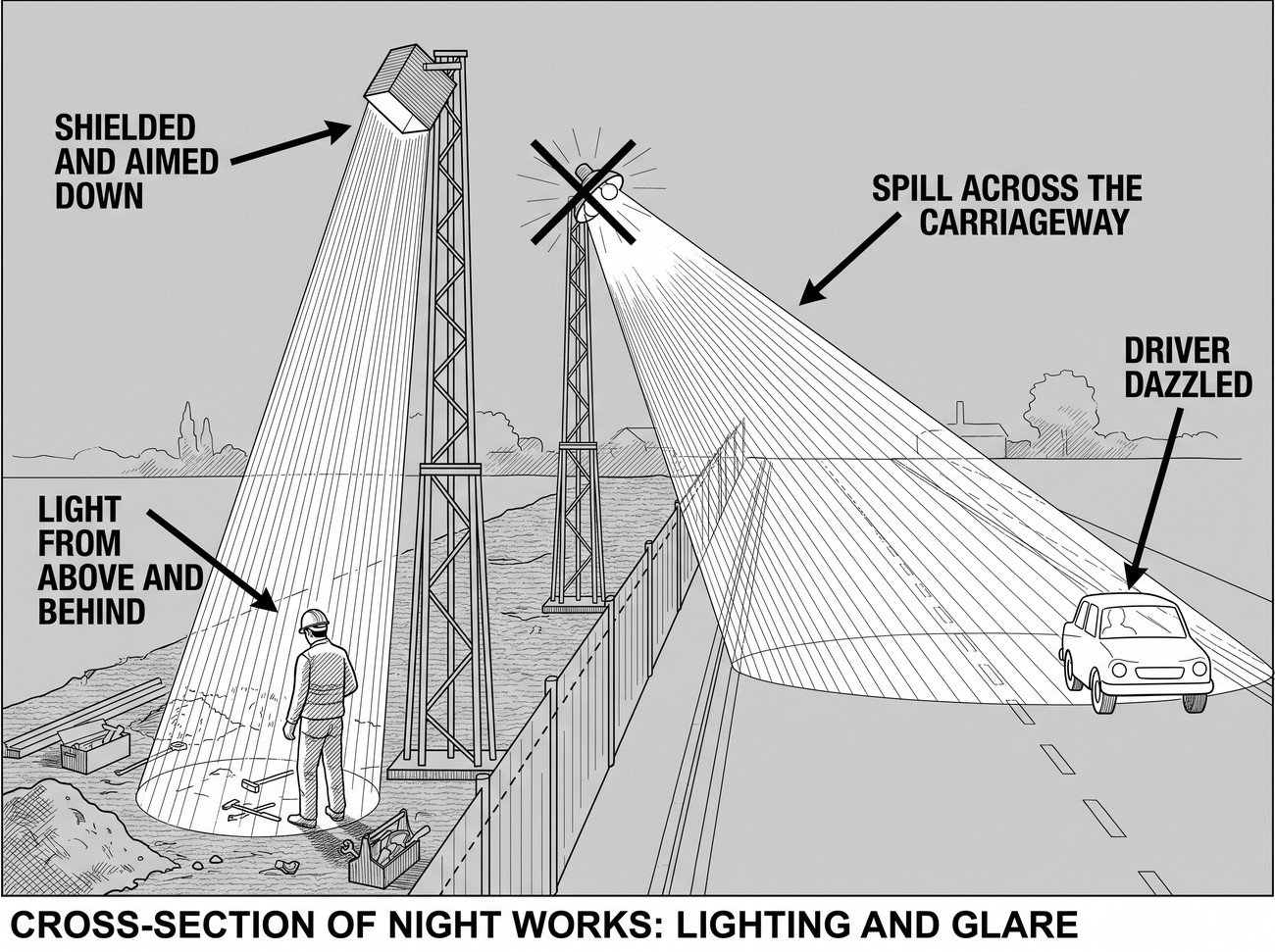
A floodlight aimed across the carriageway puts light directly into approaching drivers’ eyes, and a dazzled driver loses the ability to see anything darker than the light source for a period after passing it — including the next worker. Aiming lights down and away from traffic, using cut-off fittings that stop light escaping sideways, mounting them at a height that lets the beam fall steeply, and checking the effect from the driver’s position rather than from inside the works are what control it.
The transition into and out of darkness
A brightly lit works in an otherwise dark road creates two adaptation problems: drivers entering the lit section cannot immediately see detail, and drivers leaving it are effectively blind for several seconds as their eyes readjust. A works lit uniformly rather than in bright patches, with intensity easing at the approach rather than starting abruptly, is far easier for drivers to handle than a single blazing area.
Lit works make workers harder to see, not easier
This is the counter-intuitive part. A worker standing between an approaching driver and a bright floodlight is a silhouette, and retroreflective clothing does nothing against a bright background because it works by contrast. The crew’s conspicuity is best in a moderately lit area with the light behind or above them, not in front. Where lighting has to be strong, the working positions have to be arranged around it deliberately.
Fatigue is part of the safety case
Attention, reaction time and judgement all fall during the small hours, for the crew as much as for the drivers. That affects the errors people make in setting out cones, in judging gaps, and in noticing that a layout has been disturbed. Shift length, breaks, the arrangement of tasks so the most critical happen early, and a genuine ability to stop are all part of the control rather than welfare extras.
For why the tape stops working against bright backgrounds, see being seen at night. For the lamps on the layout itself, see lamps, beacons and warning lights.
Related standards
The standards below set the classification, testing and performance requirements behind the equipment used for this work.
- EN 12352 — Warning and Safety Light Devices
- EN ISO 20471 — High-Visibility Clothing
- EN 12899 — Fixed Vertical Road Traffic Signs
Common errors
1Aiming floodlights across the carriageway and judging the result from inside the works.
2Lighting the works as one blazing patch in an otherwise dark road.
3Working with a bright light source behind you, so drivers see a silhouette.
4Treating night work as lower risk because there are fewer vehicles.
5Scheduling the most critical tasks for the end of a night shift.
Frequently asked questions
Is night work safer because there is less traffic?
It reduces exposure to volume and increases the severity of what remains. Vehicles travel faster, the proportion of impaired and fatigued drivers is higher, and the crew is working against its body clock.
What causes glare for drivers?
Light aimed across the carriageway rather than down into the works. A dazzled driver cannot see anything darker than the light source for a period after passing it, including the next worker.
How should works lighting be checked?
From the driver's position on the approach, not from inside the works. The effect that matters is the one experienced by someone coming towards the layout.
Why can bright lighting make workers harder to see?
A worker between an approaching driver and a floodlight is a silhouette, and retroreflective clothing works by contrast so it does nothing against a bright background.
Why is fatigue part of the safety case?
Attention, reaction time and judgement all fall during the small hours for the crew as well as for drivers, which affects cone placement, gap judgement and noticing that a layout has been disturbed.
Need this as a document you can issue? The template library gives you the risk assessments, permits and inspection logs in editable form — and employer plans cover a whole team with completion records.