Safety / Tips and Tricks / Road and highway works
Activity 11 · Road
Vehicle Incursion: Planning for the Driver Who Does Not Stop
Every roadworks layout is built on the assumption that drivers will follow it. An incursion plan is what you have for the ones who do not, and it is the only part of the arrangement that assumes the signs were ignored.
Incursions are ordinary, not exceptional
Vehicles enter closed areas routinely: a driver misses the taper, follows the vehicle in front through a gap, is distracted at the wrong moment, is impaired, or deliberately uses the closed lane to get ahead of a queue. Treating incursion as a rare failure leads to layouts that have no answer for it. Treating it as a normal event that happens on most jobs leads to layouts built with somewhere for people to go.
Distance is what buys the time
Nothing about an incursion is fast enough to react to at close range. The protection is the space between the cone line and the people, because that space is what converts a vehicle entering the closure into a few seconds of warning rather than an immediate impact. Every metre of safety zone that is given up to storage, parking or convenience is taken directly out of that reaction time.
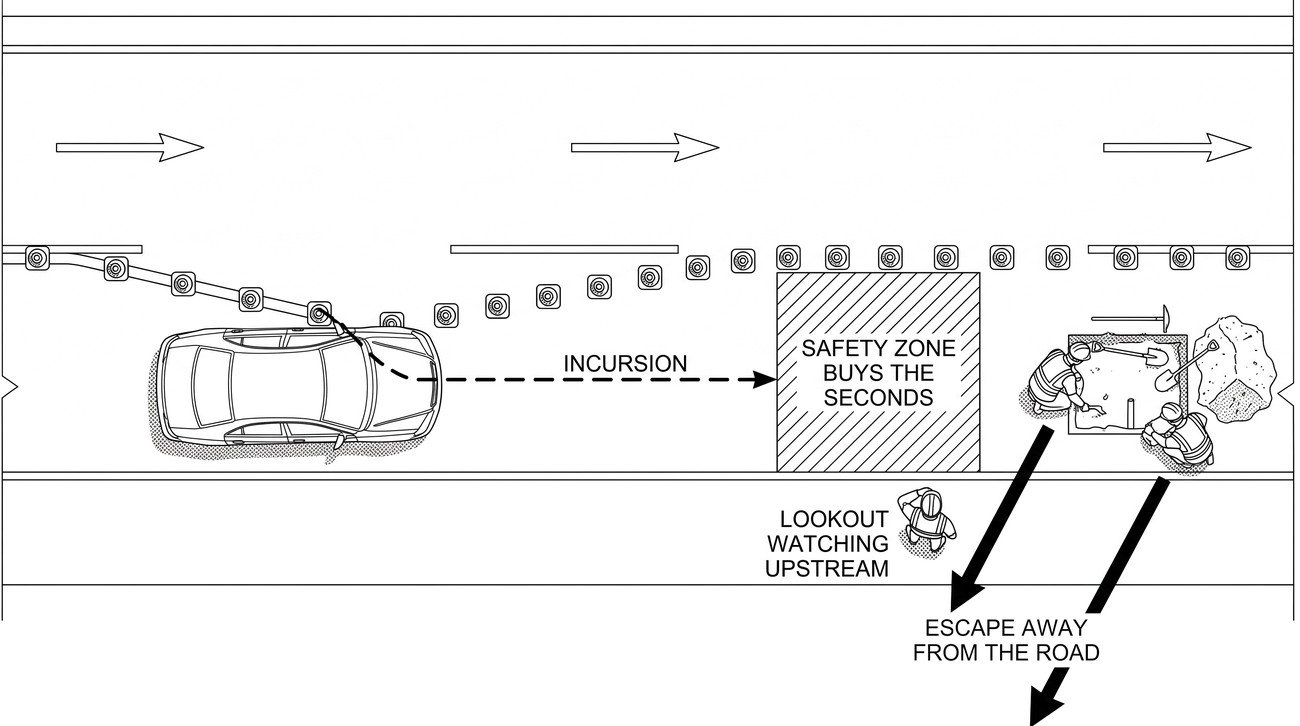
Escape routes go away from the road
Everyone working in the closure needs a direction to move that leads away from traffic, identified before work starts and kept clear as the job progresses. That last part is where it breaks down: routes get blocked by materials, by plant that arrived later, by an excavation that has been opened, or by a barrier put up for a different reason. An escape route that has to be checked is not a route; it has to be obvious and empty.
Somebody has to be watching upstream
People concentrating on a task do not see a vehicle coming, and the noise of plant removes the audible warning. On layouts where the consequence justifies it, a person whose only job is watching the approach — not working, not helping, watching — is what turns the buffer distance into a usable warning. That role needs an agreed alarm that is audible over the work and understood to mean move immediately without asking why.
What happens after
Once a vehicle has entered the closure the layout is compromised, whether or not anything was struck. Displaced cones leave a gap the next driver will use, a struck barrier may no longer perform, and the crew has just had a serious near miss. Stopping, accounting for everyone, restoring the layout properly before resuming, and recording it are all part of the response — and the record is what eventually justifies a better layout at that location.
For the space that buys the warning, see the safety zone. For what stops a vehicle rather than informing it, see what actually stops a vehicle.
Related standards
The standards below set the classification, testing and performance requirements behind the equipment used for this work.
- EN 1317 — Road Restraint Systems
- EN 13422 — Portable Warning Devices and Delineators
- EN ISO 20471 — High-Visibility Clothing
Common errors
1Treating incursion as a rare event and building a layout with no answer for it.
2Trading safety zone distance for storage or parking, which trades away reaction time.
3Letting escape routes fill with materials, plant or spoil as the job progresses.
4Giving the lookout other duties, so nobody is actually watching upstream.
5Continuing work after an incursion without restoring the layout and recording it.
Frequently asked questions
How common are vehicle incursions?
Ordinary rather than exceptional. Drivers miss the taper, follow the vehicle in front through a gap, are distracted or impaired, or deliberately use the closed lane to get ahead of a queue.
What actually protects people from an incursion?
Distance. The space between the cone line and the people is what converts a vehicle entering the closure into a few seconds of warning rather than an immediate impact.
What makes an escape route usable?
Being obvious, leading away from the carriageway, and staying empty as the job progresses. Routes commonly get blocked by materials, later-arriving plant or a newly opened excavation.
What is the lookout's job?
Watching the approach and nothing else. People concentrating on a task do not see a vehicle coming, and plant noise removes the audible warning, so the role needs an agreed alarm that means move immediately.
What should happen after an incursion?
Stop, account for everyone, restore the layout properly before resuming, and record it. Displaced cones leave a gap the next driver will use, and the record is what justifies a better layout at that location.
Need this as a document you can issue? The template library gives you the risk assessments, permits and inspection logs in editable form — and employer plans cover a whole team with completion records.