Safety / Tips and Tricks / Road and highway works
Activity 11 · Road
High-Speed Roads: What Changes
Everything that is true of roadworks generally is true of high-speed roads with less margin. The difference is not that new hazards appear, but that the time available to deal with the existing ones collapses.
Time is what disappears
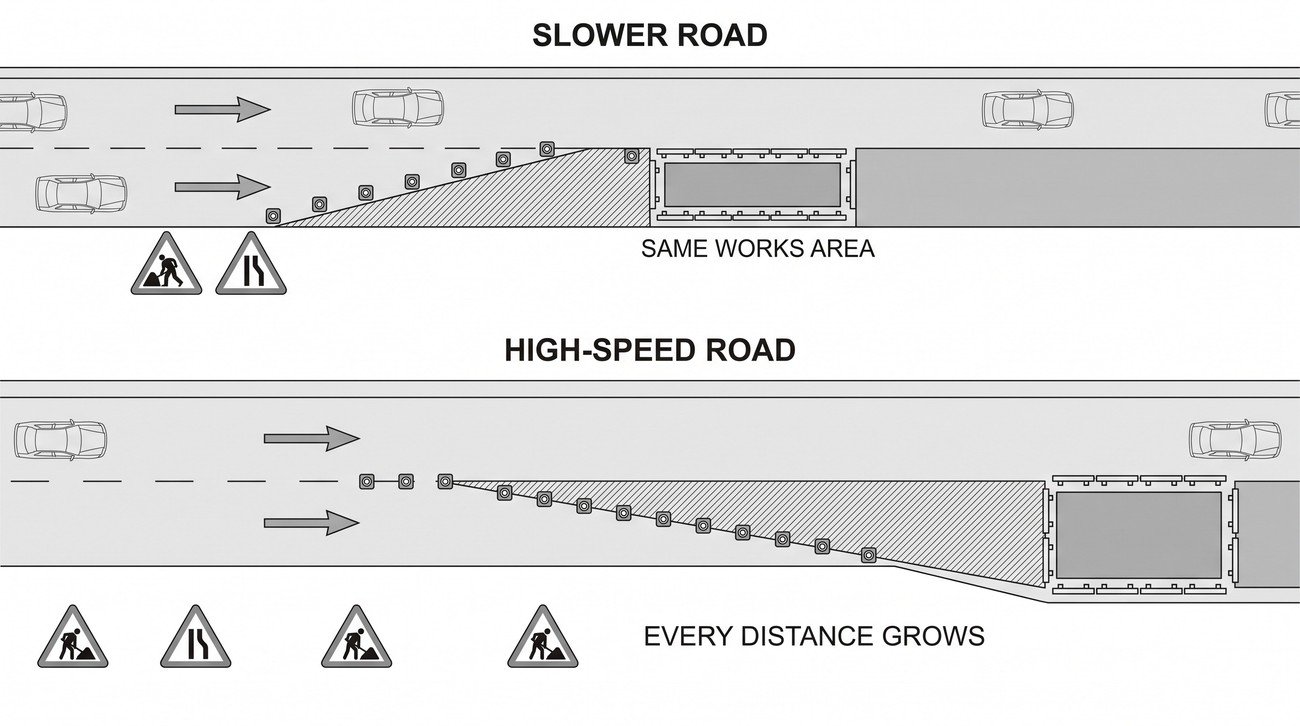
A vehicle at high speed covers a great deal of ground in the interval between a driver noticing something and acting on it. That single fact drives everything else: signs go further upstream, tapers get longer, safety zones get deeper, and the window in which a person can react to an incursion shrinks toward nothing. A layout that is adequate on a slower road is not a smaller version of the right answer; it is the wrong answer.
Impact severity rises faster than speed
The energy involved in a collision grows with the square of the speed, so a modest increase in speed produces a large increase in what a barrier has to absorb and in what happens to anyone struck. This is why restraint systems are classified by containment level, and why a system that performs on an urban road may be inadequate on a fast one. It is also why the honest answer on a high-speed road is more often full closure than clever layout.
No working on foot in a live lane
On a fast road there is no version of a person on foot in a live lane that is acceptable, including retrieving a displaced cone, crossing to the other side, or a quick look at something. Where something has to be done in a live lane, the lane is closed first. This is the rule that gets bent for small tasks, and small tasks in live high-speed lanes are how experienced people are killed.
Crossing the carriageway
Judging a gap in high-speed traffic on foot is unreliable, because closing speed is very hard to estimate and a vehicle that looks distant is not. Crossings happen at a designated point with traffic stopped, or by vehicle, or by going the long way round via an underpass or bridge. The absence of an obvious crossing is a reason to plan one rather than a reason to sprint.
Setting out is the hardest part
Everything already true about set-out and take-down applies with less time to correct anything. On high-speed roads these phases usually need their own arrangement — a rolling block, a lane closed by an impact protection vehicle, or working from a vehicle throughout — rather than being treated as the beginning and end of the same job. Planning them as separate operations with their own controls is the difference.
For the phases with the least protection, see setting out and taking down. For the containment classification, see EN 1317.
Related standards
The standards below set the classification, testing and performance requirements behind the equipment used for this work.
- EN 1317 — Road Restraint Systems
- EN 12899 — Fixed Vertical Road Traffic Signs
- EN 13422 — Portable Warning Devices and Delineators
Common errors
1Scaling a slower-road layout down to fit rather than lengthening every dimension.
2Specifying a restraint system by appearance rather than by containment level for the speed.
3Stepping into a live lane for a small task such as retrieving a cone.
4Crossing the carriageway on foot by judging a gap.
5Treating set-out and take-down as part of the same job rather than as separate operations.
Frequently asked questions
What is the fundamental difference on a high-speed road?
Time. A vehicle covers a great deal of ground between a driver noticing something and acting, so signs go further upstream, tapers get longer and safety zones get deeper.
Why does impact severity rise so sharply with speed?
Collision energy grows with the square of the speed, so a modest speed increase produces a large increase in what a barrier must absorb and in the consequences for anyone struck.
Is there any acceptable work on foot in a live high-speed lane?
No, including retrieving a displaced cone or crossing to the other side. Where something must be done in a live lane, the lane is closed first.
How should a high-speed carriageway be crossed on foot?
At a designated point with traffic stopped, by vehicle, or via an underpass or bridge. Judging a gap is unreliable because closing speed is very hard to estimate.
Why do set-out and take-down need their own arrangement?
Because there is less time to correct anything. On high-speed roads they usually need a rolling block, an impact protection vehicle, or working from a vehicle throughout.
Need this as a document you can issue? The template library gives you the risk assessments, permits and inspection logs in editable form — and employer plans cover a whole team with completion records.