Safety / Tips and Tricks / Road and highway works
Activity 11 · Road
Cones, Barriers and What Actually Stops a Vehicle
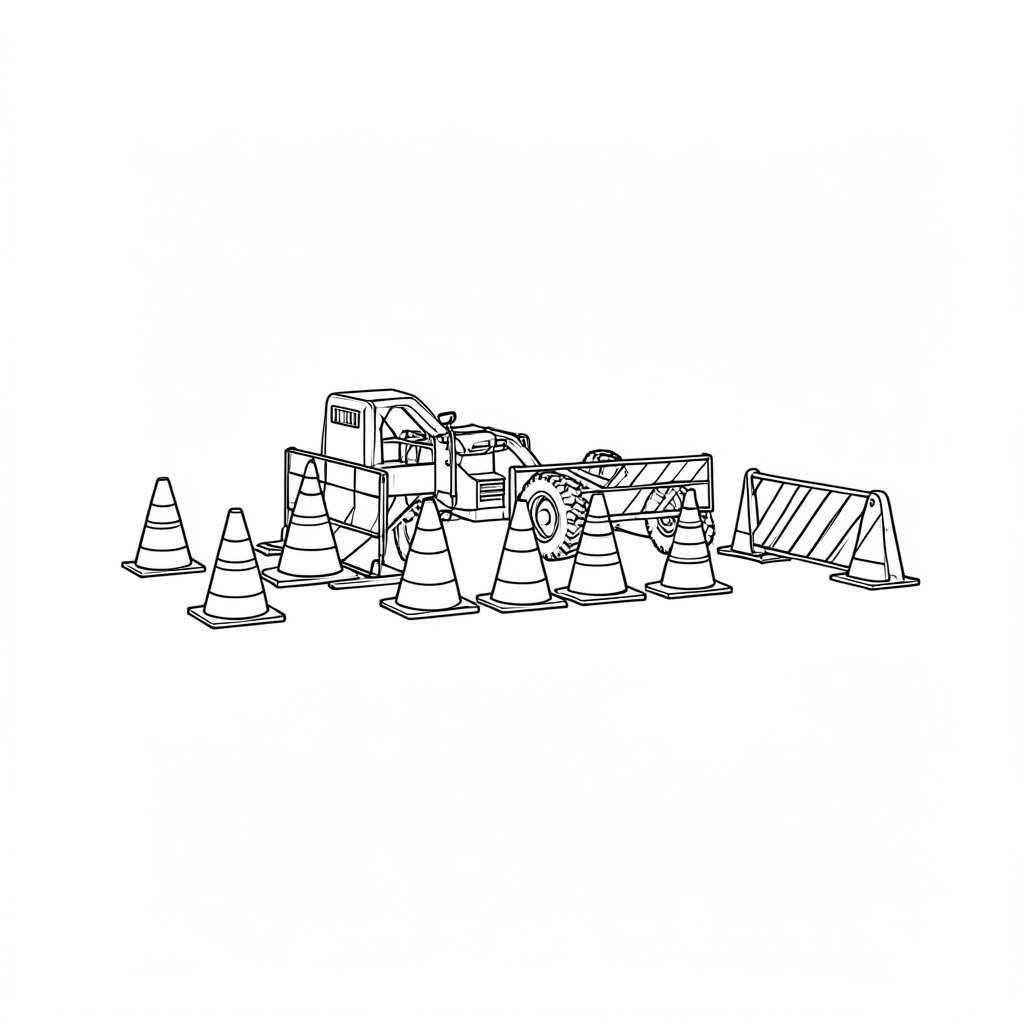
Almost everything on a roadworks layout is there to tell a driver something. Very little of it is there to stop a vehicle, and confusing the two is how people come to stand behind equipment that will not protect them.
Delineation is information, not protection
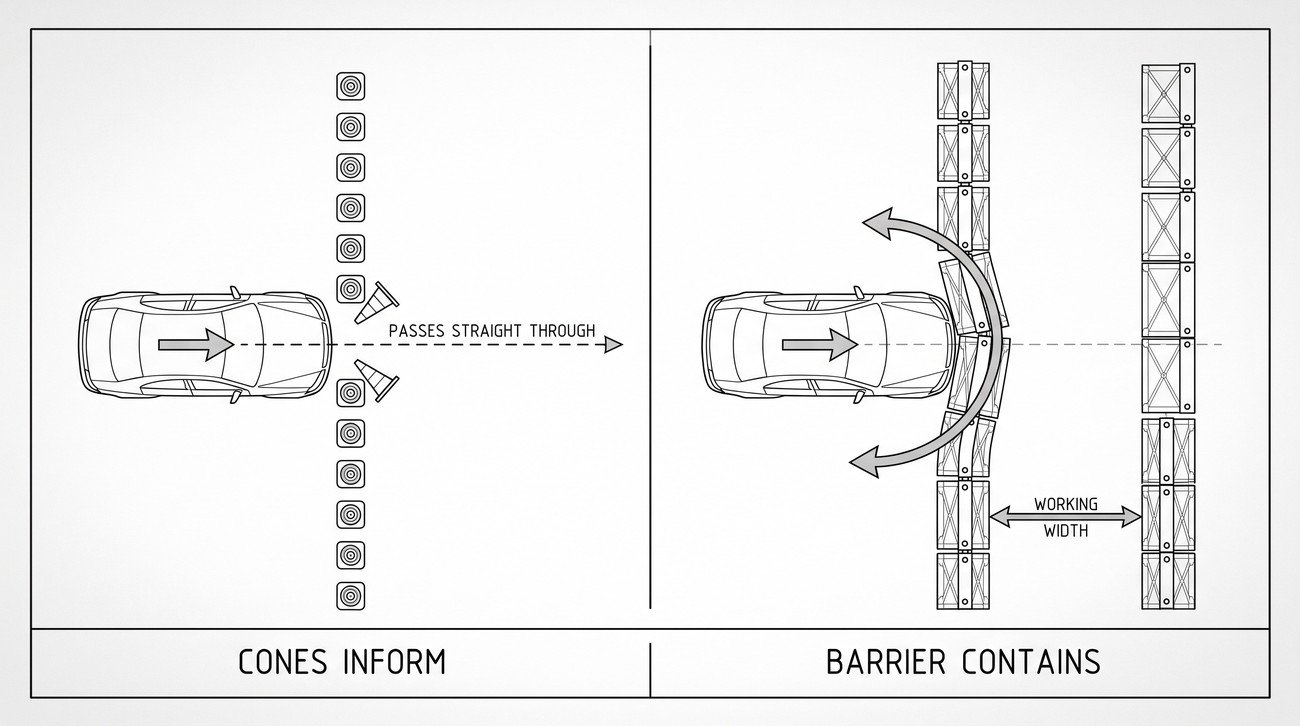
Cones, cylinders, tapes and lightweight plastic barriers guide traffic and mark the edge of the works. They are designed to be struck without damaging the vehicle or injuring its occupants, which necessarily means they do not resist it. A line of cones tells a driver where not to go; it does nothing whatever to a driver who goes there anyway. That is not a shortcoming — it is what they are for.
What a restraint system does
A road restraint system is engineered to contain and redirect an errant vehicle rather than to inform its driver. It is tested against defined impact conditions and classified by how much energy it contains, by how far it deflects when struck, and by how severe the impact is for the vehicle occupants. Those three properties matter together: a barrier that contains the vehicle but deflects two metres has not protected anyone standing one metre behind it.
Working width is the number that catches people out
When a barrier is struck it moves, and the vehicle leans over it. The space needed to accommodate both is the working width, and anything inside that space during an impact is hit by either the barrier or the vehicle. Placing people, plant or materials immediately behind a barrier assumes it is rigid, which most temporary systems are not. The barrier protects what is beyond its working width, not what is behind its face.
Ends, gaps and connections
A barrier is a system rather than a set of independent units. The connections between units carry the load along the line, so a run that has been shortened by removing a connection, or joined to a different type without the correct transition, does not behave as tested. Unprotected ends present a blunt object to an approaching vehicle and need a terminal designed for the purpose. A gap left for access is exactly where a vehicle will find its way through.
Choosing between them honestly
The question is not which looks more substantial but what is behind the line. Where an incursion would reach people, plant or an excavation, delineation is not sufficient and a restraint system is required, with enough space behind it for its working width. Where the only consequence of an incursion is a driver crossing an empty closed lane, delineation may be entirely appropriate. Deciding that honestly is the whole of the assessment.
For what a restraint system is tested to do, see EN 1317. For the buffer in front of it, see the safety zone.
Related standards
The standards below set the classification, testing and performance requirements behind the equipment used for this work.
Common errors
1Treating cones or lightweight plastic barriers as though they will stop a vehicle.
2Working, parking or stacking materials within the working width behind a barrier.
3Shortening a barrier run or mixing types without the correct transition.
4Leaving an unprotected blunt end facing approaching traffic.
5Choosing delineation because the works are short, when an incursion would reach people.
Frequently asked questions
Do cones stop vehicles?
No. Cones, cylinders, tapes and lightweight plastic barriers are delineation. They are designed to be struck without injuring vehicle occupants, which necessarily means they do not resist the vehicle.
What is a road restraint system tested for?
How much impact energy it contains, how far it deflects when struck, and how severe the impact is for the vehicle occupants. All three matter together.
What is working width?
The space a barrier needs behind it to deflect and to accommodate the vehicle leaning over it. Anything inside that space during an impact is struck by the barrier or the vehicle.
Why do barrier connections matter?
Because a barrier is a system, not a set of independent units. The connections carry load along the line, so a shortened run or a mixed system without the correct transition does not behave as tested.
When is delineation enough?
When the only consequence of an incursion is a driver crossing an empty closed lane. Where an incursion would reach people, plant or an excavation, a restraint system with room for its working width is required.
Need this as a document you can issue? The template library gives you the risk assessments, permits and inspection logs in editable form — and employer plans cover a whole team with completion records.