Safety / Tips and Tricks / Road and highway works
Activity 11 · Road
The Anatomy of a Temporary Traffic Management Layout
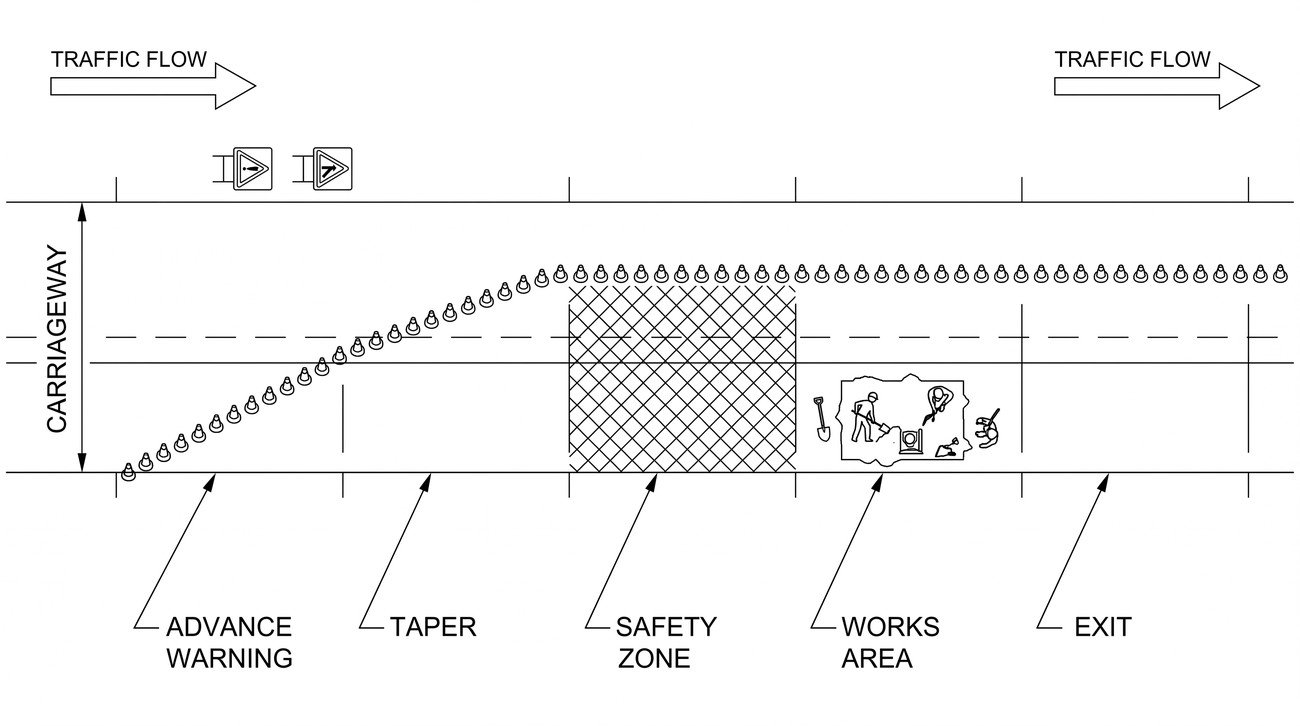
A traffic management layout is not a scattering of cones. It is a sequence of zones, each with a job, arranged so that a driver is warned, slowed, guided and kept away from people — in that order.
The advance warning area
The first thing a driver meets is information, placed far enough ahead that it can be read, understood and acted on before anything physical appears. How far ahead depends on the approach speed and on what the driver has to do about it, and the common failure is placing warning signs where they are visible but not where there is still room to respond. A sign that a driver passes at speed while still deciding has not done its job.
The transition, or taper
The taper moves traffic laterally out of the closed area, and its length is what makes that movement gradual rather than sudden. A short taper on a fast road produces exactly the abrupt lane change it exists to prevent, and it is the point at which most incursions begin. The taper is set out by the approach speed, not by the number of cones available or by the length of the works.
The safety zone
Between the traffic and the people there is a zone in which nobody works and nothing is stored. It exists to absorb the vehicle that clips a cone, drifts a little wide or brakes late, and it is the only part of the layout that assumes a driver gets it wrong. It is also the part most frequently eaten into — by a stack of materials, a parked van, a generator or simply by working a little closer to the line than planned.
The works area
Inside the safety zone is the area where the work happens, where plant operates and where people move. Its boundary needs to be as clear to the people inside it as to the drivers outside it, because a worker who steps out of it while concentrating on a task has left the protected area without noticing. Materials, welfare and parking belong inside it or off the layout entirely, never in the safety zone.
The exit
At the far end, traffic is returned to its normal path. The exit is usually shorter than the entry taper because drivers are moving back into space they can see, but it still needs to be defined rather than allowed to happen. An undefined exit leaves drivers overtaking through the end of the works and cutting back in across the last of the cones, which puts vehicles closest to the people who are packing up.
For the buffer itself, see the safety zone. Record the arrangement on the traffic management plan.
Related standards
The standards below set the classification, testing and performance requirements behind the equipment used for this work.
- EN 13422 — Portable Warning Devices and Delineators
- EN 12899 — Fixed Vertical Road Traffic Signs
- EN 1317 — Road Restraint Systems
- EN 12352 — Warning and Safety Light Devices
Common errors
1Placing advance signs where they can be seen but not where there is room to react.
2Shortening the taper to fit the cones available rather than setting it by approach speed.
3Storing materials, plant or vehicles in the safety zone.
4Leaving the works area boundary clear to drivers but vague to the people working inside it.
5Leaving the exit undefined, so drivers cut back across the end of the layout.
Frequently asked questions
What are the zones of a traffic management layout?
Advance warning, the taper that moves traffic across, the safety zone buffer, the works area itself, and the exit that returns traffic to its normal path. Each has a distinct job and they work in that order.
What sets the length of a taper?
The approach speed. A taper shortened to fit the cones available produces the abrupt lane change it exists to prevent, and that is where most incursions begin.
What is the safety zone for?
It is the only part of the layout that assumes a driver gets it wrong, absorbing a vehicle that clips a cone, drifts wide or brakes late. Nobody works in it and nothing is stored in it.
Why does the works area boundary need to be clear to workers?
Because a worker concentrating on a task can step out of the protected area without noticing. The boundary has to be as obvious from inside as it is from the carriageway.
Why does the exit matter?
An undefined exit leaves drivers overtaking through the end of the works and cutting back across the last cones, which puts vehicles closest to the people packing up.
Need this as a document you can issue? The template library gives you the risk assessments, permits and inspection logs in editable form — and employer plans cover a whole team with completion records.