Safety / Tips and Tricks / Lifting operations and rigging
Activity 10 · Lifting operations
Planning a Lift: What the Lift Plan Has to Answer
A lift plan is not a form to be completed; it is a set of questions that have to have answers before anyone touches a sling. The form exists to make it obvious when one of them does not.
The load
What does it weigh, where did that figure come from, and where is its centre of gravity? What is it made of, what will mark it, and what are its rated lifting points — if it has any. Whether it is free to lift, or still bolted, grouted, frozen, or connected to something that will resist. A load that is stuck applies a shock at the moment it releases that has nothing to do with its weight.
The equipment
Which machine, at what radius, and what does its duty chart say at that radius rather than at its best case. What is the rigging, what does the rigging itself weigh, and does the capacity of every component in the load path cover the configuration actually being used. Whether the ground will carry the machine, which is the question that turns a correct lift into a collapsed outrigger.
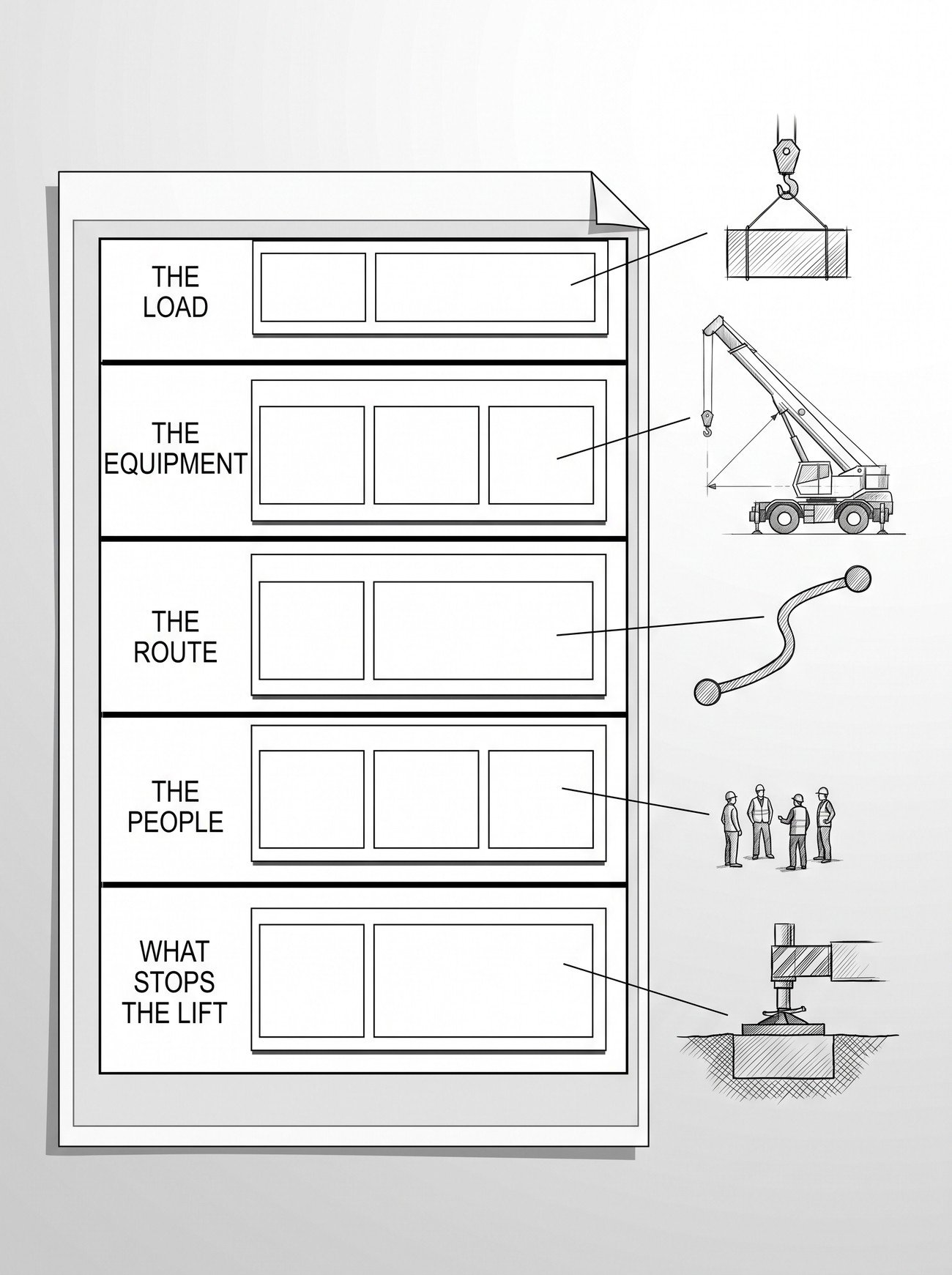
The place
Where the load starts, where it lands, and every point it passes over between the two. What is overhead: power lines, structures, other cranes with overlapping radii. What is underneath the route, and whether it can be cleared or has to be worked around. Where the crane sets up, whether that ground has been assessed for the imposed load, and what is buried beneath it.
The people
Who is in charge of the lift, who is slinging, who is signalling, who is operating, and who is keeping the exclusion zone. What each of them is competent to do, which is a question about evidence rather than about confidence. How they will communicate, and what the stop arrangement is. A plan that names roles but not people has not been finished.
What stops the lift
The conditions that end the operation before it starts or halt it partway: wind speed above the limit for the load, failing light, a change to the ground, a piece of equipment that fails its pre-use check, or anyone not being where they should be. Deciding these in advance is what makes it possible to stop, because the decision has already been made when the pressure to continue arrives.
Record it on the lift plan and authorise it with the lifting operations permit. For the weight and balance questions behind it, see estimating the load and finding the centre of gravity.
Related standards
The standards below set the safety requirements, marking and discard criteria behind the equipment used for this work.
- EN 13155 — Non-Fixed Load Lifting Attachments
- EN 13414 — Steel Wire Rope Slings
- EN 1492 — Textile Slings (Webbing and Roundslings)
- EN 818 — Short Link Chain for Lifting
Common errors
1Reading the crane duty at its best case rather than at the working radius.
2Leaving the weight of the rigging out of the capacity calculation.
3Planning the pick and the set down but not the route between them.
4Naming roles rather than people, so nobody actually holds them.
5Leaving the stop conditions undecided until the moment they are needed.
Frequently asked questions
What is a lift plan actually for?
To make sure a set of questions about the load, the equipment, the place and the people all have answers before anyone rigs. The form matters because a blank box is visible in a way an unasked question is not.
Why does the crane radius matter so much?
Capacity falls as radius increases, so a duty read at the machine's best case rather than at the working radius overstates what it can lift, sometimes by a wide margin.
What is often missed about the load itself?
Whether it is free to lift. A load still bolted, grouted, frozen or connected to something applies a shock when it finally releases that has no relation to its weight.
Why name people rather than roles?
Because a plan that lists roles without names leaves nobody actually holding them, and competence is a question about evidence for a specific person, not about the role in general.
Why decide the stop conditions in advance?
So the decision has already been made when the pressure to continue arrives. Wind limits, light, ground changes and failed pre-use checks are much easier to act on when they were agreed beforehand.
Need this as a document you can issue? The template library gives you the risk assessments, permits and inspection logs in editable form — and employer plans cover a whole team with completion records.