Standards / Lifting Accessories
EN 1492
Lifting Accessories
Current
Textile Slings (Webbing and Roundslings)
EN 1492 is the European standard for textile slings made from man-made fibre, covering both flat woven webbing slings and roundslings. It sets out the safety requirements, the way the working load limit is derived for each hitch, and the colour coding and labelling that let a sling be identified at a glance.
Scope
EN 1492 applies to slings made from man-made fibre webbing or from a fibre core enclosed in a protective cover, used for general lifting. It covers single and multi-leg assemblies, the derivation of the working load limit for straight, choke and basket hitches, the label information required, and the colour coding used to indicate capacity.
Exclusions & Related Standards
- Slings made from steel wire rope fall under EN 13414.
- Slings of short link chain fall under EN 818.
- Non-fixed load lifting attachments such as beams and clamps fall under EN 13155.
- Textile equipment used to support a person rather than a load falls under the fall protection standards, including EN 361.
Key Requirements & Marking
Textile slings are colour coded by working load limit so that capacity can be recognised without reading the label, and each sling must also carry a durable label stating the working load limit, the material, the nominal length, the manufacturer and a traceable identification. Because the label is the only proof of rating, a sling whose label is missing or unreadable has to be withdrawn even if it appears sound.
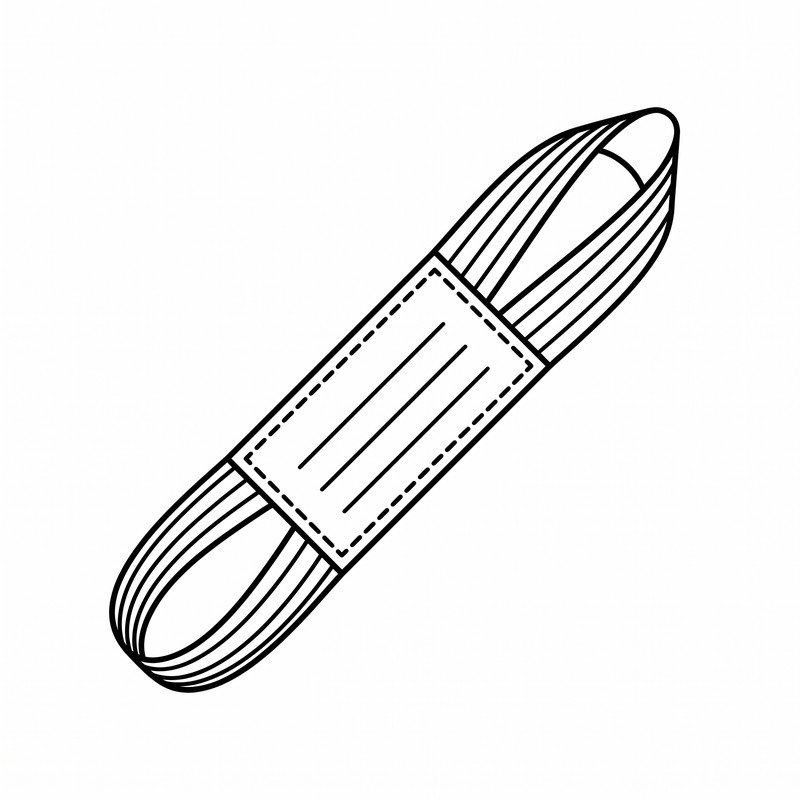
Colour indicates the capacity at a glance; the label carries the rating that actually governs.
Testing Overview
Assessment covers the breaking force of the webbing or roundsling assembly including its terminations, the strength of the stitching pattern, resistance to the effects of ultraviolet exposure and of the chemicals the material is declared suitable for, and verification that the label and colour coding correspond to the declared working load limit.
Selection Guide
Choose textile where the load surface would be marked or damaged by chain or wire rope, and where the sling has to conform to the shape of the load. Match the material to the environment, because the two common fibres differ in their resistance to acids and alkalis. Always fit edge protection where the sling passes over a corner, since textile is cut easily and a cut sling fails without warning.
Inspection, Care and Maintenance
- Inspect the full length and both faces before each use for cuts, nicks, abrasion, pulled stitching, heat glazing and chemical attack
- Withdraw any sling with a cut or tear in a load-bearing edge, however small, because the edge carries a disproportionate share of the load
- Withdraw any sling whose label is missing, illegible or detached
- On a roundsling, inspect the cover along its whole length and withdraw it if the core is visible anywhere
- Store dry, out of direct sunlight and away from chemicals, and never knot a sling to shorten it
A cut in the edge of a webbing sling removes far more strength than its size suggests.
Frequently asked questions
What does the colour of a textile sling mean?
Colour indicates the working load limit, so capacity can be recognised across a yard without reading the label. The label remains the governing document, and a sling with no readable label cannot be used regardless of its colour.
Why is a small cut in the edge of a webbing sling so serious?
The edges carry a disproportionate share of the load and a cut there acts as the starting point for progressive failure. A cut edge is a withdrawal criterion however minor it looks.
How can a roundsling be checked when the core is hidden?
The cover is the inspection surface. Any damage that exposes the core anywhere along the length means the sling must be withdrawn, because the condition of the fibre beneath can no longer be relied on.
Can a textile sling be knotted to shorten it?
No. A knot introduces a tight bend and a stress concentration that substantially reduces the strength of the sling, and the reduction cannot be quantified on site.
Does sunlight affect textile slings?
Yes. Ultraviolet exposure degrades man-made fibre over time, which is why slings are stored out of direct sunlight and why age and exposure history form part of the retirement decision alongside visible damage.