Safety / Tips and Tricks / Lifting operations and rigging
Activity 10 · Lifting operations
Shackles: Selecting, Fitting and the Ways They Fail
A shackle is the smallest, cheapest and most frequently substituted component in the load path, and it is routinely the one nobody checked.
Two shapes, two jobs
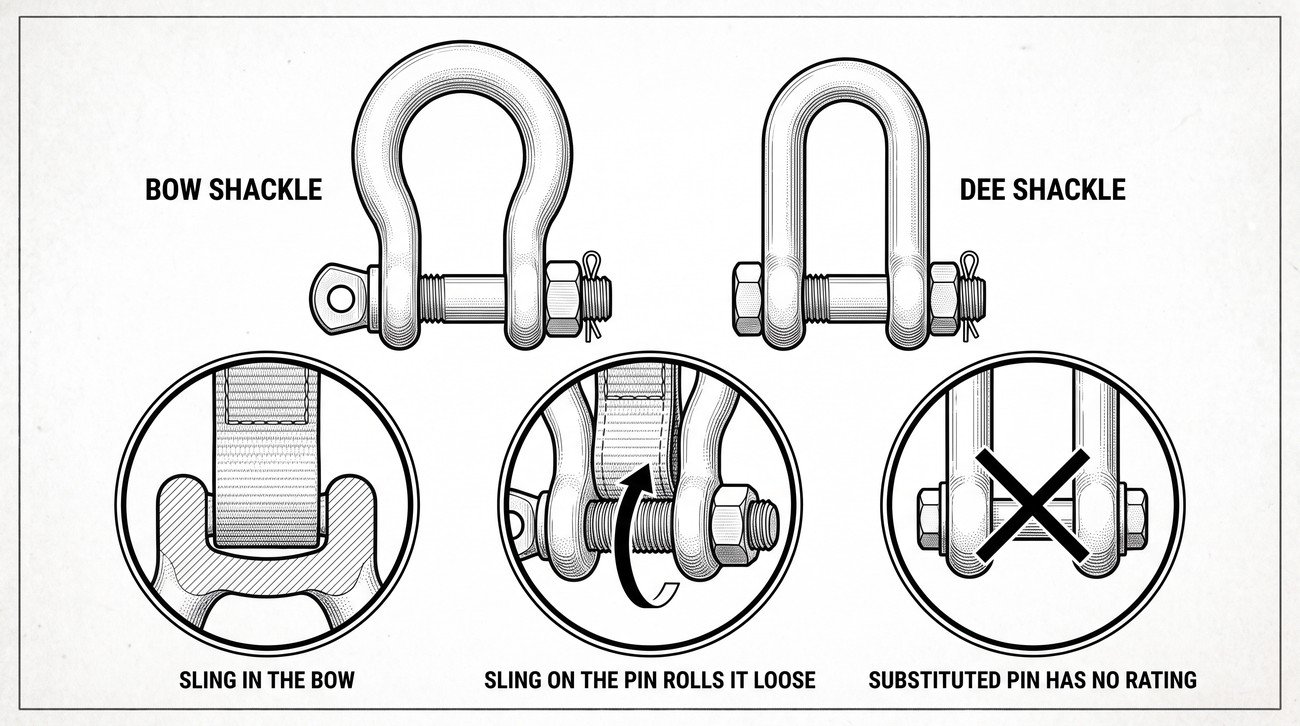
A bow shackle has a wide, rounded body and will accept several sling legs or a wide webbing eye without pinching them, and it tolerates loading from more than one direction better than the alternative. A dee shackle is narrower and is intended for a single in-line pull. Using a dee where several legs converge crowds them together and loads the shackle sideways, which is a straightforward misapplication rather than a marginal one.
The pin is a rating, not a fastener
A shackle and its pin are a matched, rated pair. A pin from another shackle, a bolt of the right diameter, or anything else that fits is not a substitute, however convincing it looks, because the pin carries the load and its rating is unknown. A shackle assembled with a foreign pin has no rating at all, and this is one of the very few faults in rigging that is both common and completely invisible once the pin is in.
Which part takes the sling
The sling goes in the bow and the load or the lifting point takes the pin. Reversing that puts the sling bearing directly on the pin, where it can roll the pin and unscrew it as the load settles. A sling in the bow can shift as the load takes up without turning anything. This is a rule about rotation as much as about strength, and it explains most of the shackles found part-unscrewed after a lift.
Side loading is the quiet one
Shackles are rated for a pull in line with the pin. Loading applied at an angle across the bow reduces capacity substantially, and the reduction grows quickly as the angle increases. Multiple sling legs converging in a single shackle create side loading almost by definition, which is why they need a bow shackle and why the arrangement should be checked rather than assumed. A shackle pulled sideways is not simply a bit weaker; it is being used outside what it was rated for.
Screw pins, bolts and where each belongs
A screw pin shackle is quick to fit and can unscrew under vibration or under a load that rotates, so it belongs on lifts that are made and broken quickly and watched throughout. A bolt type with a nut and split pin cannot back out and belongs anywhere the shackle stays in place, is left unattended, or will see repeated or vibrating loads. Choosing a screw pin for a long-term or unattended arrangement is a decision worth making deliberately rather than by what was in the bag.
For the assembly the shackle sits in, see selecting a sling. For what happens when several legs converge, see how the leg angle multiplies the load.
Related standards
The standards below set the safety requirements, marking and discard criteria behind the equipment used for this work.
- EN 13155 — Non-Fixed Load Lifting Attachments
- EN 818 — Short Link Chain for Lifting
- EN 13414 — Steel Wire Rope Slings
Common errors
1Using a dee shackle where multiple sling legs converge.
2Fitting a pin from another shackle or a bolt of the right diameter, which removes the rating.
3Putting the sling on the pin instead of in the bow, so the sling can roll the pin loose.
4Accepting side loading across the bow as though the shackle were still at full rating.
5Leaving a screw pin shackle in an unattended or vibrating arrangement where it can back out.
Frequently asked questions
What is the difference between a bow and a dee shackle?
A bow has a wide rounded body that accepts several sling legs or a wide webbing eye without pinching and tolerates loading from more than one direction. A dee is narrower and intended for a single in-line pull.
Can a shackle pin be replaced with a bolt?
No. The shackle and pin are a matched rated pair and the pin carries the load. A shackle assembled with a foreign pin has no rating, and the fault is invisible once the pin is fitted.
Which part of the shackle should the sling sit in?
The bow. Putting the sling on the pin lets it roll the pin and unscrew it as the load settles, which is why shackles are so often found part-unscrewed after a lift.
How much does side loading reduce shackle capacity?
Substantially, and the reduction grows quickly as the angle from the pin axis increases. A side-loaded shackle is being used outside its rating rather than merely at a reduced one.
When should a bolt-type shackle be used instead of a screw pin?
Wherever the shackle stays in place, is left unattended, or will see repeated or vibrating loads, because a screw pin can back out under vibration or under a load that rotates.
Need this as a document you can issue? The template library gives you the risk assessments, permits and inspection logs in editable form — and employer plans cover a whole team with completion records.