Safety / Tips and Tricks / Lifting operations and rigging
Activity 10 · Lifting operations
Sling Angle: How the Leg Angle Multiplies the Load
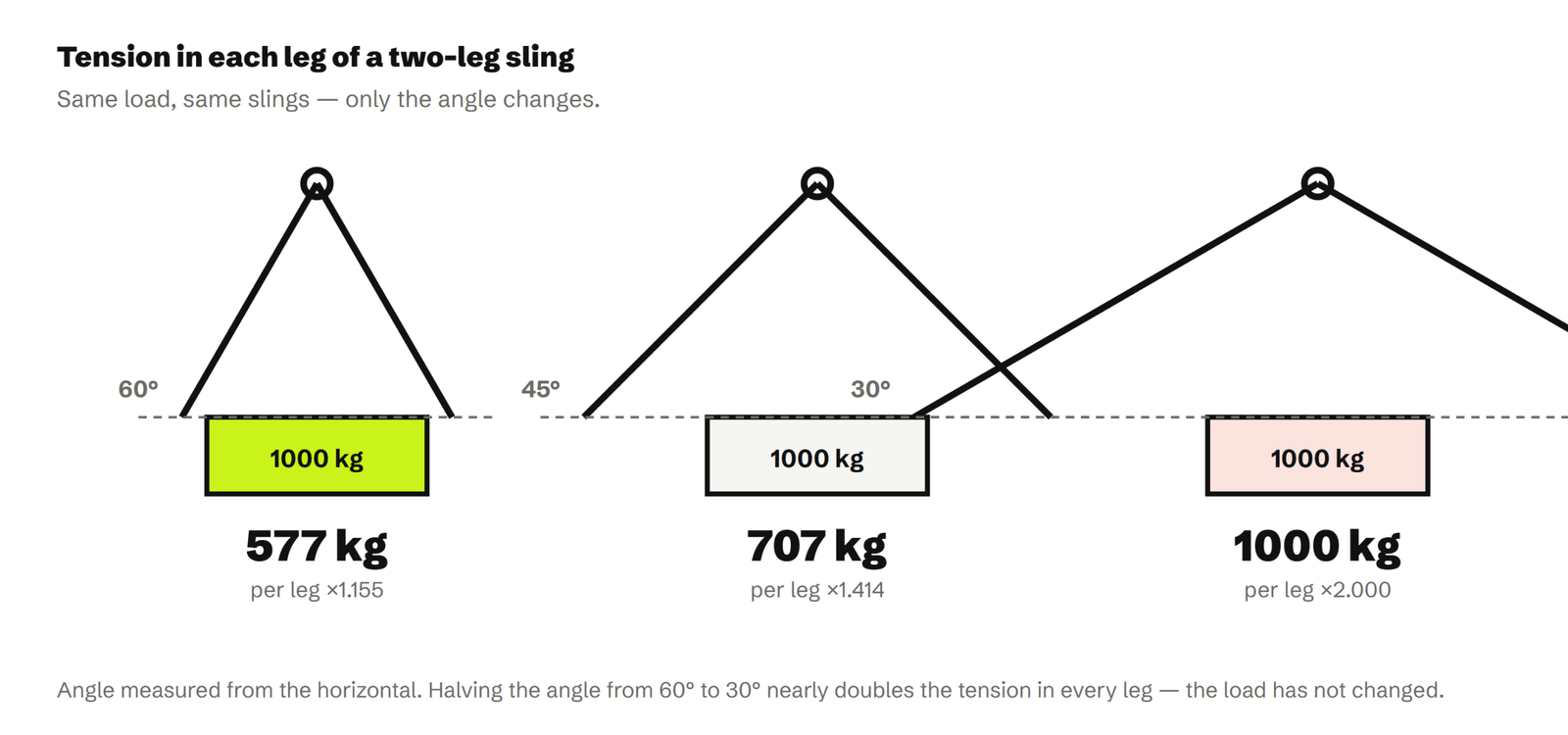
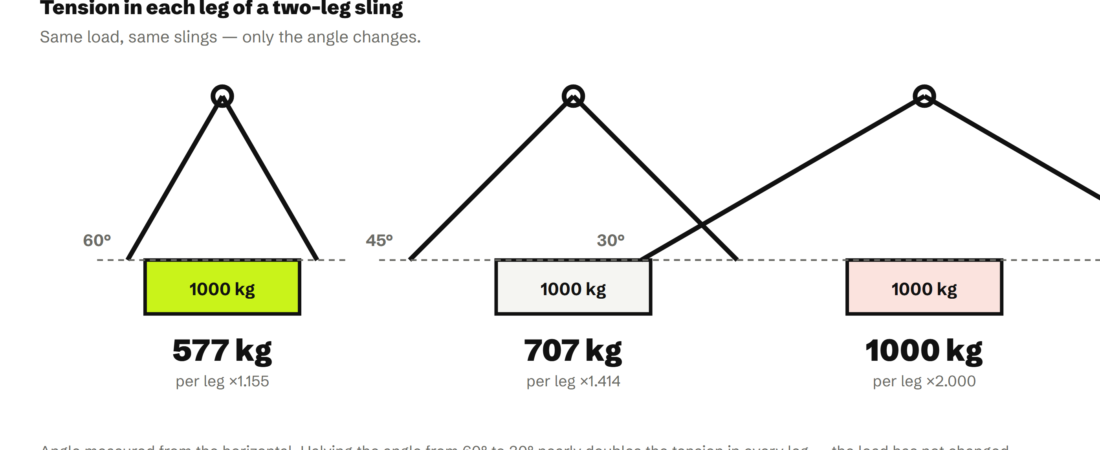
The most consistently underestimated force in rigging is the one created by the geometry rather than by the load, and a two-leg sling can be carrying far more than half the weight in each leg without anything appearing wrong.
Why the legs carry more than their share
When two legs lift a load between them, each leg carries a vertical component that supports the weight and a horizontal component that pulls towards the other leg. Only the vertical component does any lifting. As the legs spread further apart, the vertical part of each leg’s tension becomes a smaller fraction of the total tension, so the tension itself has to rise to keep supporting the same weight. The load has not changed; the geometry has made the sling work harder.
The practical consequence
Legs hanging close to vertical share the weight nearly equally between them. As the included angle opens up, the tension in each leg climbs, slowly at first and then steeply. Beyond a wide angle the tension rises fast enough that a sling comfortably rated for the load in a near-vertical configuration is being asked for far more than it can give. This is why sling capacity tables are printed against leg-angle ranges, and why a rating quoted without an angle is incomplete.
What controls the angle
Angle is set by the sling length against the spacing of the lifting points. A short sling on widely spaced points forces a wide angle, and the fix is a longer sling or a spreader beam rather than an acceptance of the geometry. A spreader beam changes the problem entirely by taking the horizontal component into the beam and leaving the slings above it hanging nearly vertical, which is why it appears on so many awkward lifts.
The horizontal force acts on the load too
The inward pull does not stop at the sling. It is applied to the lifting points and to the structure of the load, squeezing it inward. On a rigid casting that is of no consequence. On a fabricated frame, a crate, a bundle or a thin-walled vessel it can crush or distort the item being lifted, and it can load lifting points in a direction they were never designed for. A wide sling angle is therefore both a sling problem and a load problem.
Why four legs are rarely four legs
A four-leg sling on a rigid load will not share equally, because the load and the sling lengths are never perfect enough for all four to take up at once. In practice two legs take the load and the other two steady it, and that is why a four-leg arrangement on a rigid load is normally rated as though only two legs are working. Assuming otherwise is one of the quieter ways to overload a sling.
For the label that carries these figures, see reading a sling label. Where a spreader is the answer, see EN 13155.
Related standards
The standards below set the safety requirements, marking and discard criteria behind the equipment used for this work.
- EN 13414 — Steel Wire Rope Slings
- EN 1492 — Textile Slings (Webbing and Roundslings)
- EN 818 — Short Link Chain for Lifting
Common errors
1Quoting a sling capacity without stating the leg angle it applies to.
2Accepting a wide angle because the sling to hand is too short, instead of getting a longer one.
3Forgetting that the inward pull also squeezes the load and its lifting points.
4Rating a four-leg sling on a rigid load as though all four legs share equally.
5Measuring the angle at the hook by eye when it is close to the limit of the rated range.
Frequently asked questions
Why does spreading the legs increase the tension?
Each leg carries a vertical component that lifts and a horizontal component that pulls inward. Only the vertical part lifts, so as the legs spread and that part becomes a smaller fraction of the tension, the tension itself must rise to support the same weight.
What is the practical effect of a wide sling angle?
Tension in each leg climbs slowly at first and then steeply, so a sling that is comfortably rated near vertical can be asked for far more than it can give once the legs are spread wide.
How is a wide angle corrected?
With a longer sling, or with a spreader beam that takes the horizontal component into the beam and leaves the slings above it hanging nearly vertical.
Does the sling angle affect the load itself?
Yes. The inward pull is applied to the lifting points and to the structure, which can crush or distort a crate, a bundle, a fabricated frame or a thin-walled vessel, and can load lifting points in a direction they were not designed for.
Why is a four-leg sling usually rated as two legs?
Because on a rigid load the sling lengths and lifting points are never perfect enough for all four legs to take up together. In practice two carry the load and two steady it.
Need this as a document you can issue? The template library gives you the risk assessments, permits and inspection logs in editable form — and employer plans cover a whole team with completion records.