Safety / Tips and Tricks / Lifting operations and rigging
Activity 10 · Lifting operations
Reading a Sling Label and What the Working Load Limit Actually Means
A working load limit is not a single number that belongs to a sling. It is a number that belongs to a sling used in a particular way, and reading it as anything else is how correctly rated equipment ends up overloaded.
What the label has to tell you
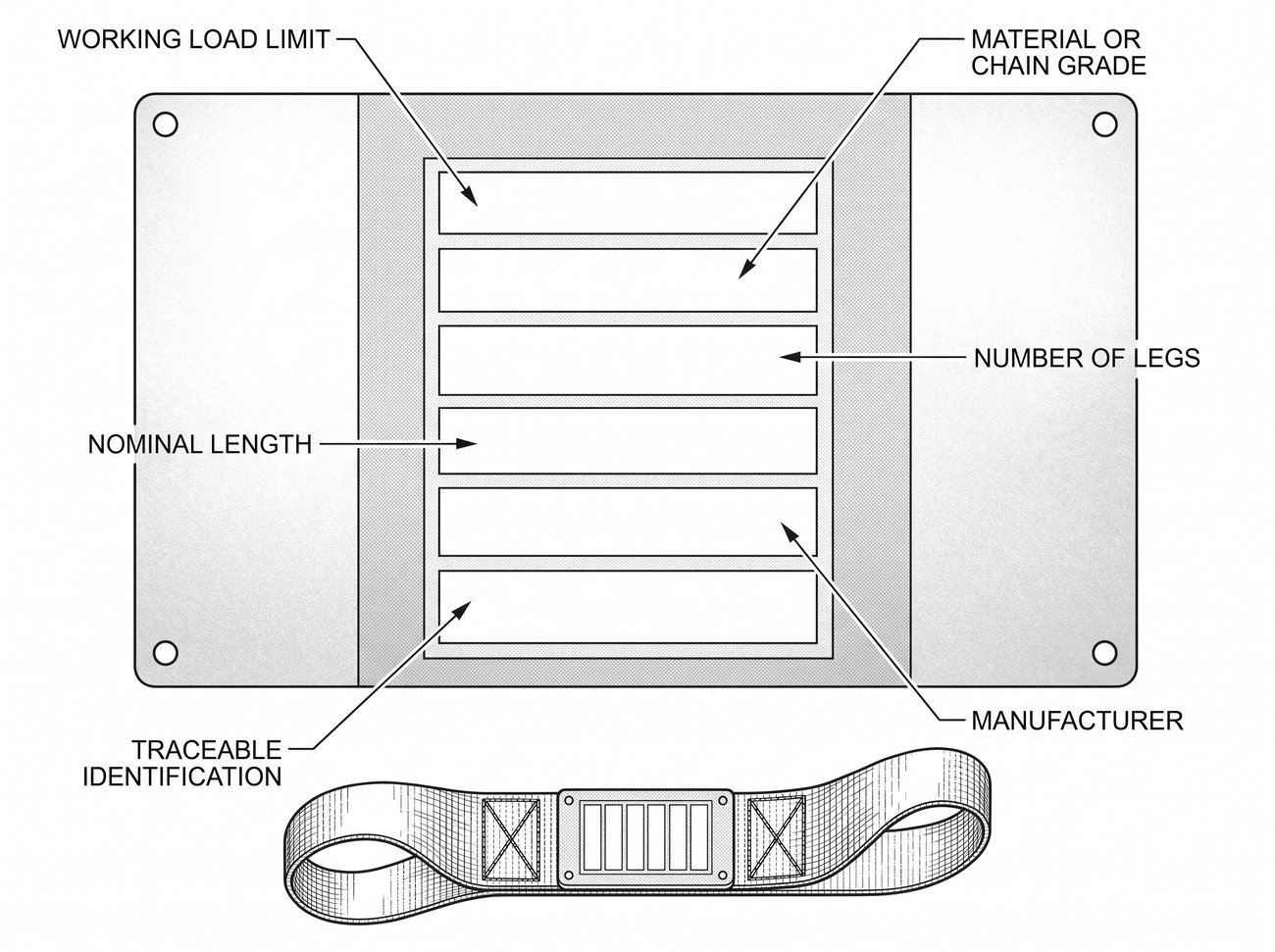
Every sling carries a durable identification stating its working load limit, its material or chain grade, the number of legs, the nominal length, the manufacturer and a traceable identification code. That code is what connects the sling in your hand to its examination record. A sling with no readable label is not an unmarked sling that is probably fine; it is a sling whose rating cannot be established, which puts it out of service regardless of its condition.
One sling, several ratings
The same sling has different capacities in a straight lift, a choke hitch and a basket hitch, and a multi-leg sling has different capacities at different leg angles. That is why a label carries a set of figures rather than one, and why quoting the largest of them is a mistake that is easy to make and hard to see afterwards. The figure that applies is the one for the configuration actually being used on this lift.
Working load limit is not breaking load
The working load limit is the maximum load the sling may be used to lift in the stated configuration. It is derived from the breaking force with a design factor applied, and that factor is not spare capacity available for use — it covers the wear, the shock and the imperfect conditions the equipment will meet in service. Treating it as headroom removes the very margin that makes the rating meaningful.
What quietly increases the load
The load on a sling is often larger than the weight of the object. Snatching a load rather than taking up the strain smoothly applies a dynamic load well above the static weight. Wind on a large surface adds a horizontal component. A load that is dragged free before it lifts can add a very large shock at the moment it releases. And a load that is not evenly shared between legs can put almost all of itself onto one of them, which is the usual reason a four-leg sling is rated as though only two legs are carrying.
Colour codes and other shortcuts
Textile slings are colour coded by capacity so a sling can be recognised across a yard, and that is a genuinely useful shortcut. It is not a substitute for the label. Colours fade, covers get replaced, and a sling that has been through a wash or a season outside may not present the colour it left the factory with. Where the colour and the label disagree, neither can be trusted and the sling goes out of service.
For how the leg angle changes the figure, see how the leg angle multiplies the load. For the standards behind the marking, see EN 1492 and EN 13414.
Related standards
The standards below set the safety requirements, marking and discard criteria behind the equipment used for this work.
- EN 1492 — Textile Slings (Webbing and Roundslings)
- EN 13414 — Steel Wire Rope Slings
- EN 818 — Short Link Chain for Lifting
Common errors
1Quoting the highest figure on a label rather than the one for the hitch and angle in use.
2Treating the design factor as spare capacity available for a heavier load.
3Using a sling whose label is missing, detached or unreadable.
4Calculating from the weight of the object and ignoring snatch, wind and uneven leg loading.
5Relying on the colour code alone when the label disagrees with it or has gone.
Frequently asked questions
Why does one sling have several working load limits?
Because capacity depends on how the sling is used. A straight lift, a choke hitch and a basket hitch give different figures, and a multi-leg sling gives different figures at different leg angles.
Is the working load limit the same as the breaking load?
No. It is derived from the breaking force with a design factor applied, and that factor covers wear, shock and imperfect conditions in service. It is not spare capacity available for a heavier load.
Can a sling be used if the label has come off?
No. The label is the only evidence of the rating and of the traceable identification linking the sling to its examination record, so an unlabelled sling has to be withdrawn regardless of its apparent condition.
What makes the load on a sling larger than the weight of the object?
Snatching instead of taking up the strain smoothly, wind acting on a large surface, a load that releases suddenly after being dragged free, and uneven sharing between the legs of a multi-leg sling.
Is the colour code on a textile sling reliable?
It is a useful shortcut for recognising capacity at a distance, but colours fade and covers get replaced. Where the colour and the label disagree, neither can be trusted and the sling goes out of service.
Need this as a document you can issue? The template library gives you the risk assessments, permits and inspection logs in editable form — and employer plans cover a whole team with completion records.