Safety / Tips and Tricks / Lifting operations and rigging
Activity 10 · Lifting operations
Selecting a Sling: Chain, Wire Rope or Textile
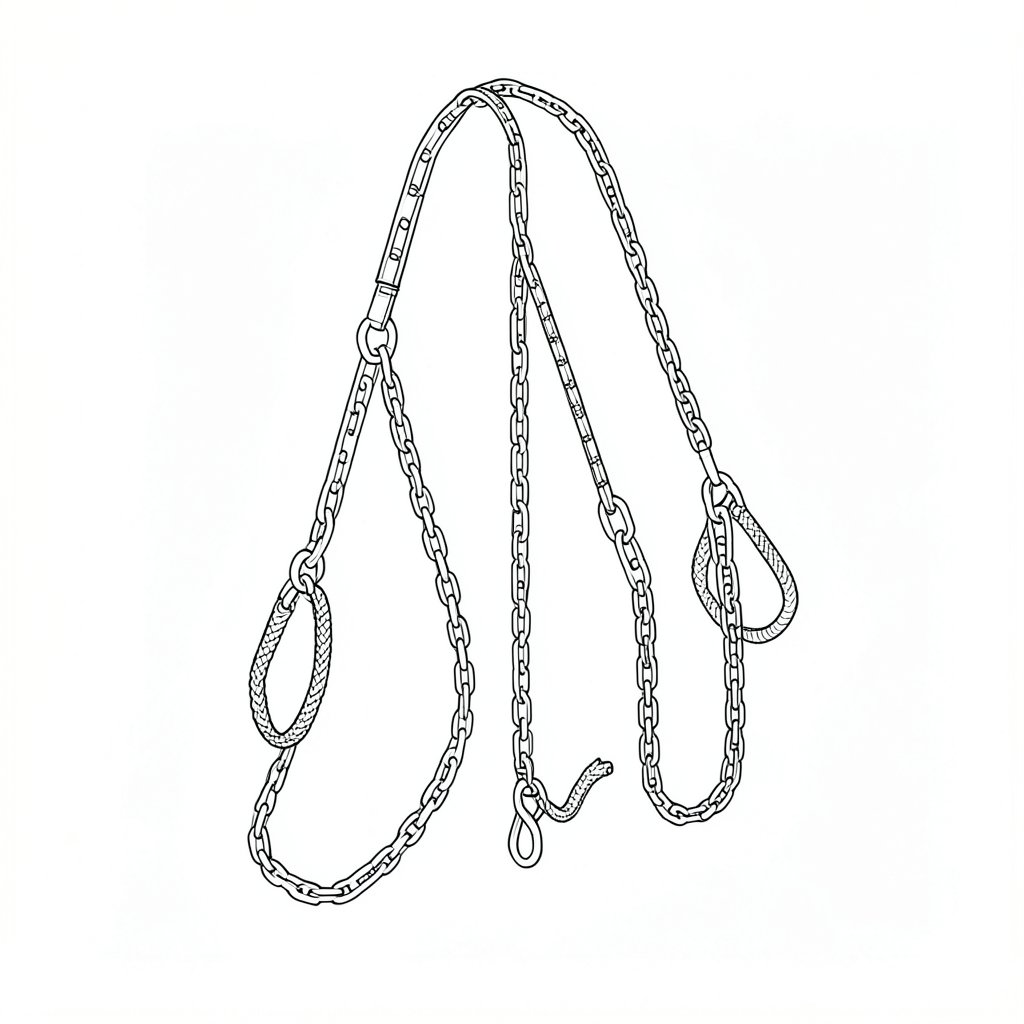
There is no strongest sling material, only a material that suits the load in front of you — and most of the arguments about chain against textile disappear once the question is asked as what will damage what.
What each material is actually good at
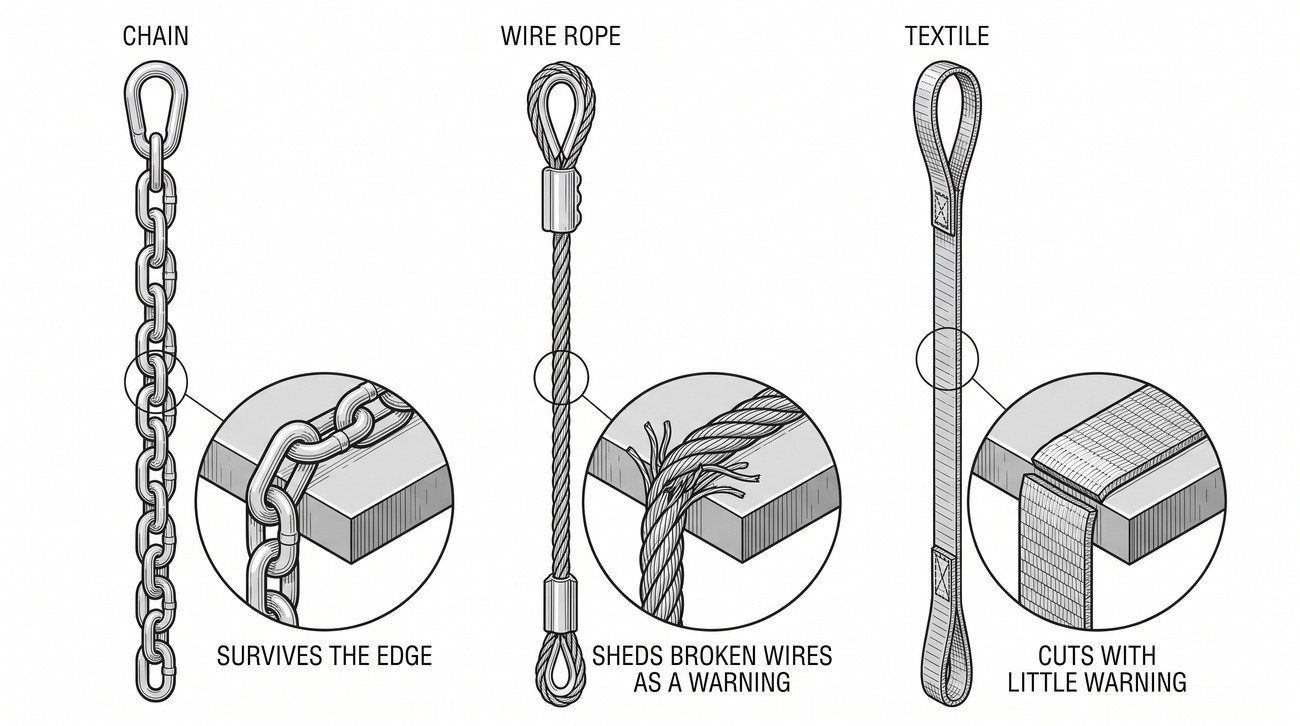
Chain survives sharp edges, hot surfaces and years of rough handling, and it can be shortened with purpose-made fittings to level an awkward load. Wire rope sits between the two: more resistant to abrasion and heat than textile, more flexible than chain, and it gives visible warning as it deteriorates because broken wires appear before the rope parts. Textile is light, kind to finished surfaces and conforms to the shape of the load, which is exactly why it is also the easiest of the three to destroy.
Let the load choose
A machined casting with painted faces is a textile job, because chain will mark it and wire rope will scuff it. A steel fabrication with flame-cut edges is a chain job, because textile will be cut on the first lift and wire rope will be damaged at every corner. Anything hot rules textile out entirely. Anything that must not be scratched rules chain out. Where the material is fixed by the load, the remaining decision is the configuration, not the type.
How each one warns you before it fails
This is the difference that matters most in practice. Wire rope sheds broken wires, and a rope showing them is telling you it is on the way out. Chain stretches and its links stop articulating freely, which is detectable by hand. Textile gives the least warning of the three: a cut in the edge of a webbing sling can remove a large part of its strength while the sling still looks and feels serviceable, and a roundsling hides its load-bearing core inside a cover entirely. That is not an argument against textile, but it is an argument for inspecting it more carefully.
Environment, not just the load
Temperature limits differ sharply between materials, and man-made fibre loses strength well below the point where it looks affected. Chemical exposure divides the two common textile fibres: one resists acids better, the other alkalis, and using the wrong one in a plating shop or a concrete works produces a sling that fails without any visible cause. Ultraviolet exposure degrades textile over time, which is why a sling left hanging outside for a season is a different item from the one that was bought.
The assembly is only as good as its weakest component
A sling rarely works alone. The shackle, the master link, the hook and the lifting point all form part of the same load path, and the capacity of the arrangement is set by the lowest-rated item in it, not by the sling. Mixing components of different grades into one assembly is the most common way a correctly chosen sling ends up in an under-rated lift, and it is invisible unless every part is checked.
For what governs the rating once the material is chosen, see reading a sling label. For protecting whichever material you choose, see protecting slings from edges and corners.
Related standards
The standards below set the safety requirements, marking and discard criteria behind the equipment used for this work.
- EN 13414 — Steel Wire Rope Slings
- EN 1492 — Textile Slings (Webbing and Roundslings)
- EN 818 — Short Link Chain for Lifting
- EN 13155 — Non-Fixed Load Lifting Attachments
Common errors
1Choosing a material by what is nearest to hand rather than by what the load will do to it.
2Using textile against flame-cut or sheared edges without protection.
3Assuming textile is safe simply because it looks undamaged, when a cut edge gives little warning.
4Ignoring temperature and chemical limits, which affect textile long before any visible change.
5Building an assembly from mixed-grade components and rating it by the sling alone.
Frequently asked questions
Which sling material is strongest?
The question does not resolve that way. Capacity is set by the rating of the specific sling, not the material class, and each material fails for different reasons: chain from stretch and wear, wire rope from broken wires, textile from cuts and chemical attack.
When should textile never be used?
Against sharp or flame-cut edges without protection, on hot loads, and where the chemical environment attacks the fibre. Man-made fibre also loses strength at temperatures well below the point where it looks affected.
Why is textile said to give the least warning?
A cut in the edge of a webbing sling removes a large part of its strength while the sling still looks serviceable, and a roundsling hides its load-bearing core inside a cover, so the fibre carrying the load cannot be seen at all.
Does the choice of sling affect the load itself?
Yes, and it is half the decision. Chain marks machined and painted surfaces and wire rope scuffs them, which is why textile is used on finished work even though it is the most easily damaged of the three.
What rates a sling assembly rather than the sling?
The lowest-rated component in the load path, including the shackle, master link, hook and the lifting point on the load. Mixing grades is the usual way a correctly chosen sling ends up in an under-rated arrangement.
Need this as a document you can issue? The template library gives you the risk assessments, permits and inspection logs in editable form — and employer plans cover a whole team with completion records.