Safety / Tips and Tricks / Lifting operations and rigging
Activity 10 · Lifting operations
Choosing a Hitch: Straight, Choke and Basket
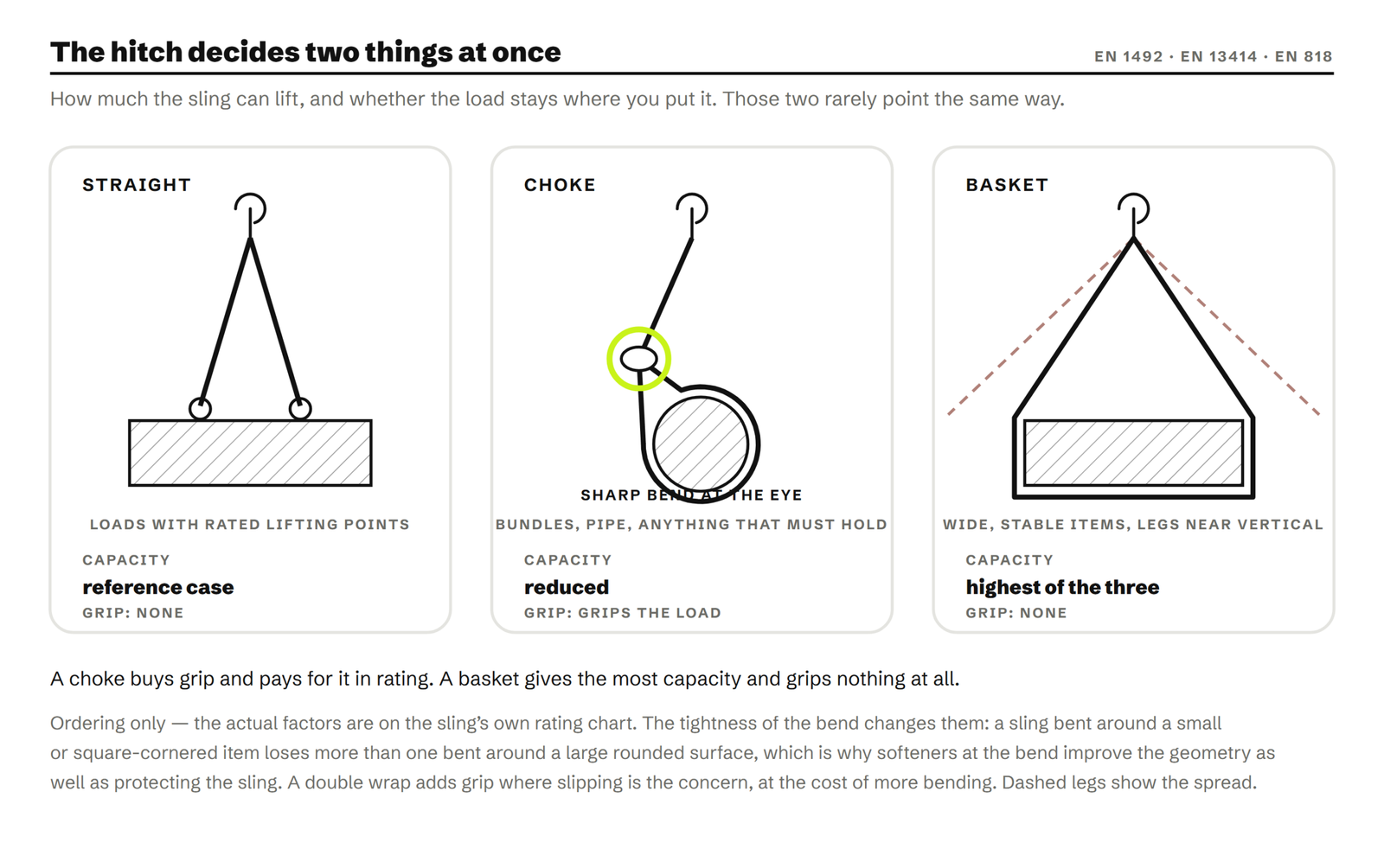
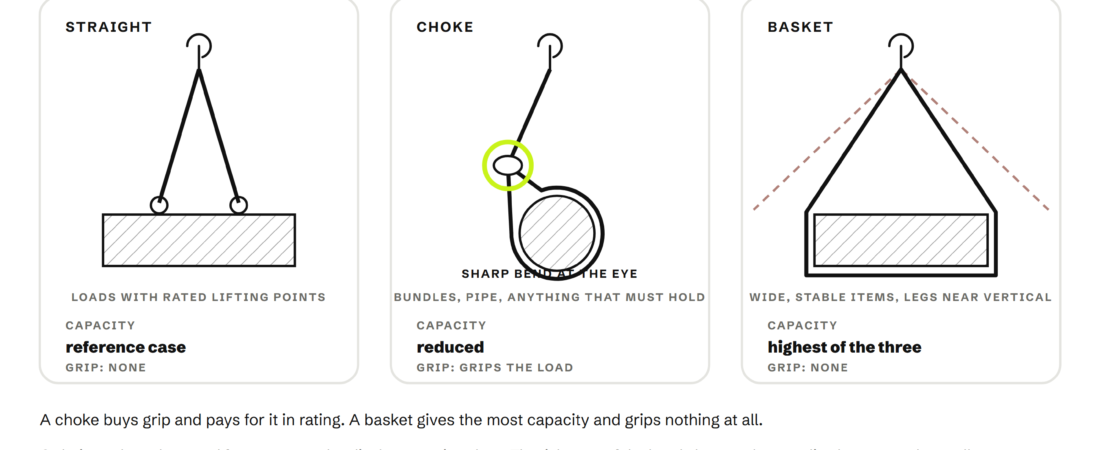
The hitch decides two things at once: how much the sling can lift, and whether the load will stay where you put it. Those two rarely point in the same direction, which is what makes the choice worth thinking about.
The straight lift
A sling attached at each end to a lifting point on the load, hanging in line with the pull, is the simplest arrangement and the reference case for the rating. Nothing is bent tightly, nothing is gripping, and the sling does exactly what it was rated to do. It also does nothing at all to stop the load rotating or sliding, which is why it belongs on loads with proper lifting points rather than on loose items.
The choke hitch
A choke passes the sling around the load and back through its own eye, so the sling tightens on the load as it takes the strain. That grip is the reason it is used: it holds a bundle together and stops a cylindrical item sliding out. The cost is that the sling is bent sharply at the choke point, and that bend reduces the capacity substantially compared with a straight lift. A choke is a control decision that you pay for in rating, not a way of getting more from a sling.
The basket hitch
A basket passes the sling under the load with both ends up to the hook, so two parts of the sling support the weight. That gives the highest capacity of the three arrangements, provided the legs stay close to vertical — because the moment the sides of a basket spread, the leg angle penalty applies exactly as it does to a two-leg sling. A basket also grips nothing at all, so a smooth load can slide out of it, and that is precisely how loads are dropped from an arrangement that looked generous on capacity.
Matching the hitch to the load
Loads with rated lifting points take a straight lift. Bundles, pipe and anything that must be held together take a choke, accepting the reduced capacity. Wide, stable items with no lifting points take a basket, provided the sling cannot slip along the load and the sides do not spread. A double wrap adds grip to either a choke or a basket where slipping is the concern, at the cost of more bending in the sling.
Where the sling bends is where it matters
Every hitch except a straight lift bends the sling around something, and the tightness of that bend affects the capacity. A sling bent around a small-diameter or square-cornered item loses more than one bent around a large, rounded surface. This is why the same choke hitch on a large pipe and on a sharp-cornered box are not the same lift, and why softeners at the bend do more than protect the sling — they improve the geometry as well.
For the angle penalty a spread basket reintroduces, see how the leg angle multiplies the load. For softeners at the bend, see protecting slings from edges and corners.
Related standards
The standards below set the safety requirements, marking and discard criteria behind the equipment used for this work.
- EN 1492 — Textile Slings (Webbing and Roundslings)
- EN 13414 — Steel Wire Rope Slings
- EN 818 — Short Link Chain for Lifting
Common errors
1Choosing a basket for its capacity and losing the load because nothing grips it.
2Letting the sides of a basket spread, which reintroduces the leg-angle penalty in full.
3Using a choke and rating it as though it were a straight lift.
4Choking around a sharp-cornered item without a softener at the bend.
5Assuming a choke will stop a load sliding when the sling can travel along the load itself.
Frequently asked questions
Which hitch gives the highest capacity?
A basket, because two parts of the sling support the load, provided the legs stay close to vertical. As soon as the sides spread, the leg-angle penalty applies exactly as it does to a two-leg sling.
Why does a choke hitch reduce the rating?
The sling is bent sharply where it passes back through its own eye, and that bend concentrates stress at one point. The reduction is the price paid for the grip a choke provides.
When is a basket hitch the wrong choice?
On a smooth load that can slide out of it, because a basket grips nothing at all. Capacity is not the only consideration and a generous rating is no help if the load slips free.
What does a double wrap achieve?
It adds grip to a choke or a basket where slipping is the concern, at the cost of introducing more bending into the sling.
Does the shape of the load change the hitch capacity?
Yes. A sling bent around a small-diameter or square-cornered item loses more capacity than one bent around a large rounded surface, which is why softeners at the bend improve the geometry as well as protecting the sling.
Need this as a document you can issue? The template library gives you the risk assessments, permits and inspection logs in editable form — and employer plans cover a whole team with completion records.