Safety / Tips and Tricks / Lifting operations and rigging
Activity 10 · Lifting operations
Chain Sling Discard Criteria and Safe Shortening
Chain is the most forgiving sling material and the one people inspect least carefully, largely because it looks indestructible right up to the point where it has quietly stretched beyond use.
Grade governs everything
Chain of the same nominal size has very different capacity at different grades, and the grade is stated on the tag rather than being visible in the chain. That matters most when components are mixed: a master link, hook or coupling of a lower grade fitted into an assembly reduces the rating of the whole sling to that of the weakest part, and nothing about the assembled sling shows it. An assembly is a single rated item, not a collection of separately rated ones.
Stretch is detected by hand, not by eye
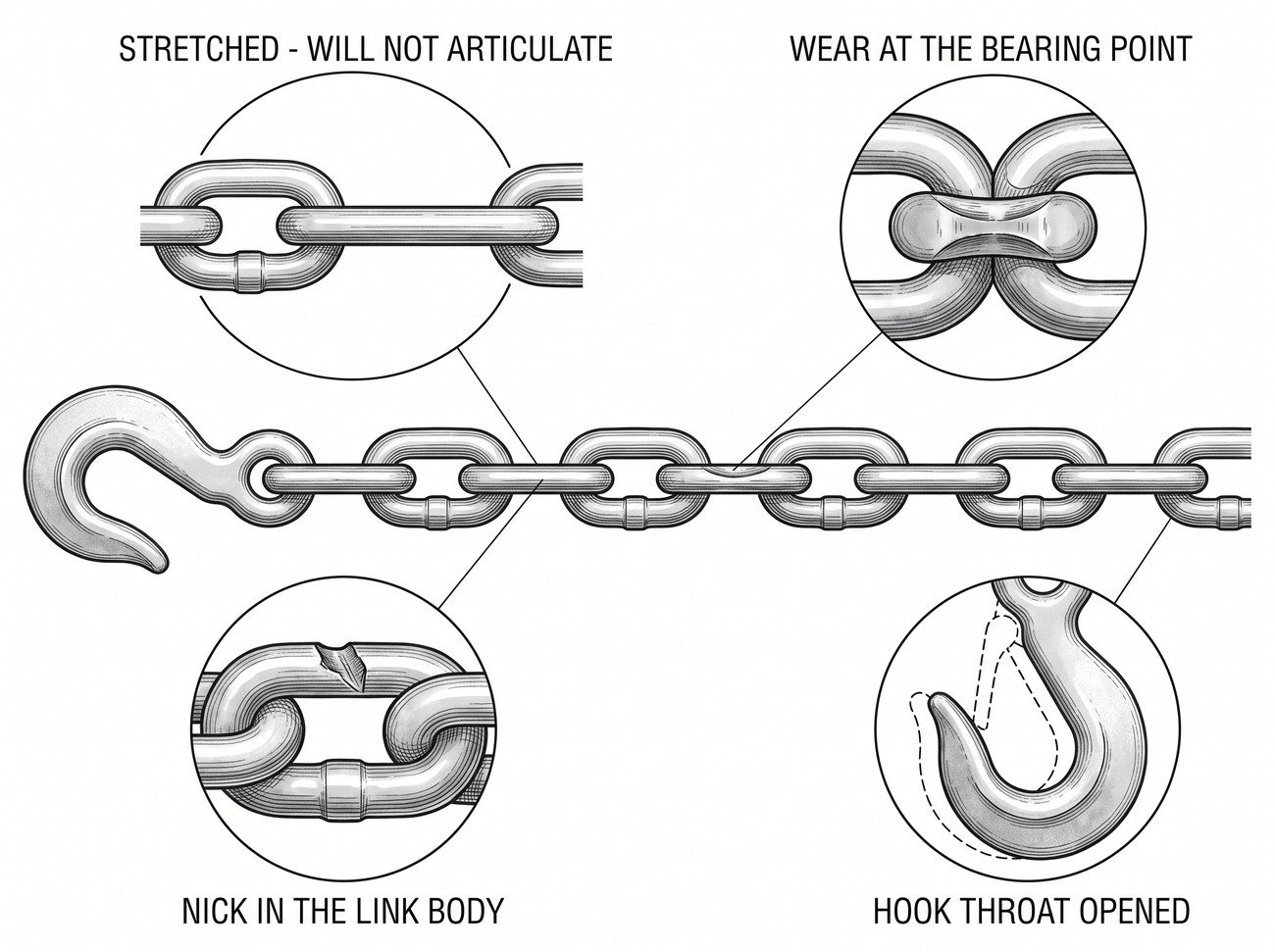
A stretched link becomes longer and narrower, and the first symptom is that it stops articulating freely against its neighbours. Running the chain through your hands and feeling for a point where it has become stiff finds this long before it is obvious to look at. A chain that has gone stiff at a particular point is showing deformation, not dirt, and stiffness that does not free up when the link is worked is a reason to withdraw the sling.
Wear, nicks and gouges
Chain wears where the links bear against each other, so the inside of the link at the contact point is where material is lost. A nick or gouge in the body of a link is more serious than its size suggests, because it acts as a stress raiser in a component that is loaded to a high proportion of its capacity by design. Cracks, twisted links and any link that cannot be turned in the normal way are all withdrawal criteria without further assessment.
The hook tells you about the past
A hook whose throat has opened has been overloaded, whatever the paperwork says. The deformation shows that the material has yielded, and a yielded hook cannot be relied on at its rated load again. Check the saddle for wear where the sling or load has been bearing, check that any safety latch closes and springs properly, and treat an opened throat as evidence about how the assembly has been used rather than as a single component fault.
Shortening it properly
Chain slings are shortened to level an off-centre load, and that is a legitimate and common operation — provided it is done with the shortening device supplied as part of the assembly. Knotting the chain introduces a tight bend and a bending load the chain was never designed to take. Bolting a link back on itself, or hooking the chain back into itself at a random point, does the same. Both reduce the capacity by an amount nobody on site can calculate, which is precisely why the fitting exists.
For the grades and requirements behind the assembly, see EN 818. For what shortening is used to achieve, see finding the centre of gravity.
Related standards
The standards below set the safety requirements, marking and discard criteria behind the equipment used for this work.
Common errors
1Mixing components of different grades into one assembly and rating it by the chain alone.
2Looking for stretch instead of feeling for a link that will not articulate freely.
3Dismissing a nick or gouge as cosmetic on a component loaded to a high proportion of its capacity.
4Keeping a hook in service after the throat has opened.
5Shortening a chain by knotting it or hooking it back into itself rather than using the shortening device.
Frequently asked questions
Why does chain grade matter more than chain size?
Chain of the same nominal size has very different capacity at different grades, and the grade appears on the tag rather than being visible in the chain itself. A lower-grade component reduces the whole assembly to its rating.
How is stretch in a chain found?
By running the chain through your hands and feeling for a point that has become stiff. A stretched link is longer and narrower and stops articulating freely, which is detectable long before it is visible.
Why is a small nick in a link serious?
It acts as a stress raiser in a component that is loaded to a high proportion of its capacity by design, so the effect on strength is out of proportion to the size of the mark.
What does an opened hook throat mean?
That the hook has been overloaded and the material has yielded. It cannot be relied on at its rated load again, and it is also evidence about how the whole assembly has been used.
Can a chain sling be shortened on site?
Yes, using the shortening device supplied as part of the assembly. Knotting the chain or hooking it back into itself introduces a bending load it was never designed for and reduces capacity unpredictably.
Need this as a document you can issue? The template library gives you the risk assessments, permits and inspection logs in editable form — and employer plans cover a whole team with completion records.