Safety / Tips and Tricks / Lifting operations and rigging
Activity 10 · Lifting operations
Eyebolts and Lifting Points: The Cost of Off-Axis Loading
An eyebolt screwed into a machine looks like a lifting point that will take a pull from any direction. It is not, and the difference between the two types of eyebolt is one of the few genuinely dangerous ambiguities in rigging hardware.
Two types that look almost identical
A plain collared eyebolt is rated for a pull along the axis of its shank, straight up. A dynamo or collar-eye type with a wider machined collar seated hard against the face is rated for a pull in the plane of the eye as well, and its rating in that plane is much lower than its axial one. To the eye on a workshop bench, the two look alike. Fitting the first where the second is needed produces a component being loaded in the one direction it was never rated for.
The penalty for pulling at an angle
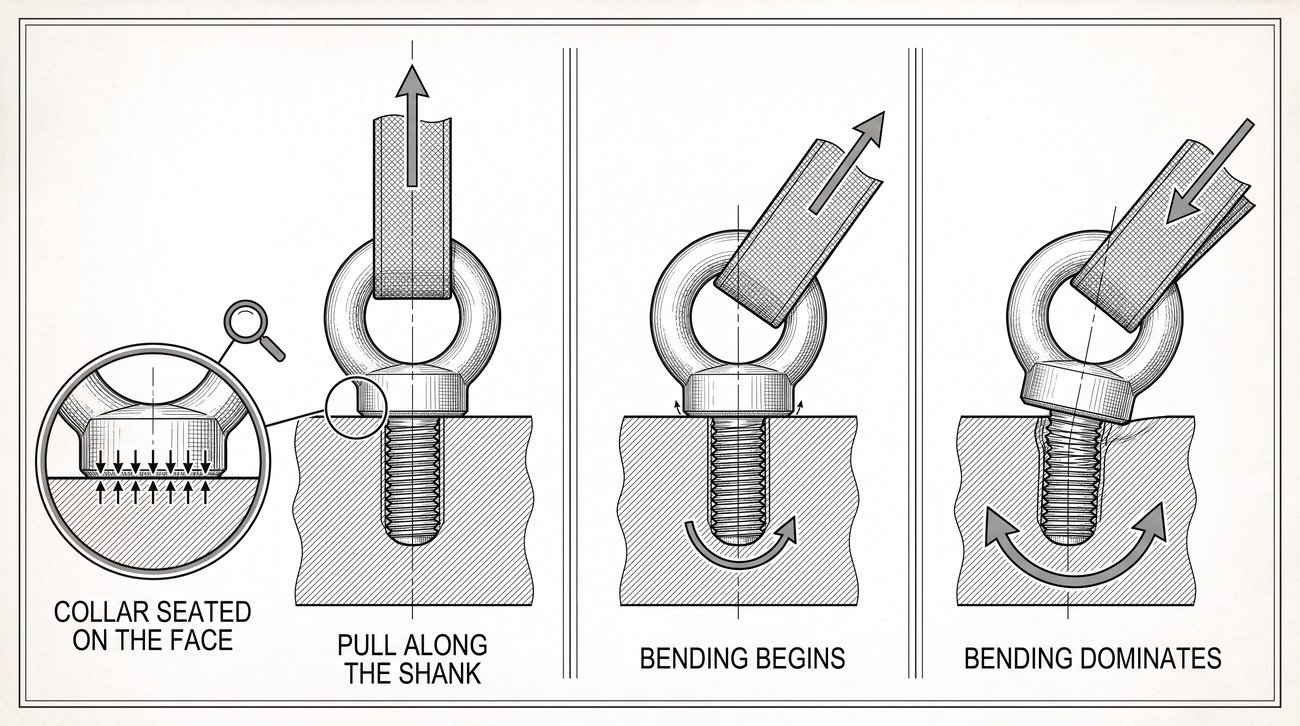
Loading an eyebolt away from its axis applies a bending moment to the shank rather than pure tension, and the shank is comparatively slender. The capacity falls sharply as the angle opens, far faster than most people expect, and at wide angles the remaining capacity is a small fraction of the axial rating. This is the mechanism behind a large proportion of eyebolt failures: nothing was overloaded in terms of weight, but the geometry converted a modest load into a bending failure.
The collar has to be seated
An eyebolt that is not screwed fully home so its collar bears evenly on a flat machined face is carrying its load on a few threads instead of on the seat. Packing washers under the collar to get the eye to point the right way is the same fault dressed up: it lifts the collar off its seat and puts the load into the thread. Where the eye ends up pointing the wrong way once tight, the answer is a swivel-type point, not a shim.
What is underneath the hole
The eyebolt is rarely the weakest part. The thread it is screwed into, the material around it, and whether that material was ever intended to carry a lifting load are the real questions, and none of them are visible from outside. A tapped hole in a thin cover plate, a casting boss with a crack behind it, or a thread stripped by a previous lift all look identical to a sound point. A lifting point on a machine is only a lifting point if the manufacturer says so.
Swivel points solve the problem properly
A swivel hoist ring rotates and articulates so that the load always pulls in a rated direction regardless of how the sling runs, which removes the off-axis question altogether. They cost more than an eyebolt and they need the same attention to seating and to what is beneath the thread, but on any load lifted repeatedly, or lifted with legs that cannot be kept vertical, they are the correct component rather than the expensive one.
For the geometry that creates the angle, see how the leg angle multiplies the load. For the attachments that avoid the problem, see EN 13155.
Related standards
The standards below set the safety requirements, marking and discard criteria behind the equipment used for this work.
Common errors
1Treating a plain collared eyebolt as though it were rated for a pull in the plane of the eye.
2Accepting a wide sling angle at an eyebolt, where the capacity penalty is far steeper than at a hook.
3Packing washers under the collar to orient the eye, which loads the thread instead of the seat.
4Assuming a tapped hole is a lifting point because an eyebolt fits it.
5Using eyebolts on a repeated lift where a swivel hoist ring is the correct component.
Frequently asked questions
What is the difference between the two common eyebolt types?
A plain collared eyebolt is rated for a pull along the axis of its shank only. A collar-eye or dynamo type with a wide machined collar seated against the face is also rated for a pull in the plane of the eye, at a much lower figure than its axial rating.
Why does angled loading reduce eyebolt capacity so sharply?
It applies a bending moment to a comparatively slender shank instead of pure tension. Capacity falls far faster than the angle suggests, and at wide angles only a small fraction of the axial rating remains.
Can washers be used to orient an eyebolt?
No. Packing under the collar lifts it off its seat and transfers the load into the thread. Where the eye points the wrong way once tight, a swivel-type lifting point is the answer.
Is any tapped hole a lifting point?
No. The thread, the material around it and whether that material was ever intended to carry a lifting load are the real questions, and none are visible from outside. A point is a lifting point only if the manufacturer says so.
When is a swivel hoist ring worth the cost?
On any load lifted repeatedly, or lifted with sling legs that cannot be kept vertical, because it rotates and articulates so the pull is always in a rated direction.
Need this as a document you can issue? The template library gives you the risk assessments, permits and inspection logs in editable form — and employer plans cover a whole team with completion records.