Safety / Tips and Tricks / Construction and demolition
Activity 09 · Construction
Safety Footwear for Construction: Reading the EN ISO 20345 Markings
Safety footwear is one of the few items of site equipment whose entire specification is stamped inside the boot, and the short code printed on the tongue label tells you more about what the boot will and will not do than any product description.
The base requirement everything else is added to
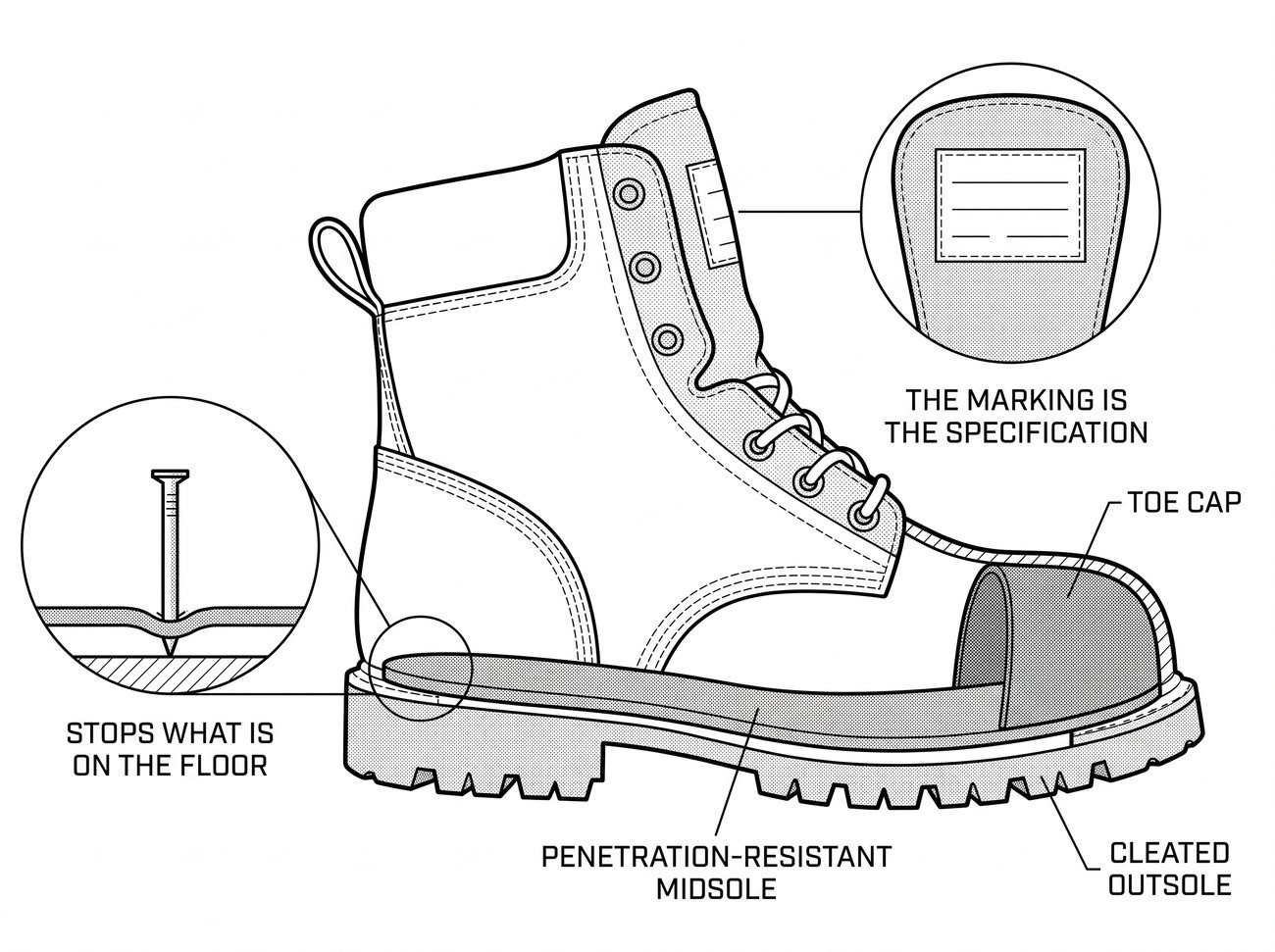
All safety footwear in this family shares one non-negotiable feature: a toe cap tested against a defined impact and a defined static compression. That is the baseline. Everything after it — penetration resistance, antistatic behaviour, energy absorption in the heel, water resistance, resistance to fuel oil — is an addition that either was or was not specified when the boot was bought. A boot with the base marking alone is a legitimate safety boot and is entirely unsuitable for walking across a slab strewn with nails.
Reading the letter codes
The letter codes are cumulative rather than a ranking, so a higher letter is not automatically a better boot for your job. The distinction that matters most on a construction site is between a boot with penetration resistance and one without: only the former has a protective midsole between the tread and your foot. The second distinction that matters is water: a boot rated only for water resistance of the upper behaves differently from one built as a fully waterproof unit, and a groundworker in a wet trench will find that out within an hour.
Steel or composite midsole
A steel penetration-resistant plate covers the full footprint and resists a small-diameter nail reliably, but it is heavier, conducts cold, and cannot follow the flex of the foot as closely. A textile composite plate is lighter, warmer and more flexible, and covers the whole sole area without a rigid edge, but its performance against very fine, sharp objects depends on the construction. Neither is universally correct; the choice follows the actual debris on your site.
Slip resistance is a floor test, not a site test
Slip performance is measured on defined laboratory surfaces with defined contaminants, which is why a boot that passes comfortably can still slide on wet clay, on a dusty steel deck, or on a smooth screed. Treat the marking as a minimum guarantee rather than as a description of behaviour on your ground conditions, and expect open, self-clearing tread channels to matter more than the rating once mud is involved.
Ankle support, lacing and what actually fails first
Most construction footwear is withdrawn not because the toe cap failed but because the sole unit separated, the tread wore smooth, or the upper split at the flex point. None of these are visible while the boot is on, so the check has to be deliberate: flex the sole to look for cracking at the ball, look along the welt for separation, and check that the tread depth still has usable channels. A boot with a sound toe cap and a bald sole is a slip hazard wearing a safety marking.
For the equivalent choice in a warehouse setting, see safety footwear for warehouse and logistics work. Where standing water and chemicals are involved, see chemical-resistant footwear.
Related standards
The standards below set the test methods and performance levels behind the protective equipment used for this work.
- EN ISO 20345 — Safety Footwear
- EN ISO 20346 — Protective Footwear
- EN ISO 20347 — Occupational Footwear
Common errors
1Buying on the base marking alone and expecting penetration resistance that was never specified.
2Treating the letter codes as a quality ranking rather than a list of added features.
3Assuming a water-resistant upper is the same as a waterproof boot.
4Reading the slip rating as a description of behaviour on site rather than on a test surface.
5Keeping boots in service with a smooth tread because the toe cap is still sound.
Frequently asked questions
What is the one feature all EN ISO 20345 footwear shares?
A toe cap tested against a defined impact energy and a defined static compression. Every other property, including penetration resistance and water resistance, is an addition that has to be specified.
How do I know if a boot has a protective midsole?
It is shown by the marking code on the tongue label rather than by appearance. Without that specific marking there is no penetration-resistant layer between the tread and the foot.
Is a steel or a composite penetration plate better?
Neither is universally better. Steel is more reliable against fine nails but heavier and conducts cold; composite is lighter, warmer and more flexible. The choice follows the debris actually present on the site.
Why can a boot with a good slip rating still slide on site?
The rating comes from defined laboratory surfaces and contaminants. Wet clay, dust on steel decking and smooth screed are not those surfaces, so the marking is a minimum guarantee rather than a prediction.
What usually takes construction boots out of service?
Sole unit separation, tread worn smooth, or the upper splitting at the flex point, none of which are visible while the boot is being worn. The toe cap almost never fails first.
Need this as a document you can issue? The template library gives you the risk assessments, permits and inspection logs in editable form — and employer plans cover a whole team with completion records.