Safety / Tips and Tricks / Construction and demolition
Activity 09 · Construction
Selecting a Safety Helmet for Construction Work: What EN 397 Actually Covers
An industrial safety helmet is tested for one headline case above all others — an object falling onto the crown — and almost every complaint about helmets on a construction site comes down to a mismatch between that test and the way the helmet is actually being worn.
What the crown test does and does not tell you
The core requirement behind an industrial helmet is shock absorption from a mass dropped vertically onto the top of the shell, together with resistance to a pointed object penetrating it. That combination describes a tool or a brick dropped from a level above, which is the dominant fatal mechanism on a multi-level site. It says very little about a sideways impact into a scaffold tube, a fall from a working platform, or a strike that arrives at an angle, and a helmet chosen only on the crown test will behave exactly as tested and no better.
Retention: the difference between a helmet and a hat
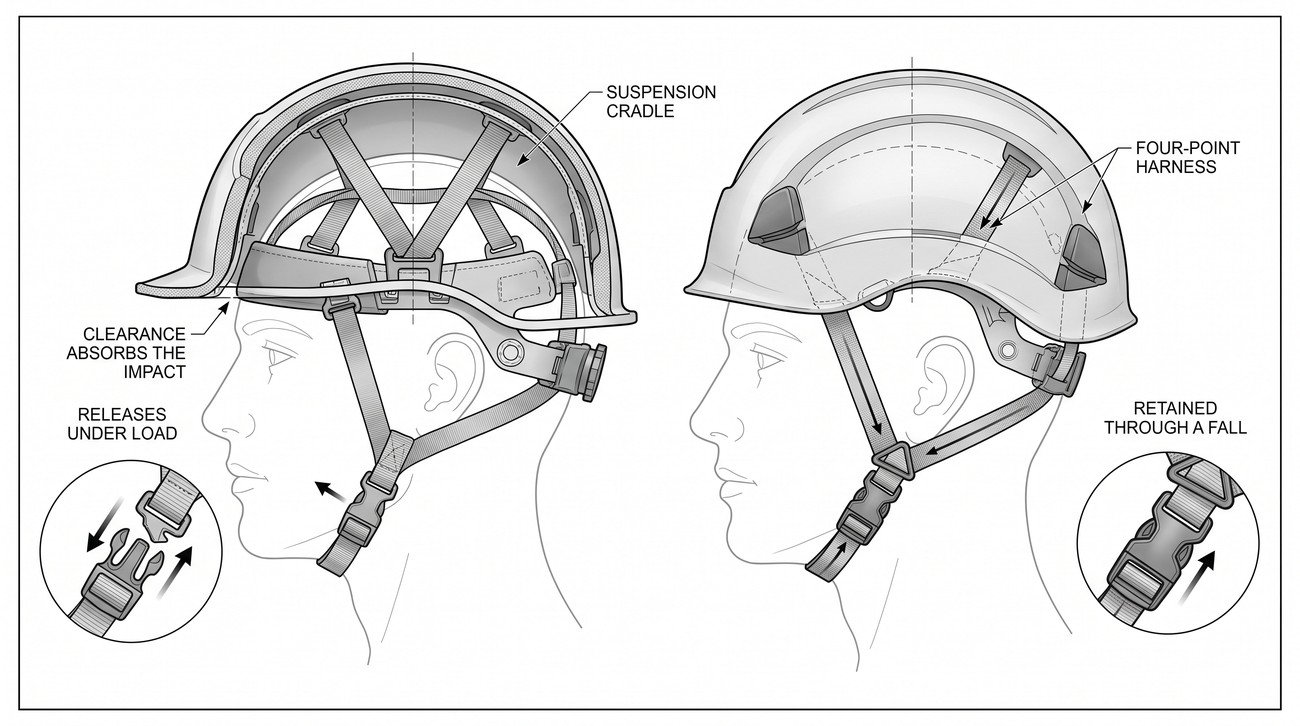
A conventional industrial helmet is designed with a chinstrap that releases under load, so that a helmet snagged on projecting steel does not become a strangulation hazard. That release behaviour is deliberate and correct for a person standing on solid ground under an overhead risk. It is the wrong behaviour for someone who might fall, because the helmet leaves the head at the moment of the fall and the head arrives unprotected. Where a fall is foreseeable, the helmet needs a retention system that holds under load rather than releasing.
The harness inside matters more than the shell
The gap between the shell and the skull is where the energy is absorbed, and that gap is created by the suspension cradle rather than by the shell itself. A cradle adjusted so the shell sits low and hard against the head removes the very space the design depends on, which is why a helmet that has been squashed down for a better fit is measurably worse than one adjusted to sit clear. The same logic explains why a helmet should not be worn over a thick hat or with anything packed inside the cradle.
Optional performance you have to ask for
Several properties are not automatic and are only present if the helmet was specified with them: performance at low or high temperature, resistance to lateral deformation, protection against short-duration electrical contact, and resistance to molten metal splash. None of these are implied by a general marking, and each is recorded separately on the shell. On a site where any of these apply — winter groundworks, deep excavations with confined access, work near live services — the specification has to name them explicitly.
Service life, damage and what quietly disqualifies a shell
Shell material degrades with ultraviolet exposure long before it looks worn, and a helmet left on a dashboard through a summer can be past its useful life while appearing new. Crazing, a chalky surface, a colour that has visibly faded, or any creak when the shell is flexed by hand are all reasons to withdraw it. So is any impact, whether or not damage is visible, because the absorbing structures are designed to deform once. Solvent-based markers, stickers over the crown, and drilled ventilation holes all compromise the shell and are not recoverable.
Where the head risk is a knock against a fixed object rather than a falling one, see bump caps versus safety helmets. For helmet systems combined with hearing and face protection, see choosing a helmet system for grounds work.
Related standards
The standards below set the test methods and performance levels behind the protective equipment used for this work.
- EN 397 — Industrial Safety Helmets
- EN 14052 — High-Performance Industrial Helmets
- EN 812 — Industrial Bump Caps
- EN ISO 13688 — General Requirements for Protective Clothing
Common errors
1Using a helmet with a releasing chinstrap for work where a fall from height is foreseeable.
2Tightening the cradle so the shell sits hard on the skull, removing the clearance that absorbs the impact.
3Assuming lateral deformation, low-temperature or electrical performance is included when it has not been specified.
4Keeping a shell in service after an impact because no damage is visible from the outside.
5Applying solvent markers or covering the crown with stickers.
Frequently asked questions
What does the main EN 397 test actually simulate?
A mass dropped vertically onto the crown of the shell, plus resistance to a pointed object penetrating it. It represents a tool or material falling from a level above, which is the dominant overhead risk on a multi-level site.
Why does an industrial helmet chinstrap release under load?
So that a helmet snagged on projecting steel or reinforcement cannot become a strangulation hazard. It is correct behaviour for someone standing under an overhead risk, and wrong for someone who might fall.
When should a construction helmet be replaced with a retained-harness type?
Whenever a fall from height is foreseeable, because a releasing strap lets the helmet leave the head at the start of the fall, so the head arrives at the impact unprotected.
Why is the suspension cradle adjustment so important?
The gap between the shell and the skull is where impact energy is absorbed. Adjusting the cradle so the shell sits hard against the head removes that clearance and reduces the protection the helmet was tested to give.
What quietly takes a helmet shell out of service?
Ultraviolet degradation showing as crazing, a chalky surface or faded colour, any creak when the shell is flexed, any impact whether or not damage is visible, and contamination from solvent-based markers.
Need this as a document you can issue? The template library gives you the risk assessments, permits and inspection logs in editable form — and employer plans cover a whole team with completion records.