Safety / Tips and Tricks / Chemical Handling
Activity 06 · Chemical Handling
Chemical-Resistant Footwear
Footwear sits in direct, sustained contact with the ground for an entire shift, which makes it uniquely vulnerable to a slow chemical exposure that a brief splash to other body areas would not create — a small amount of the wrong chemical trapped against the foot for hours can cause more harm than a larger, briefly-contacted splash elsewhere.
Why the general safety footwear baseline is not enough alone
EN ISO 20345 sets the general safety footwear baseline for impact, compression and puncture resistance, and this baseline still applies for chemical handling tasks alongside whatever chemical-specific protection is needed, but it does not itself address chemical resistance. Footwear for chemical handling needs both the general safety baseline and a specific chemical resistance rating checked against the actual chemicals in use, not one in place of the other.
Material choice: rubber and PVC versus leather
Seamless rubber or PVC boots are generally the appropriate choice for chemical handling because they resist a broad range of chemicals and, being non-porous, do not absorb chemical contamination the way leather does. Leather footwear absorbs many chemicals into the material itself, and a chemical absorbed into leather remains in prolonged contact with the foot even after the visible splash has been wiped away, which is a fundamentally different and more concerning exposure pattern than a chemical resting briefly on a non-absorbent surface.
Seamless construction and boot height
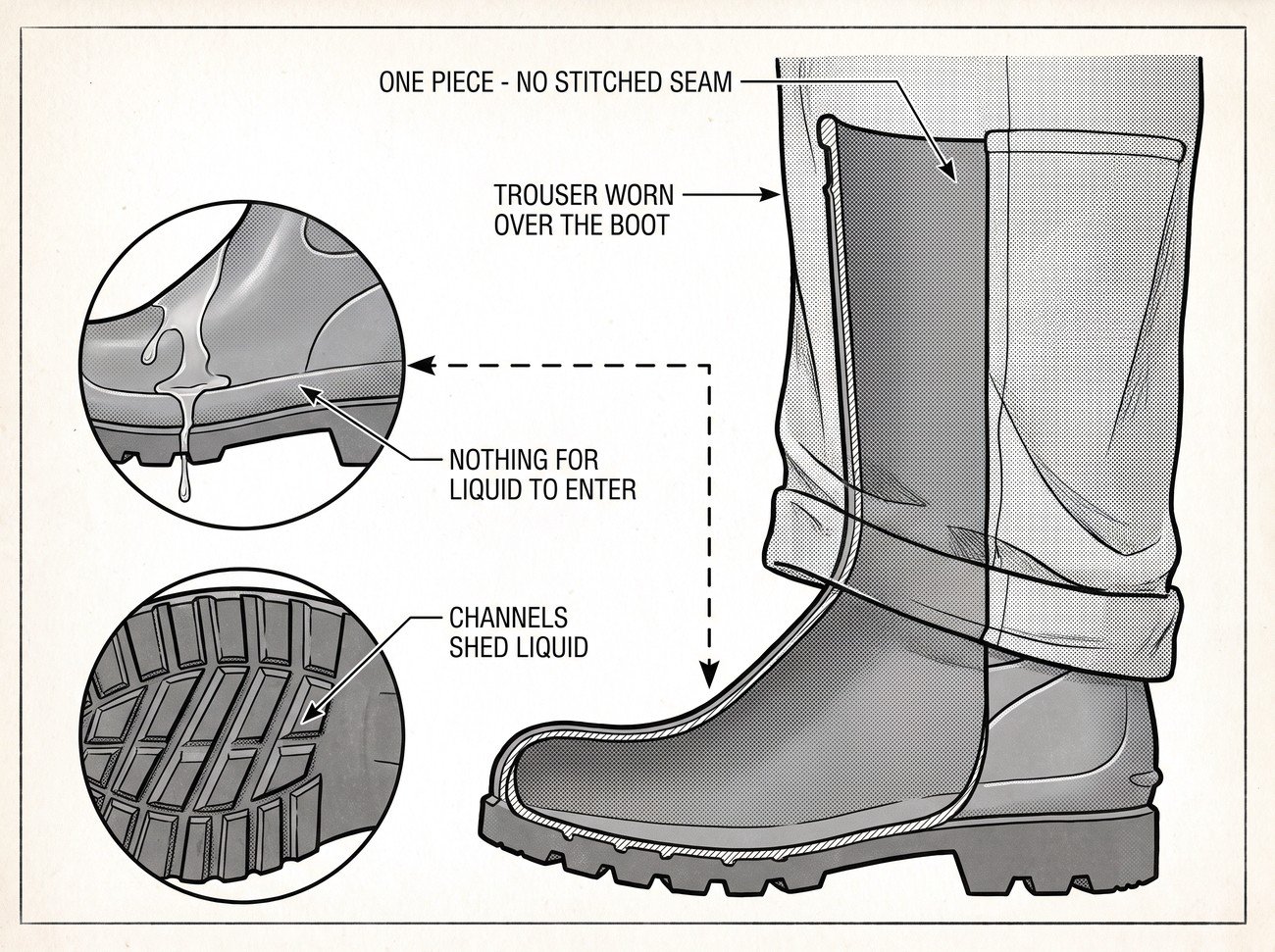
Stitched or glued seams give chemicals a potential entry route that a genuinely seamless, molded boot does not have, so boot construction matters as much as the base material itself for tasks with a real liquid exposure risk. Boot height should match the actual splash or immersion risk of the task — ankle-height boots suit low splash risk, while knee-height boots are appropriate where deeper liquid contact, such as standing in a shallow spill or working over an open tank, is a realistic possibility.
Matching sole and upper material to the specific chemical group
Different chemical families degrade different rubber and polymer compounds at very different rates — a compound that performs well against acids can perform poorly against certain solvents, and vice versa — so material selection should be checked against manufacturer chemical resistance data for the specific chemical group actually in use, the same principle covered for gloves. Assuming any rubber boot resists any chemical because rubber is generally chemical-resistant overlooks this material-specific variation.
Inspection and replacement
Cracking, softening, swelling or discoloration of the boot material are all signs of chemical attack that reduce the boot’s actual protective performance even if no hole is yet visible, and boots showing these signs should be replaced rather than continued in service until a hole actually develops. Rinsing footwear at the end of each task, and inspecting it before the next use, catches degradation before it becomes a failure.
For the gloves and clothing this footwear is worn alongside, see selecting chemical-resistant gloves and chemical protective clothing.
Related standards
The standards below set the test methods and performance levels behind the equipment referenced in this note.
- EN ISO 20345 — Safety footwear
- EN ISO 20346 — Protective footwear
- EN 374 — Chemical resistant gloves
Common errors
1Using leather footwear for tasks with a genuine chemical splash or contact risk.
2Assuming any rubber or PVC boot resists any chemical without checking material-specific resistance data.
3Choosing boot height that does not match the task's actual splash or immersion risk.
4Continuing to use boots showing cracking, softening or swelling because no hole has developed yet.
Frequently asked questions
Does EN ISO 20345 safety footwear provide chemical resistance on its own?
No, it covers the general safety baseline for impact, compression and puncture resistance, but not chemical resistance, so footwear for chemical handling needs both the general baseline and a specific chemical resistance rating.
Why is leather footwear a poor choice for chemical handling?
Leather absorbs many chemicals into the material, keeping the chemical in prolonged contact with the foot even after the visible splash is wiped away, unlike non-porous rubber or PVC.
Why does seamless construction matter for chemical-resistant boots?
Stitched or glued seams give chemicals a potential entry route that a genuinely seamless, molded boot does not have, so construction matters as much as the base material.
Does any rubber boot resist any chemical equally well?
No, different chemical families degrade different rubber and polymer compounds at very different rates, so material selection should be checked against manufacturer resistance data for the specific chemical group in use.
What signs indicate chemical-resistant footwear needs replacing?
Cracking, softening, swelling or discoloration of the boot material, all of which reduce protective performance even before a hole is visible.
Need this as a document you can issue? The template library gives you the risk assessments, permits and inspection logs in editable form — and employer plans cover a whole team with completion records.