Safety / Tips and Tricks / Chemical Handling
Activity 06 · Chemical Handling
Selecting Chemical-Resistant Gloves to EN 374
Not all chemical-resistant gloves resist all chemicals, and the single biggest mistake in glove selection is treating any glove marked as chemical-resistant as interchangeable with any other, when in reality a glove that performs excellently against one chemical family can fail within minutes against another.
Reading the EN 374 pictogram
EN 374 covers protective gloves against dangerous chemicals and micro-organisms, and a glove certified to it carries a beaker-shaped pictogram alongside a set of letter codes, each letter corresponding to a specific test chemical from a standard panel covering different chemical classes such as alcohols, ketones, acids and amines. The letters shown on a specific glove indicate which of those test chemicals it has been proven to resist for a minimum breakthrough time, not that it resists chemicals generally, so the letters actually present matter far more than the presence of the pictogram itself.
Breakthrough time and what the numbers mean
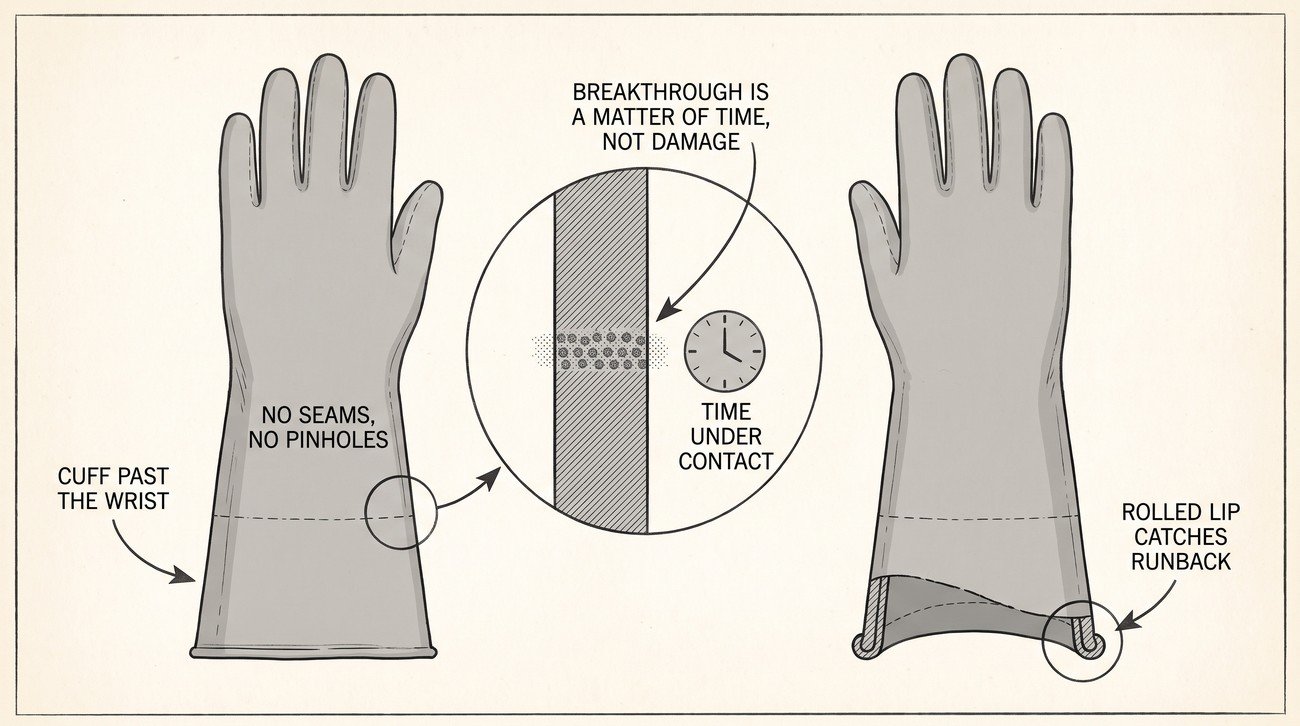
For each test chemical a glove is rated against, EN 374 assigns a breakthrough time class from 1 to 6, corresponding to increasing minimum times before the chemical is detected passing through the glove material at a molecular level, ranging from over ten minutes at class 1 up to over eight hours at class 6. A glove worn for a task lasting longer than its rated breakthrough time for the specific chemical in use is no longer providing reliable protection even though it may show no visible sign of failure, which makes task duration a genuine input into glove selection, not an afterthought.
Type A, B and C classification
Gloves are further classified as Type A, B or C based on how many of the panel chemicals they achieve at least a class 2 breakthrough time against, with Type A requiring the broadest resistance and Type C the narrowest. This classification is a useful starting filter, but it is not a substitute for checking the specific letters relevant to the actual chemical in use, since a Type C glove that happens to perform very well against the one chemical actually being handled can be a better choice than a Type A glove with only marginal performance against that same chemical.
Matching glove material to the actual chemical
Different glove polymers — nitrile, neoprene, butyl rubber, PVC and others — have very different resistance profiles against different chemical classes, and a material that performs superbly against one class of solvent can degrade or allow rapid permeation against another. Manufacturer chemical resistance charts, cross-referenced against the safety data sheet for the specific product in use, are the right source for this decision, not a general assumption that any thick or robust-looking glove will perform adequately against any chemical.
Fit, thickness and dexterity trade-offs
Thicker gloves generally extend breakthrough time but reduce tactile sensitivity and grip, which matters directly for tasks involving fine manipulation, valve operation, or handling of small containers where reduced dexterity itself becomes a safety issue through dropped items or fumbled connections. Selecting the thinnest glove that still meets the required breakthrough time for the task duration, rather than defaulting to the thickest available option, balances both risks rather than trading one for the other.
For choosing gloves when more than one chemical is involved, see permeation versus degradation. For the clothing worn alongside these gloves, see chemical protective clothing.
Related standards
The standards below set the test methods and performance levels behind the equipment referenced in this note.
- EN 374 — Chemical resistant gloves
- EN 388 — Gloves against mechanical risks
- EN ISO 13688 — General requirements for protective clothing
Common errors
1Assuming any glove with the EN 374 beaker pictogram resists the specific chemical in use without checking the letter codes.
2Continuing to wear a glove beyond its rated breakthrough time for the chemical and task duration in use.
3Choosing a glove based on Type A, B or C classification alone without checking performance against the specific chemical actually handled.
4Defaulting to the thickest available glove regardless of the dexterity the task actually requires.
Frequently asked questions
What do the letter codes on an EN 374 glove actually mean?
Each letter corresponds to a specific test chemical from a standard panel, and the letters present on a glove show which of those chemicals it has been proven to resist for a minimum breakthrough time, not that it resists chemicals generally.
What happens if a glove is worn beyond its rated breakthrough time?
It is no longer providing reliable protection even though it may show no visible sign of failure, because breakthrough happens at a molecular level before any visible degradation occurs.
What is the difference between Type A, B and C glove classification?
It reflects how many of the panel chemicals a glove achieves at least a class 2 breakthrough time against, with Type A the broadest and Type C the narrowest, but it should not replace checking performance against the specific chemical in use.
Why can a thinner glove sometimes be the safer choice?
Because reduced dexterity from an overly thick glove can itself cause safety issues through dropped items or fumbled connections, so the thinnest glove that still meets the required breakthrough time for the task balances both risks.
Where should glove material selection be based, beyond the EN 374 pictogram?
On manufacturer chemical resistance charts cross-referenced against the safety data sheet for the specific product in use, since different glove polymers have very different resistance profiles across chemical classes.
Need this as a document you can issue? The template library gives you the risk assessments, permits and inspection logs in editable form — and employer plans cover a whole team with completion records.