Safety / Tips and Tricks / Construction and demolition
Activity 09 · Construction
Eye Protection on a Construction Site: Impact Grades Under EN 166
Eye protection is the one item of site equipment where the difference between adequate and inadequate is decided in about a millisecond, and where the marking on the lens and the marking on the frame have to agree before the protection means anything.
The impact grades, in order
Impact performance is graded by the speed of a small steel ball fired at the lens. The lowest grade covers general low-energy impact and is appropriate for handling and general site presence. The next grade up covers medium energy and is the realistic minimum wherever a powered tool throws material. The highest grade covers high energy and is what cut-off saws, grinders, nail guns and cartridge tools call for. Each grade is a genuine step, not a marketing tier, and a lens rated for one grade offers no tested performance at the grade above it.
Frame and lens are rated separately
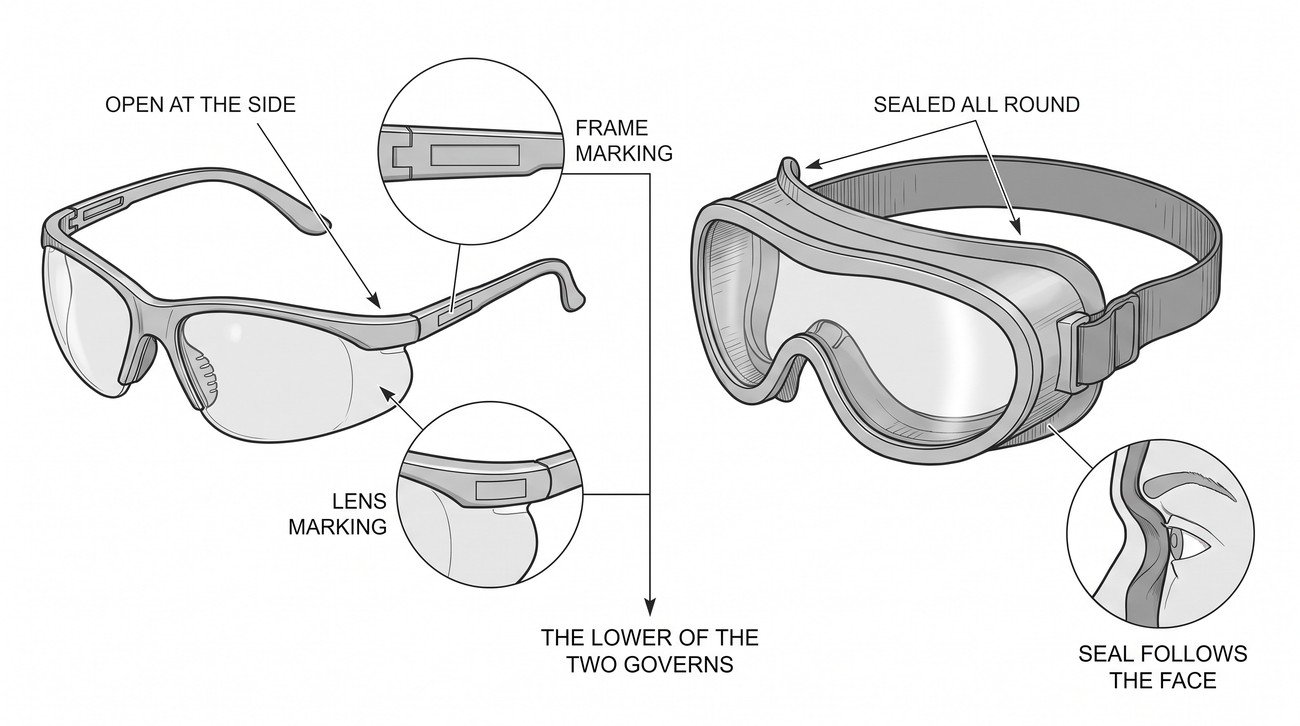
This is the failure that catches people out. A lens can carry a high impact grade while the frame holding it is rated lower, and in that combination the assembly performs to the lower of the two. For the assembly to be relied on at a given grade, the same grade has to appear on both the lens and the frame. Where the marking appears on only one component, the safe assumption is that the assembly is not rated at that grade.
Spectacles, goggles and the gap at the temple
Open-sided spectacles protect against material arriving from the front and do very little about material arriving from the side or from below — which is the usual direction when a disc throws debris off a floor slab or when overhead drilling drops dust. Side shields close part of that gap. A sealed goggle closes it completely and is the correct choice for overhead work, for dusty demolition, and for anything involving a rotating abrasive wheel. The added discomfort is real, and it is the reason goggles are so often found pushed up on a helmet.
Fogging is a safety problem, not a comfort problem
A fogged lens gets lifted, and a lifted lens protects nothing. Anti-fog coatings, indirect ventilation, and matching the eyewear to the physical effort of the task all address this directly, and are worth more in practice than a higher impact grade that ends up on the worker’s forehead. Where a task is hot and heavy and the eye risk is high, ventilated goggles usually outperform sealed ones because they stay on.
Scratches, coatings and when to bin a lens
A scratched lens scatters light, which both reduces vision and creates glare that encourages removal. It also loses impact performance, because the scratch is a stress concentration. Cleaning a dusty lens dry, with a sleeve or a rag, is the fastest way to produce those scratches: the dust itself is the abrasive. Lenses should be rinsed before wiping, and any lens with visible scratching across the field of view should be replaced rather than tolerated.
For eye protection against liquid rather than impact, see eye and face protection for chemical splash. For radiation as well as impact, see eye and face protection near welding.
Related standards
The standards below set the test methods and performance levels behind the protective equipment used for this work.
Common errors
1Assuming a high-grade lens gives high-grade protection in a lower-rated frame.
2Using open-sided spectacles for overhead drilling or grinding, where debris arrives from below and the side.
3Choosing a higher impact grade over a lens that will actually stay on the face.
4Wiping a dusty lens dry, which grinds the dust into the coating.
5Keeping scratched lenses in service, losing both vision and impact performance.
Frequently asked questions
What do the EN 166 impact grades represent?
The speed of a small steel ball fired at the lens: a low-energy grade for general site presence, a medium-energy grade wherever a powered tool throws material, and a high-energy grade for cut-off saws, grinders and cartridge tools.
Why do the frame and lens markings both matter?
They are rated separately, and the assembly performs to the lower of the two. A high-grade lens fitted in a lower-rated frame gives only the frame's performance.
When are spectacles not enough?
Whenever debris can arrive from the side or from below, which is the usual direction for overhead drilling and for a disc throwing material off a slab. Sealed or indirectly ventilated goggles close that gap.
Why does fogging matter as much as impact grade?
A fogged lens gets pushed up onto the helmet, and eyewear on the forehead protects nothing. Eyewear that stays on the face outperforms a higher grade that does not.
Why should a scratched lens be replaced?
Scratches scatter light, causing glare that encourages removal, and act as stress concentrations that reduce the lens impact performance below its marked grade.
Need this as a document you can issue? The template library gives you the risk assessments, permits and inspection logs in editable form — and employer plans cover a whole team with completion records.