Safety / Tips and Tricks / Welding and hot work
Activity 05 · Welding
Eye and Face Protection for Bystanders and Helpers Near Welding
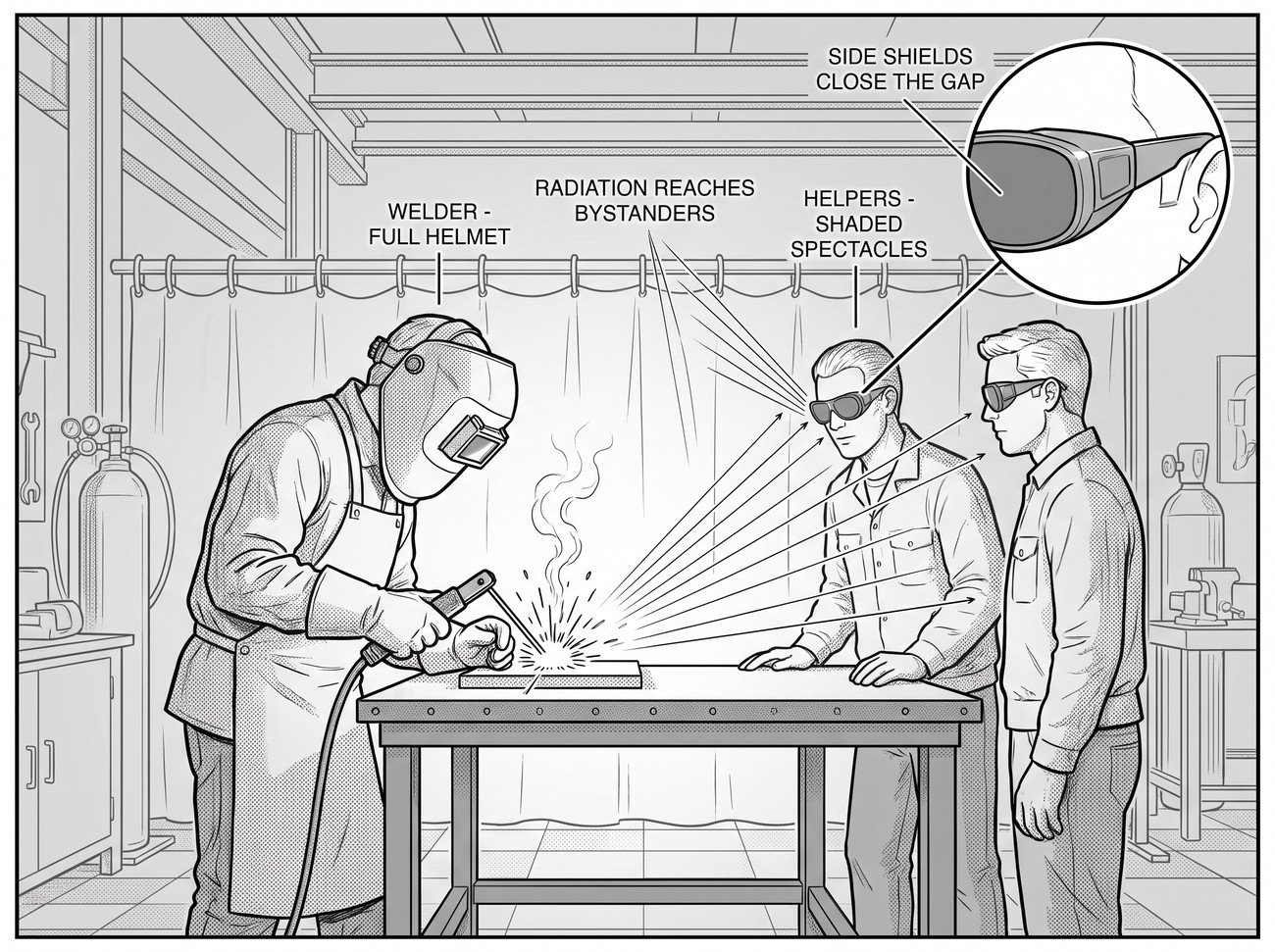
The welder wearing a filtered helmet is not the only person exposed to arc radiation on a welding task — anyone working nearby, helping position material, or simply passing through the area receives UV and IR exposure too, without the filtered protection the welder is using.
Why indirect exposure still causes injury
Arc eye (photokeratitis) results from UV exposure to the cornea and does not require looking directly at the arc — reflected and scattered UV from surrounding surfaces, and direct line-of-sight exposure to an unshielded arc from several meters away, are both sufficient to cause it, typically with symptoms delayed several hours after exposure. This delay is part of why bystander exposure is easy to underestimate at the time: the discomfort that would prompt someone to move away or shield their eyes has not yet appeared when the actual exposure is happening.
What standard safety eyewear does and does not provide
General safety glasses meeting EN 166 protect against mechanical hazards such as flying particles but are not, by default, rated for the UV and IR filtering a welding arc requires — shaded or specifically UV/IR-filtering lenses, rated for arc exposure rather than only impact resistance, are what actually protects bystanders’ eyes from arc radiation. Checking that eyewear provided for people working near welding carries the appropriate shade or filter rating, not just an EN 166 impact mark, is the detail that is easy to miss.
Screens as the primary control
Physical screens or curtains positioned around the welding area, blocking line-of-sight to the arc from adjacent work areas and walkways, remove the exposure for anyone outside the screened zone entirely, which is a more reliable control than relying on every bystander to correctly select and consistently wear shaded eyewear. Screens and shaded eyewear work together rather than as alternatives — anyone who does need to be inside the screened area, such as a helper positioning material, still needs appropriately rated eye protection of their own.
Distance and duration
Exposure risk scales with both proximity to the arc and cumulative time in view of it, so a person briefly passing at a distance faces a different level of risk than a helper standing close to the weld for an extended period, and protection decisions should reflect that actual exposure pattern rather than a single blanket rule applied regardless of position or duration. Areas with sustained welding activity and regular foot traffic nearby are where this distinction matters most in practice.
For screening the welding area itself, see welding screens and curtains. For the welder’s own helmet and filter, see welding helmets and auto-darkening filters.
Related standards
The standards below set the test methods and performance levels behind the equipment referenced in this note.
Common errors
1Assuming bystanders are not at risk because they are not looking directly at the arc.
2Providing standard EN 166 safety glasses without a specific UV/IR shade rating to people working near welding.
3Relying on individual bystander eyewear instead of screening off the welding area where practical.
4Treating brief, distant exposure and sustained, close exposure as the same level of risk.
Frequently asked questions
Can someone develop arc eye without looking directly at the arc?
Yes, reflected and scattered UV from surrounding surfaces, or direct line-of-sight exposure from several meters away, are both sufficient to cause photokeratitis, and symptoms are typically delayed several hours after exposure.
Do standard EN 166 safety glasses protect against arc radiation?
Not by default — they protect against mechanical hazards like flying particles but are not automatically rated for the UV and IR filtering a welding arc requires, so a specific shade or filter rating is needed.
Why are physical screens considered the primary control for bystander eye protection?
They block line-of-sight to the arc for anyone outside the screened zone entirely, which is more reliable than depending on every bystander to correctly select and consistently wear shaded eyewear.
Do helpers working inside a screened welding area still need eye protection?
Yes, screens and shaded eyewear work together rather than as alternatives, and anyone inside the screened zone still needs appropriately rated eye protection of their own.
Why does exposure distance and duration matter for bystander protection decisions?
Risk scales with proximity and cumulative time in view of the arc, so a person briefly passing at a distance faces a different level of risk than a helper standing close to the weld for an extended period.
Need this as a document you can issue? The template library gives you the risk assessments, permits and inspection logs in editable form — and employer plans cover a whole team with completion records.