Safety / Tips and Tricks / Welding and hot work
Activity 05 · Welding
Hot Work Permits and Fire Watch
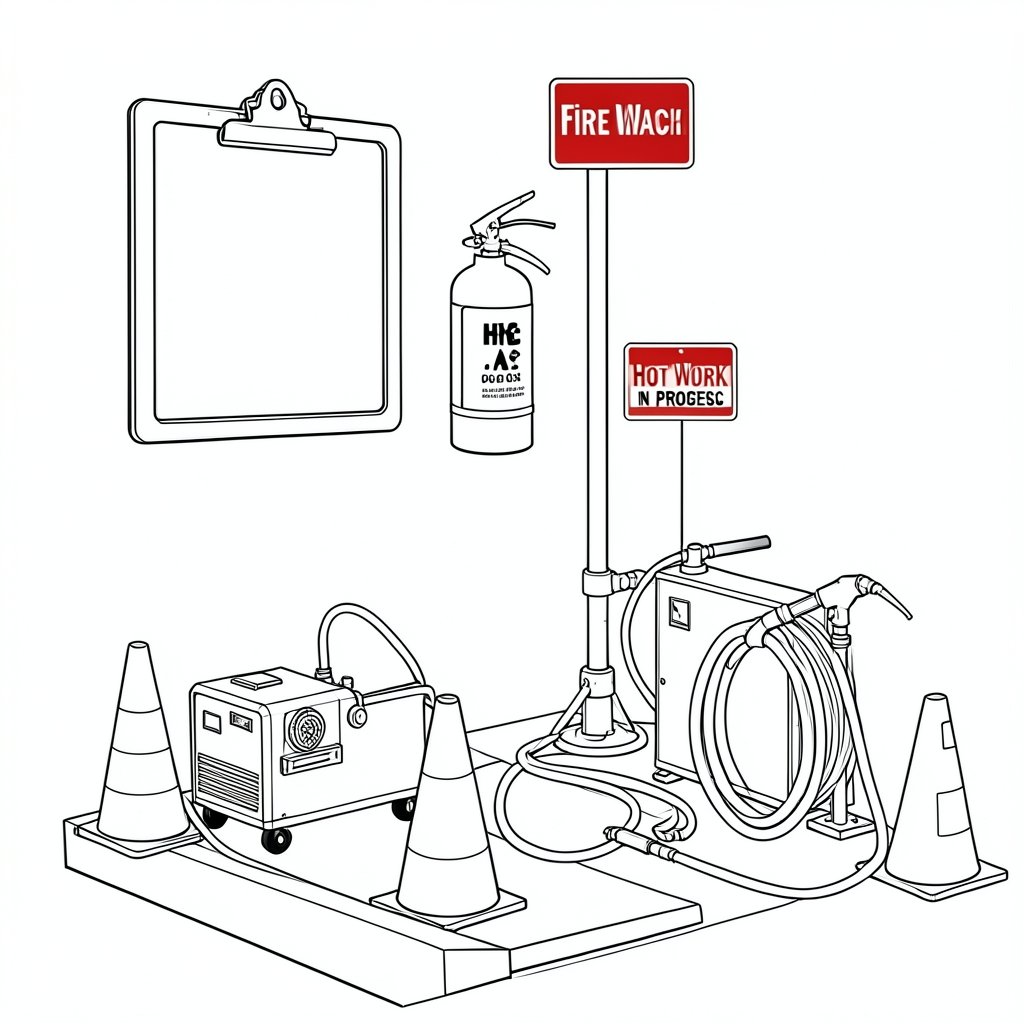
A hot work permit exists because welding, cutting and grinding introduce an ignition source into an area that was not designed around one, and the permit process is what forces a deliberate check of that area before the ignition source arrives, rather than relying on the operator's judgment alone in the moment.
What the permit process actually checks
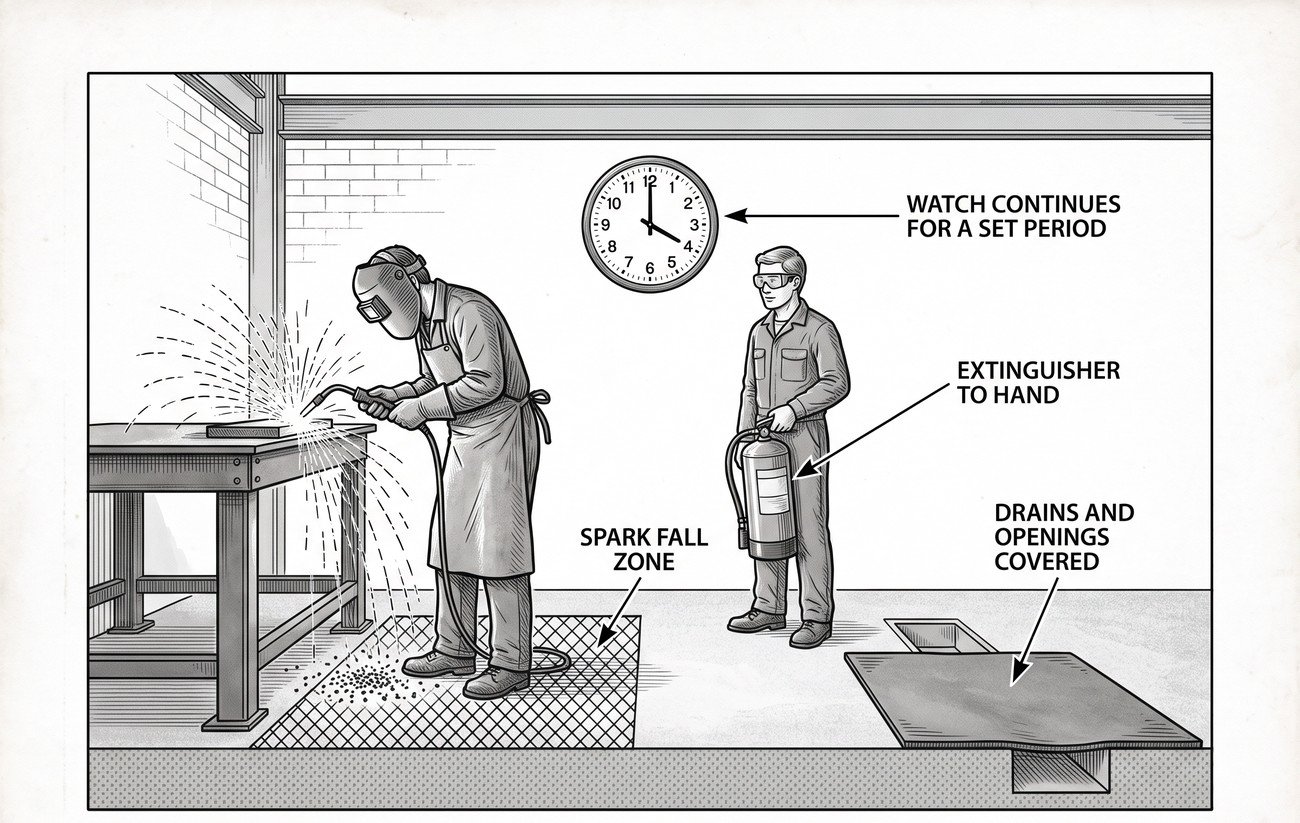
A properly completed hot work permit confirms the immediate area has been cleared of combustible material or that combustibles have been adequately shielded, that floor openings, drains and gaps to adjacent spaces have been covered or sealed against falling sparks, and that any process equipment, piping or tanks in the area have been checked for flammable residue or isolated where relevant. The permit is a record that this checking actually happened, not paperwork completed after the fact to document work that was already going ahead.
The hidden-combustible problem
Sparks and hot slag travel further than they appear to, and can pass through small gaps, along cable trays, or through wall penetrations into spaces that are not visible from the work location itself — a fire starting on the far side of a wall from where welding is taking place is a well-documented failure pattern precisely because that space was not checked as part of the visible work area. Permit checks that only cover the immediate visible surroundings miss this risk; checking adjoining spaces on the other side of walls, floors and ceilings the work is near is part of a genuinely complete assessment.
Fire watch during and after work
A dedicated fire watch, someone whose task is solely to monitor for ignition and not to assist with the welding itself, should be present for the duration of hot work in any area with residual fire risk, equipped with an appropriate fire extinguisher and the means to raise an alarm. This watch needs to continue for a defined period after the work itself stops — smoldering ignition in insulation, dust, or other slow-burning material can take considerably longer than the visible work to develop into an active fire, and stopping the watch the moment the torch is switched off misses exactly the failure mode fire watch exists to catch.
Time limits and re-authorization
Permits are typically valid for a defined period or shift, not indefinitely, because area conditions can change — new combustible material brought in, a ventilation system taken offline, adjacent work starting — in ways that invalidate the original assessment. Treating an expired permit as requiring genuine re-assessment, not just a signature renewal, keeps the process meaningful rather than becoming a formality.
For the gas cylinder handling that is often part of the same hot work setup, see gas cylinder handling and storage.
Related standards
The standards below set the test methods and performance levels behind the equipment referenced in this note.
- EN ISO 11612 — Heat and flame protective clothing
- EN 407 — Thermal risk gloves
- EN 175 — Eye and face protection for welding
Common errors
1Completing permit paperwork after hot work has already started rather than as a genuine pre-work check.
2Checking only the immediate visible work area and missing adjoining spaces sparks could reach through gaps or penetrations.
3Ending fire watch the moment the welding or cutting itself stops, rather than continuing for the required period afterward.
4Treating permit renewal as a signature formality rather than a genuine re-assessment of current area conditions.
Frequently asked questions
What does a hot work permit actually verify?
That the immediate area has been cleared of or shielded from combustible material, that floor openings and gaps to adjacent spaces have been covered, and that nearby equipment has been checked for flammable residue or isolated where relevant — before the work starts, not after.
Why do sparks sometimes start fires in spaces that were not being welded in?
Sparks and hot slag can travel through small gaps, cable trays, or wall penetrations into adjoining spaces that are not visible from the work location, so permit checks need to cover those adjoining spaces, not just the visible work area.
Why does fire watch need to continue after the welding itself stops?
Smoldering ignition in insulation, dust or other slow-burning material can take considerably longer than the visible work to develop into an active fire, so stopping the watch immediately misses the failure mode it exists to catch.
Why are hot work permits only valid for a limited time?
Area conditions can change during that period — new combustible material, a ventilation system going offline, adjacent work starting — in ways that invalidate the original assessment, so permits need genuine re-assessment rather than indefinite validity.
What is the role of a dedicated fire watch during hot work?
To monitor solely for ignition, not to assist with the welding itself, equipped with an appropriate fire extinguisher and the means to raise an alarm if a fire starts.
Need this as a document you can issue? The template library gives you the risk assessments, permits and inspection logs in editable form — and employer plans cover a whole team with completion records.