Safety / Tips and Tricks / Welding and hot work
Activity 05 · Welding
Gas Cylinder Handling and Storage for Welding and Cutting
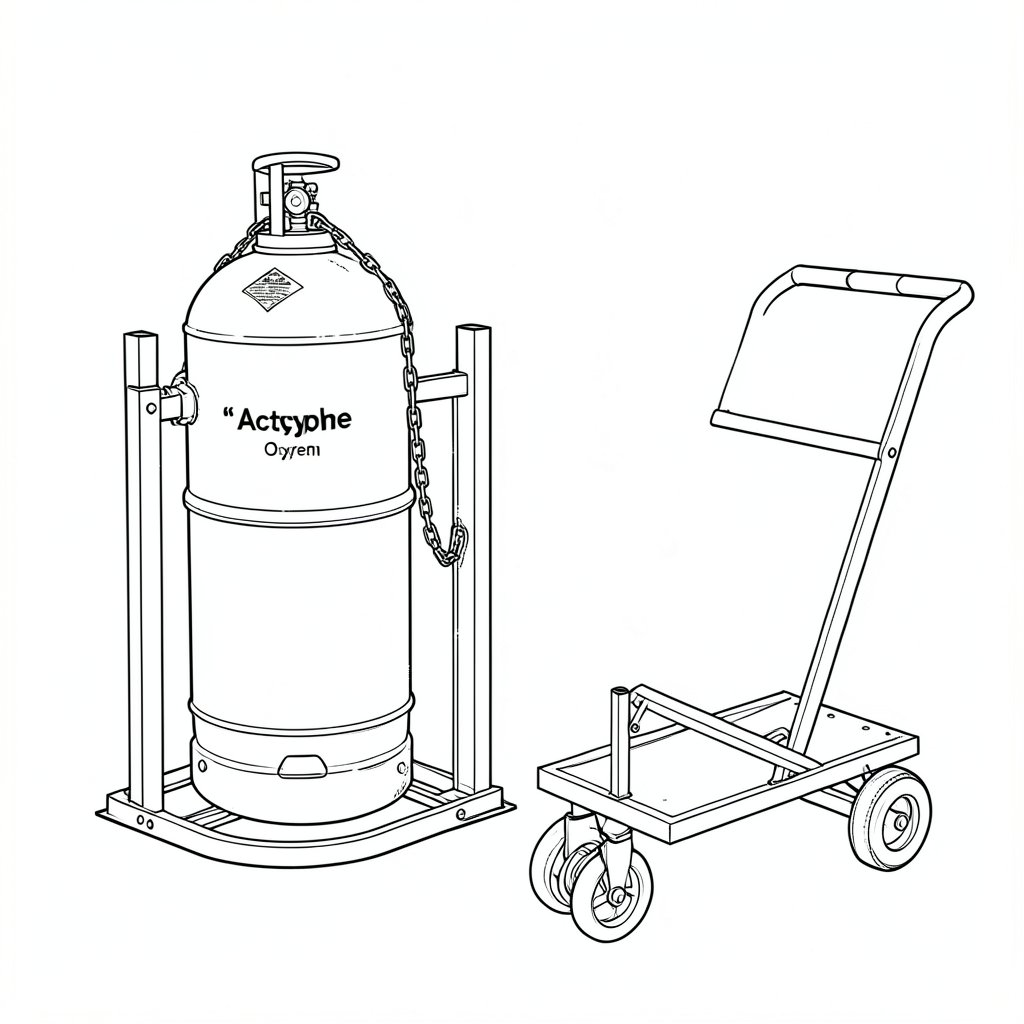
A gas cylinder under pressure is a stored-energy hazard independent of whatever gas it contains, and the handling and storage rules around welding and cutting gas cylinders exist to control that stored energy as much as the flammability or reactivity of the gas itself.
Why securing cylinders upright matters
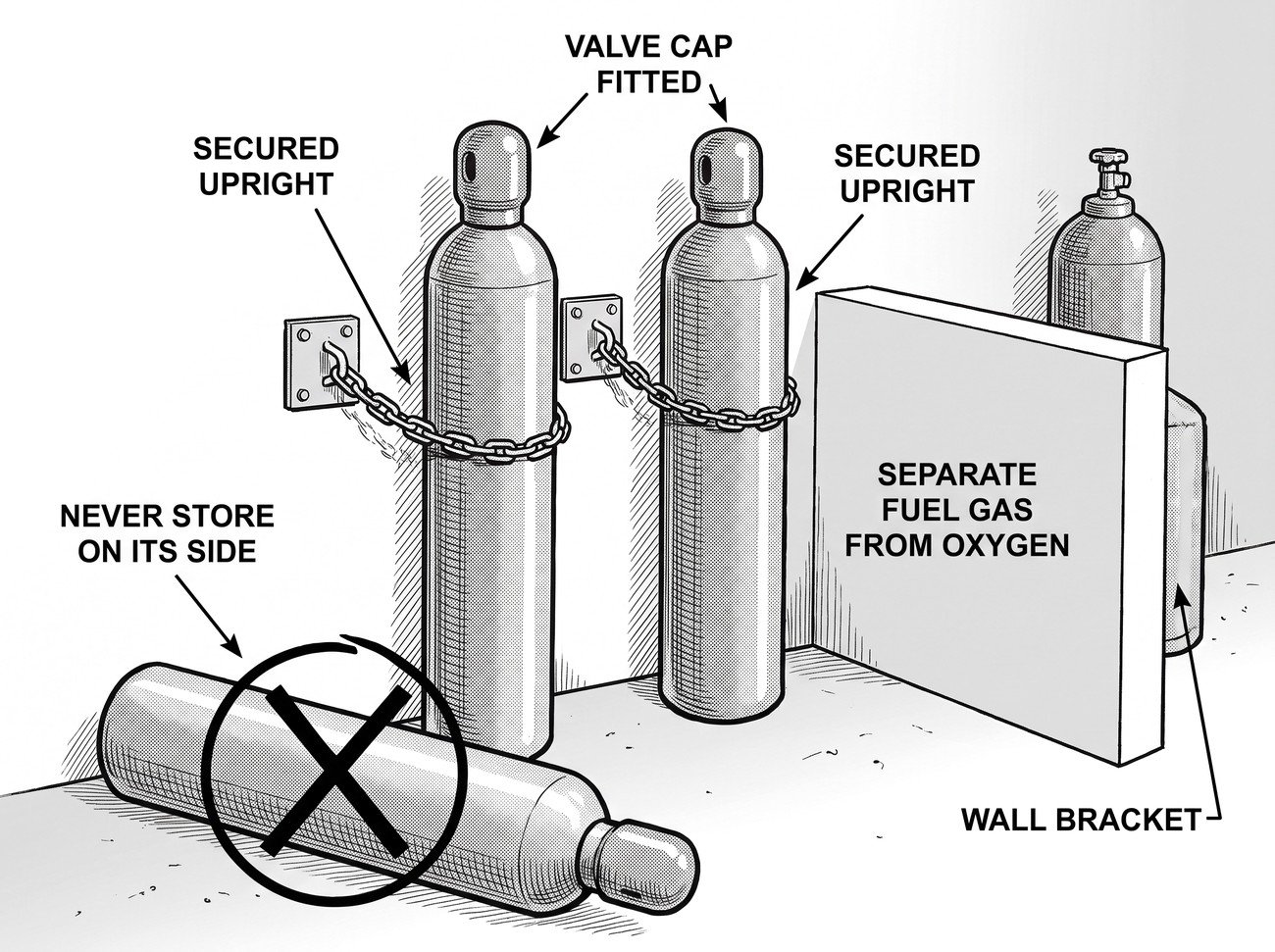
A cylinder that falls and shears its valve, whether from being left unsecured, knocked over, or transported loose, can become a projectile driven by the full pressure of the gas escaping through the damaged valve opening — a failure mode that has caused serious injury and structural damage. Cylinders should be secured upright with a chain or strap at all times they are in use or storage, not only when convenient, and this applies equally to full and apparently empty cylinders, since an “empty” cylinder can still retain significant residual pressure.
Separating fuel gas from oxygen in storage
Fuel gas cylinders (such as acetylene) and oxygen cylinders should be stored separated by distance or a fire-rated barrier, because oxygen dramatically accelerates combustion and a leak from either cylinder type in close proximity to the other significantly increases fire severity if ignition occurs. This separation applies to storage areas specifically; cylinders in active use on a trolley together are managed through other controls such as flashback arrestors, but storage separation remains a distinct requirement.
Protective caps and connection points
The valve protection cap fitted to a cylinder when it is not connected for use protects the valve itself from impact damage that could otherwise cause exactly the kind of sudden pressure release securing the cylinder upright is meant to prevent, and caps should be fitted for any cylinder movement, storage or transport where it is not actively connected to a regulator. Oil, grease, or petroleum-based lubricants should never contact oxygen cylinder valves or fittings, since oxygen can react violently with these contaminants in a way that is not intuitive from how they behave with ordinary compressed air.
Leak checking
Suspected leaks should be checked using a soap-and-water solution applied to fittings and connections, watching for bubbles, never with an open flame, which is an outdated and dangerous practice given the flammability of the gases involved. A confirmed or suspected leak on a cylinder in use should be treated as a reason to stop work and isolate the cylinder, not something to continue working around while monitoring.
Transport and positioning during use
Cylinders should be transported on an appropriate trolley rather than dragged, rolled, or carried in a way that risks impact to the valve, and positioned during use where they will not be exposed to falling spatter, direct heat from the work, or physical impact from other site activity. Regulators, hoses and torches should be matched to the specific gas in use, since fittings for different gases are deliberately non-interchangeable as a safeguard against connecting the wrong gas to the wrong equipment.
For the broader hot work permit process this equipment is typically used under, see hot work permits and fire watch. For the specific hazards of oxy-fuel cutting, see oxy-fuel cutting hazards.
Related standards
The standards below set the test methods and performance levels behind the equipment referenced in this note.
Common errors
1Leaving cylinders unsecured or lying on their side during use or short-term storage.
2Storing fuel gas and oxygen cylinders together without adequate separation.
3Allowing oil or grease to contact oxygen cylinder valves or fittings.
4Checking for gas leaks with an open flame instead of a soap-and-water solution.
Frequently asked questions
Why is a fallen or unsecured gas cylinder considered so dangerous?
If it falls and shears its valve, the full pressure of the escaping gas can drive it as a projectile, a failure mode that has caused serious injury and structural damage, which is why cylinders must be secured upright at all times.
Does an apparently empty cylinder still need to be secured and capped?
Yes, an "empty" cylinder can still retain significant residual pressure, so it should be handled with the same precautions as a full one.
Why are fuel gas and oxygen cylinders stored separately?
Oxygen dramatically accelerates combustion, so a leak from either cylinder type in close proximity to the other significantly increases fire severity if ignition occurs.
Why should oil or grease never contact oxygen cylinder fittings?
Oxygen can react violently with petroleum-based contaminants in a way that does not happen with ordinary compressed air, making this a distinct and serious hazard specific to oxygen service.
What is the correct way to check a gas fitting for a leak?
Using a soap-and-water solution applied to the fitting and watching for bubbles, never an open flame, which is an outdated and dangerous method given the flammability of the gases involved.
Need this as a document you can issue? The template library gives you the risk assessments, permits and inspection logs in editable form — and employer plans cover a whole team with completion records.