Safety / Tips and Tricks / Welding and hot work
Activity 05 · Welding
Welding Helmets and Auto-Darkening Filters: EN 175 and EN 169
A welding helmet does two separate jobs at once: it shields the face from spatter and radiant heat, and its filter lens controls exactly how much of the arc's visible, ultraviolet and infrared light reaches the eyes. Getting either one wrong has consequences that range from a missed weld to permanent eye damage.
The two-standard system
EN 175 covers the helmet itself as a piece of personal protective equipment, testing the shell and the way the filter is mounted and retained. EN 169 covers the filter lens separately, rating it by shade number for the specific welding process and current the lens is designed to be used at. A helmet can be correctly EN 175 certified and still be unsafe in use if the shade fitted to it does not match the process, so the two markings need to be checked together, not assumed to cover each other.
Choosing the right shade number
Shade number requirements scale with the welding process and the current in use — light-duty TIG work at low amperage needs a much lower shade than heavy-duty stick welding or gouging at high current. Using a shade that is too light lets through enough UV and IR radiation to cause arc eye even if the visible glare feels tolerable at the time, since the damage mechanism is not the same as ordinary glare discomfort. Manufacturer shade-selection charts, keyed to process and amperage range, should be checked rather than guessed at when moving between different welding tasks.
Auto-darkening filters
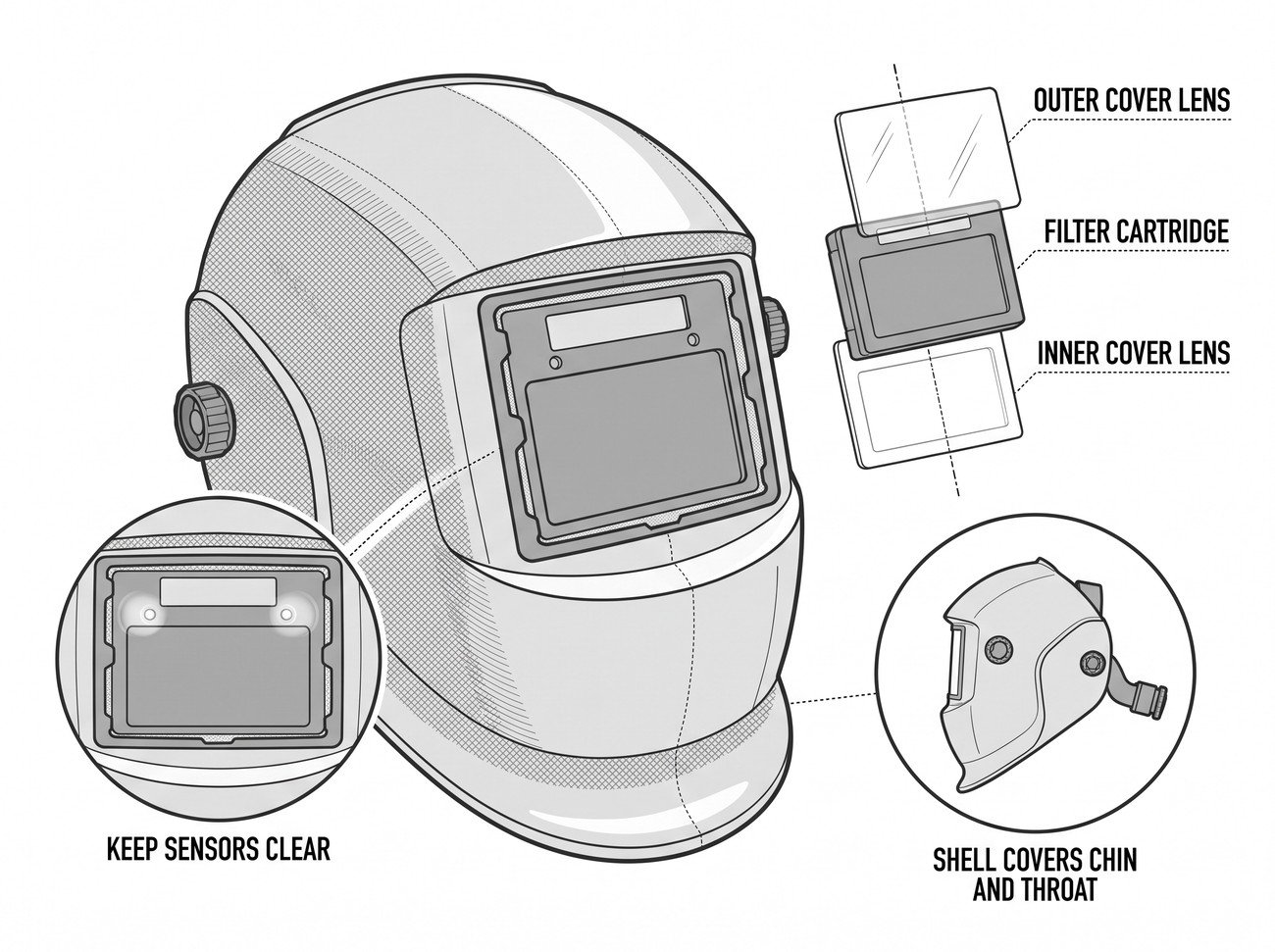
Auto-darkening filters (ADF) switch from a light state to the working shade within a fraction of a second of arc ignition, sensed by photodiodes in the lens, and allow the welder to keep the helmet down between strikes rather than flipping it up and down manually. The sensors and their field of view matter in practice — a sensor blocked by an awkward working angle or a poorly positioned second welder’s arc can delay switching, so sensor placement and the helmet’s fit for the actual working position both affect real protection, not just the filter’s rated switching speed.
Battery, solar backup and failure modes
Most auto-darkening filters combine solar cell power with a replaceable battery, and a filter running low on power can fail to switch or switch late, which is functionally the same failure as wearing the wrong shade at the moment of arc strike. Checking the filter’s charge indicator and carrying a spare battery for the model in use avoids being caught with a filter that will not reliably darken. A helmet that lifts to a light state should always be treated as a genuine fault requiring the filter to be tested or replaced, not something to work around by looking away at the moment of strike.
Grinding mode and passive protection behind the lens
Many ADF helmets include a grinding mode that disables the auto-darkening function for tasks like grinding welds or removing slag, and leaving a helmet in grinding mode and then striking an arc exposes the eyes to full arc radiation with no filtering at all. Confirming the helmet’s mode before starting to weld, every time it has been used for grinding, is a simple check that prevents a serious and entirely avoidable exposure.
For the gloves and flame-resistant clothing worn alongside this helmet, see selecting welding gloves and flame-resistant welding clothing.
Related standards
The standards below set the test methods and performance levels behind the equipment referenced in this note.
Common errors
1Using a filter shade that does not match the welding process and current in use.
2Continuing to weld with a low-battery auto-darkening filter that switches late or unreliably.
3Striking an arc with the helmet left in grinding mode from a previous task.
4Assuming an EN 175 helmet marking guarantees the fitted filter's shade is appropriate for the task.
Frequently asked questions
Why are the helmet and the filter lens certified to two different standards?
EN 175 tests the helmet shell and how it retains the filter, while EN 169 tests the filter lens itself for the shade number and radiation protection it provides for a specific welding process and current.
What happens if the filter shade is too light for the process?
It lets through enough UV and IR radiation to cause arc eye even if the visible glare feels tolerable, because the damage mechanism is separate from ordinary visible-light glare.
How can a low battery affect an auto-darkening filter's safety?
A filter running low on power can fail to switch or switch late, which exposes the eyes to unfiltered arc radiation at the moment of strike, the same practical failure as wearing the wrong shade.
What is grinding mode and why does it matter for safety?
It disables the auto-darkening function for grinding tasks; if a helmet is left in grinding mode and an arc is then struck, the eyes receive no filtering from the lens at all.
Should a helmet that lifts to a light state during welding be worked around?
No, it should be treated as a genuine fault and the filter tested or replaced, not compensated for by looking away at the moment of arc strike.
Need this as a document you can issue? The template library gives you the risk assessments, permits and inspection logs in editable form — and employer plans cover a whole team with completion records.