Safety / Tips and Tricks / Construction and demolition
Activity 09 · Construction
Asbestos: Recognising It and Stopping Before You Disturb It
Asbestos does not announce itself. It is inside materials that look entirely ordinary, it causes no immediate symptom when disturbed, and the harm appears decades later — which is precisely why the decision has to be made before the first cut rather than after it.
Where it is, and why age is the first question
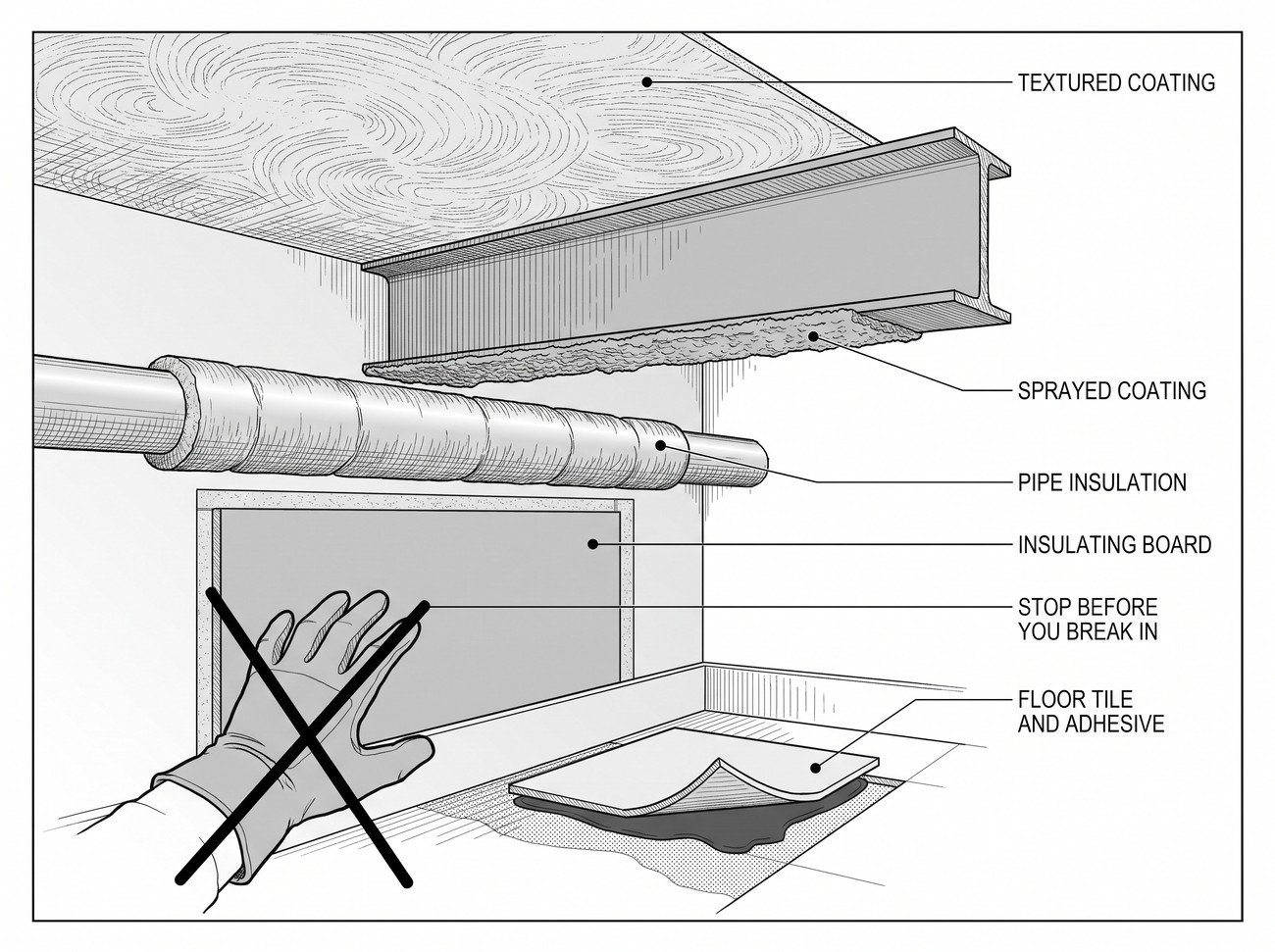
Asbestos was used across an enormous range of building products, and the single most useful indicator is the age of the building or the age of the alteration you are working on. Insulation to pipework and boilers, sprayed coatings to structural steel, insulating board used for panels, ceiling tiles and soffits, textured decorative coatings, cement sheets for roofing and cladding, floor tiles and their bitumen adhesive, rope seals and gaskets, and the backing of some vinyl floor coverings all appear routinely. Refurbishment work is higher risk than new build for exactly this reason.
You cannot identify it by looking
There is no reliable visual test. Asbestos insulating board and non-asbestos board of the same era look alike; cement sheet containing asbestos looks like cement sheet that does not. The correct response to a suspect material is not a closer look or a small sample taken by hand, but to stop work and have it identified properly. The temptation to make a judgement is strongest exactly where it is least reliable, on a material that is familiar and probably fine.
What makes a material dangerous is disturbance
Asbestos in good condition and left alone releases very little. The fibres become airborne when the material is broken, drilled, cut, sanded, swept or demolished, and power tools are far worse than hand tools because they turn the material into fine dust and project it. This is why the practical rule on site is about actions rather than substances: if you are about to break into a material you have not had identified, in a building old enough to contain asbestos, that is the moment to stop.
Finding a register before you find the material
Buildings in commercial use are generally required to have an asbestos register recording what is known to be present and where. Reading it before the work starts is faster than any survey and is the single most effective step available. What the register does not cover matters as much as what it does: a register based on a management survey will not have looked inside structures, so opening up a floor, a ceiling void or a duct can reach material the survey never saw. A register saying nothing is present in a location is not the same as a survey having looked there.
If you think you have disturbed it
Stop immediately and do not try to clean up. Sweeping or vacuuming with ordinary equipment spreads the fibres and makes the situation considerably worse. Leave the area, prevent others entering, keep the clothing you were wearing in the area rather than walking it through the site, and report it so the response can be planned properly. The instinct to tidy the evidence away is the most damaging possible reaction.
Where work is planned rather than accidental, it is documented on the asbestos plan of work. For the respiratory principles that apply to any fine airborne fraction, see respiratory protection for construction dust.
Related standards
The standards below set the test methods and performance levels behind the protective equipment used for this work.
- EN 149 — Filtering Half Masks (FFP1/FFP2/FFP3)
- EN 143 — Particle Filters
- EN 136 — Full Face Masks
- EN 140 — Half Masks and Quarter Masks
Common errors
1Judging a material safe by appearance, when asbestos and non-asbestos products of the same era look identical.
2Taking a sample by hand to check, which disturbs the material you were trying to assess.
3Treating a management survey register as covering voids and enclosed structures it never opened.
4Using power tools on suspect material because the job is small.
5Sweeping or vacuuming a suspected release with ordinary equipment.
Frequently asked questions
What is the first indicator that asbestos may be present?
The age of the building or of the alteration being worked on. Refurbishment of older construction is far higher risk than new build, because asbestos was used across a very wide range of building products.
Can asbestos be identified by looking at it?
No. Asbestos insulating board and non-asbestos board of the same era look alike, as do cement sheets with and without it. Suspect material has to be identified properly, not assessed by eye.
Why is disturbance the thing that matters?
Material in good condition and left alone releases very little. Fibres become airborne when it is broken, drilled, cut, sanded, swept or demolished, and power tools are far worse than hand tools.
What does an asbestos register not tell you?
A register based on a management survey will not have looked inside floors, ceiling voids or ducts. Nothing recorded in a location is not the same as a survey having examined it.
What should you do if you think you have disturbed asbestos?
Stop, do not clean up, leave the area and prevent others entering, keep affected clothing in the area rather than walking it through the site, and report it. Sweeping or ordinary vacuuming spreads the fibres.
Need this as a document you can issue? The template library gives you the risk assessments, permits and inspection logs in editable form — and employer plans cover a whole team with completion records.