Safety / Tips and Tricks / Lifting operations and rigging
Activity 10 · Lifting operations
Tag Lines and Controlling a Swinging Load
A suspended load is a pendulum with a person attached to the bottom of it if the tag line is used badly, and most tag line injuries come from the rope rather than from the load.
What a tag line is for
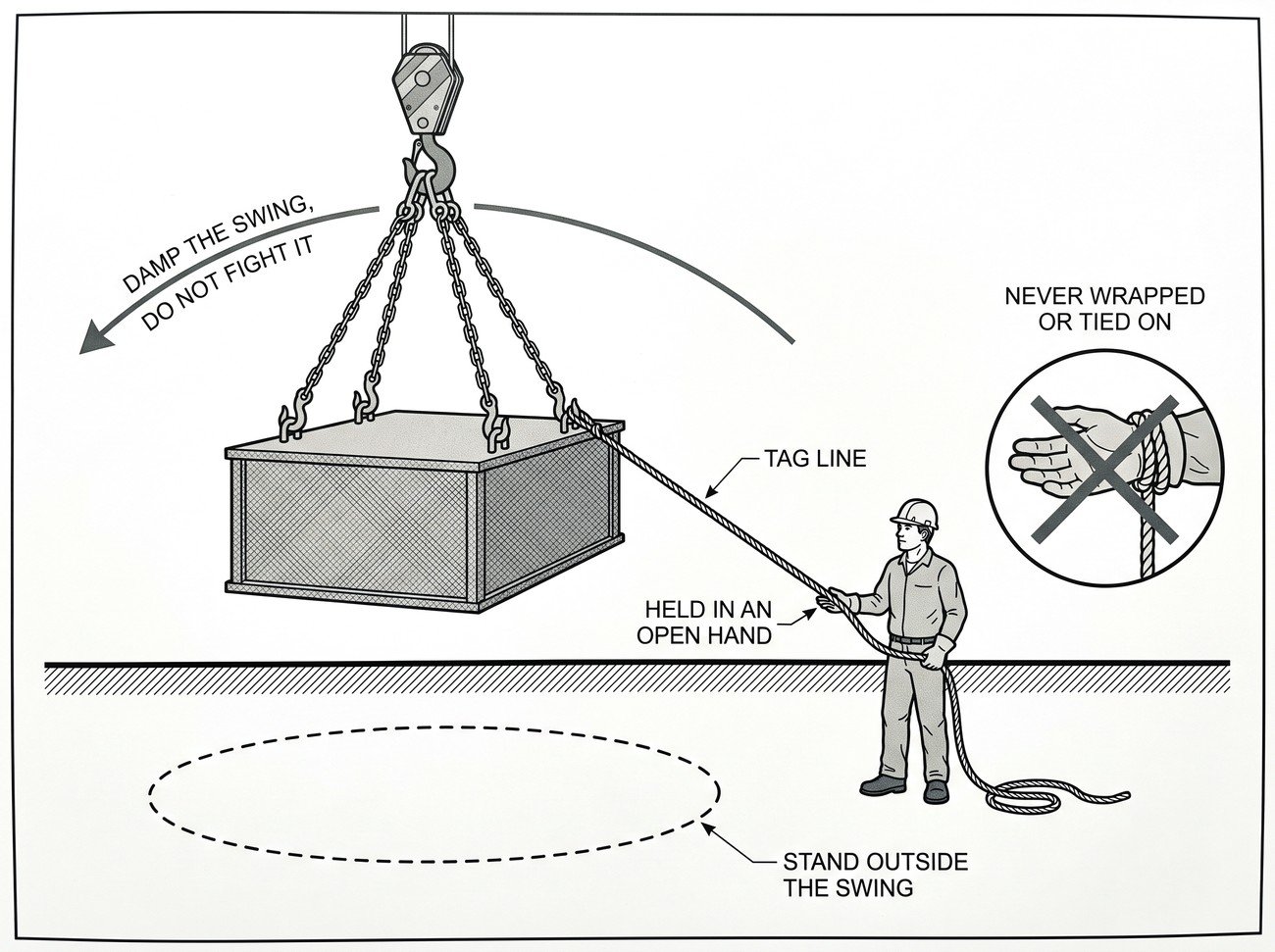
A tag line controls the orientation and the swing of a load from a distance, keeping the person who is steering it outside the area the load can reach. That distance is the entire point. A tag line short enough that the handler is under or beside the load has converted a control measure into a way of guaranteeing someone is in the wrong place, and a load steadied by hand has no tag line at all.
Steering, not stopping
A tag line guides a load; it cannot arrest one. A swinging load carries far more energy than a person on a rope can absorb, and attempting to stop a swing by pulling against it drags the handler toward the load or pulls them off balance. The technique is to damp the motion progressively and to work with the swing rather than against it, which is also why a tag line is put on before the load leaves the ground rather than grabbed once it is already moving.
Never attach yourself to the load
The rope is held, not worn. Wrapping it around a hand or a wrist, tying it to a belt, or taking a turn around the body means the handler goes wherever the load goes, and a load that drops or swings hard will take an arm or a person with it. This is the single rule that matters most, and it is broken most often when the rope is slipping and the handler wants a better grip.
Where to stand
Outside the radius the load can swing to, on stable ground, with a clear route to retreat further and nothing behind to trip over. In wind, position upwind so the load moves away rather than towards you. Two tag lines on opposite sides give far better control of a long load than one, and they let two handlers work against each other gently rather than one handler fighting the whole rotation.
Wind is the variable that changes everything
A large flat load is a sail, and the force on it rises steeply with wind speed. Panels, sheet material, formwork and empty containers can become uncontrollable in wind that feels unremarkable at ground level, and it is always stronger at height than where the crew is standing. Wind is a reason to stop a lift rather than a reason to add more people to the tag lines.
For where the handler should be standing, see exclusion zones under a load. For the same wind problem at height, see weather limits for roof work.
Related standards
The standards below set the safety requirements, marking and discard criteria behind the equipment used for this work.
- EN 388 — Protective Gloves Against Mechanical Risks
- EN 397 — Industrial Safety Helmets
- EN ISO 20471 — High-Visibility Clothing
Common errors
1Using a tag line short enough that the handler stands within reach of the load.
2Wrapping the rope around a hand, wrist or body to get a better grip.
3Trying to arrest a swing by pulling against it rather than damping it progressively.
4Attaching the tag line after the load is already moving instead of before it lifts.
5Adding handlers to control a load in wind instead of stopping the lift.
Frequently asked questions
What is a tag line for?
Controlling the orientation and swing of a load from a distance, keeping the handler outside the area the load can reach. The distance is the entire purpose.
Can a tag line stop a swinging load?
No. A swinging load carries far more energy than a person on a rope can absorb, and pulling against it drags the handler toward the load or off balance. The technique is to damp the motion progressively.
Why must the rope never be wrapped around a hand or wrist?
Because the handler then goes wherever the load goes. A load that drops or swings hard will take an arm or a person with it. The rope is held in an open hand, never worn.
Where should a tag line handler stand?
Outside the radius the load can swing to, on stable ground, with a clear route to retreat and nothing behind to trip over, and upwind where there is any wind.
When does wind stop a lift?
When a large flat load becomes a sail. Panels, sheet material, formwork and empty containers can become uncontrollable in wind that feels unremarkable at ground level, and wind is always stronger at height.
Need this as a document you can issue? The template library gives you the risk assessments, permits and inspection logs in editable form — and employer plans cover a whole team with completion records.