Safety / Tips and Tricks / Lifting operations and rigging
Activity 10 · Lifting operations
Exclusion Zones and Why Nobody Stands Under a Load
Every other control in a lift reduces the chance of the load falling. The exclusion zone is the only one that decides what happens if it does, which is why it is the one that must not be negotiable.
The zone is about consequence, not probability
Rigging can be checked, capacity can be calculated and equipment can be examined, and all of that reduces the likelihood of a failure without ever reaching zero. Standing clear is the control that assumes the failure happens anyway. That is why it survives the argument that the lift is short, the load is light, or the rigging was checked five minutes ago — none of those change what a falling load does to a person underneath it.
Sizing it for where things actually go
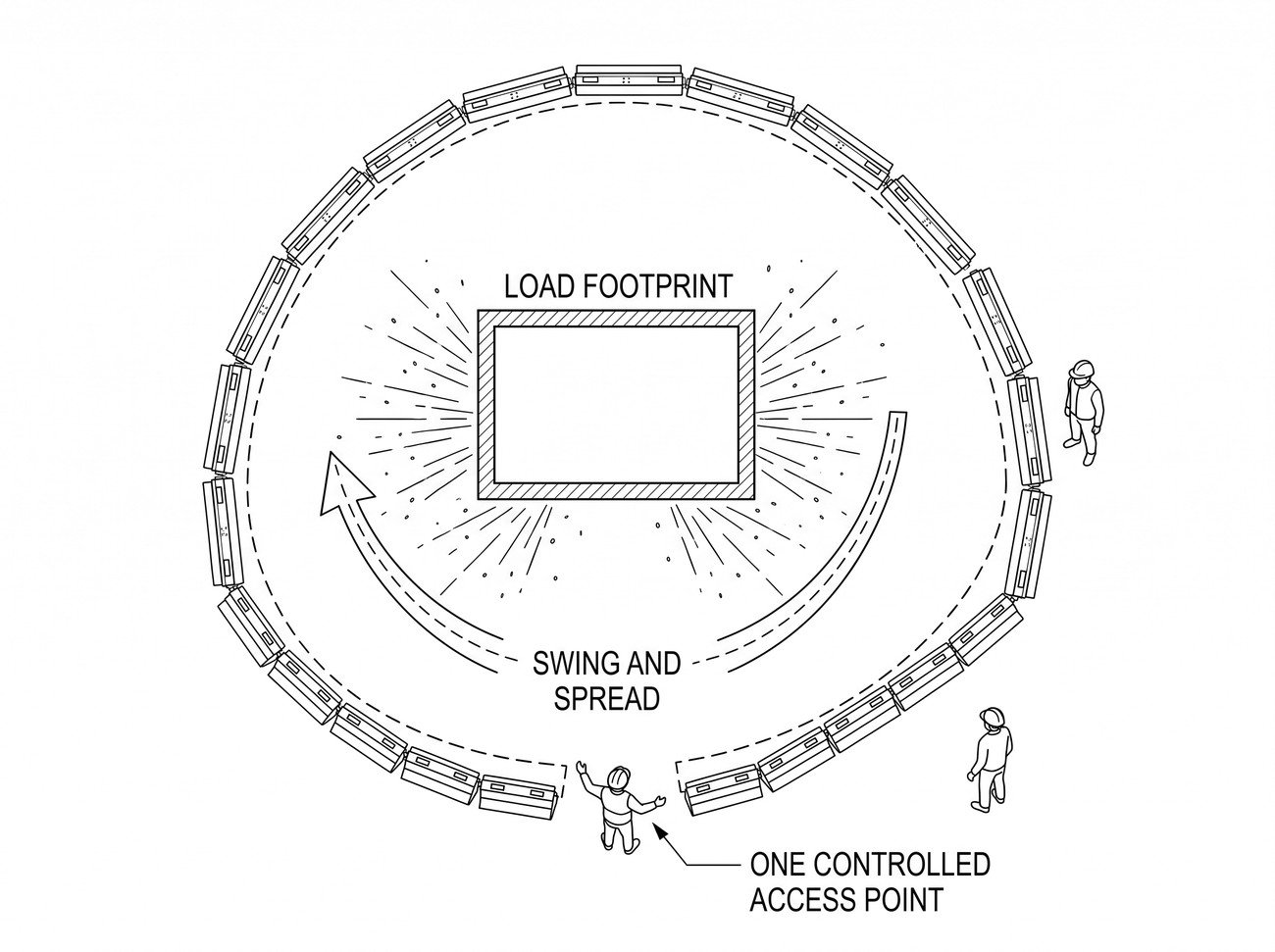
A dropped load does not land neatly beneath the hook. It can swing before it falls, it can bounce, it can shed part of its contents outward, and a bundle can spread across a wide area on impact. A zone drawn tightly around the vertical footprint is a zone drawn for the best case. Size it for the load travelling, for its contents scattering, and for material bouncing outward on impact, and remember it moves with the load rather than staying where it was marked.
Barriers rather than briefings
The people who walk into a lift area are usually the ones who were not at the briefing: a delivery driver, a visiting engineer, someone from another trade taking a short cut. A verbal instruction reaches the crew and nobody else. A physical barrier with a person controlling the access point reaches everyone, and it keeps working when the lift takes longer than planned and attention drifts.
The moments people step in
Almost nobody stands under a load for the whole lift. They step in for a few seconds: to guide the load onto its bearers, to pull a sling free, to retrieve a dropped tool, to check a mark on the floor. Those brief entries are where the injuries happen, and they are best designed out rather than prohibited — tag lines to guide from outside, pull cords to release slings, setting down on packers that leave the sling accessible from the side.
Landing the load is not the end
A load resting on the ground is not stable until it is stable. It can topple as the slings slacken, roll off uneven packing, or settle and shift as it takes its own weight. The zone stays until the load is standing on its own and the slings are slack and clear, and stepping in the moment the hook takes the weight off is stepping in at the point the load is least predictable.
For guiding a load from outside the zone, see tag lines and load control. For the same principle around plant, see working near mobile plant.
Related standards
The standards below set the safety requirements, marking and discard criteria behind the equipment used for this work.
- EN 397 — Industrial Safety Helmets
- EN ISO 20471 — High-Visibility Clothing
- EN ISO 20345 — Safety Footwear
Common errors
1Sizing the zone to the vertical footprint rather than to swing, travel and spread on impact.
2Marking the zone once when the lift travels, so the boundary is left behind.
3Relying on a briefing that only reaches the crew, not the visitors and other trades.
4Stepping in briefly to guide the load, free a sling or retrieve a tool.
5Entering as soon as the load touches down, before it is standing stably on its own.
Frequently asked questions
Why is the exclusion zone treated as non-negotiable?
Because every other control reduces the chance of a failure without eliminating it. Standing clear is the only control that decides the outcome if the load does come down.
How wide should an exclusion zone be?
Wide enough for the load to swing, for it to travel, and for its contents or a bundle to spread outward on impact. A zone drawn to the vertical footprint is drawn for the best case.
Why are barriers better than a briefing?
The people who walk into a lift area are usually the ones who were not at the briefing, such as delivery drivers and other trades. A physical barrier and a controlled access point reach everyone.
When do people actually enter the zone?
In brief moments: guiding a load onto its bearers, pulling a sling free, retrieving a dropped tool. Those entries are best designed out with tag lines, pull cords and packers that keep slings accessible from the side.
When can the zone be released?
Once the load is standing stably on its own with the slings slack and clear. A load can topple as slings slacken, roll off uneven packing, or shift as it takes its own weight.
Need this as a document you can issue? The template library gives you the risk assessments, permits and inspection logs in editable form — and employer plans cover a whole team with completion records.