Safety / Tips and Tricks / Roofing and work at height
Activity 02 · Roofing
Weather Limits for Roof Work: Wind, Rain and Ice
Roof work has weather limits for a reason that goes beyond comfort: wind, rain and ice each change the physics of the task in ways that PPE and technique cannot fully compensate for. Knowing where those limits sit, and having the authority to stop work when they are reached, matters as much as any piece of equipment on the roof.
Wind
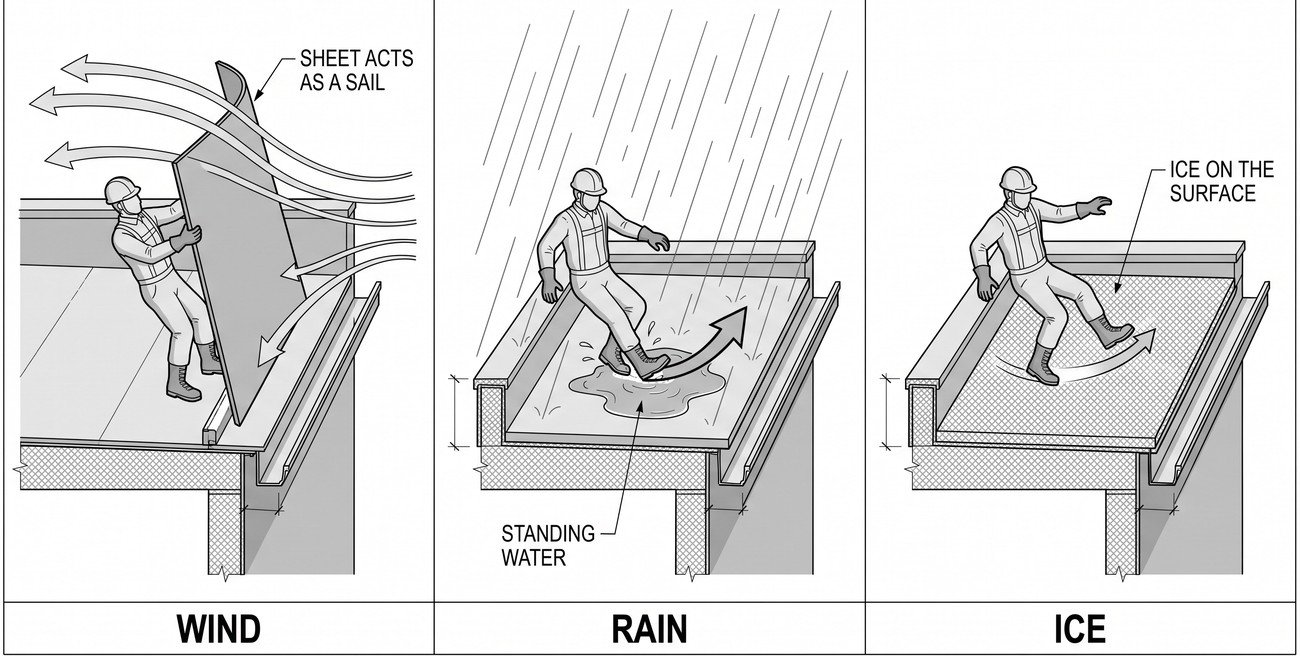
Wind affects roof work in two distinct ways: it destabilises the worker directly, particularly at height and near edges where a gust can shift body position with no warning, and it turns loose materials, sheeting and tools into hazards for anyone below. Wind speed limits for roof work are typically set well below the point most people would call “dangerous” in everyday terms, precisely because the margin for error at a roof edge is much smaller than at ground level. Gusting conditions are more hazardous than a steady wind of the same average speed, since a sudden gust arrives with no build-up to react to.
Large flat materials — sheeting, insulation boards, membrane rolls — act like sails in wind and need specific handling limits separate from the general work-stoppage threshold, since a worker can be pulled or pushed by a sheet they are carrying well before the general wind limit for walking the roof is reached.
Rain and surface moisture
Wet roofing materials lose friction, sometimes dramatically — a membrane or metal surface that offers secure footing dry can become close to unwalkable wet, and the loss of grip is not always proportional to how heavy the rain looks. Standing water pooling on low-pitch roofs compounds the slip risk and can also disguise surface damage or a fragile area underneath it. Rain reduces visibility and can affect the grip and function of tools and equipment, adding hazards beyond the footing itself. In reduced visibility, high-visibility clothing meeting EN ISO 20471 matters more for keeping workers visible to each other and to anyone below.
Ice and frost
Ice removes friction almost entirely from whatever surface it forms on, and it forms unevenly — a shaded, north-facing section of roof can remain icy long after a sunlit section has cleared, creating a hazard that is easy to miss if the whole roof is not checked. Frost behaves similarly on cold mornings even without visible ice, and metal roofing in particular can hold frost well after surrounding surfaces have warmed. Any roof access in near-freezing conditions needs a specific check for ice and frost before work begins, not an assumption based on the general forecast.
Setting and enforcing the limits
Weather limits should be set in advance, specific to the roof pitch, material and task, and tied to an actual measurement — a wind gauge reading, a forecast threshold, a visual check for ice — rather than a subjective judgement made under time pressure. Whoever is authorised to stop work for weather needs to actually exercise that authority without needing to justify it against a schedule, since the point of a pre-set limit is to remove the in-the-moment pressure to push through marginal conditions.
For how pitch changes the risk these weather conditions create, see roof pitch and choosing the right fall protection system.
Common errors
1Judging wind conditions by how it feels rather than an actual measured threshold.
2Continuing to handle large sheet materials in wind that is within the general walking limit but beyond the material-handling limit.
3Assuming a roof is ice-free because the forecast temperature is above freezing, without checking shaded sections directly.
4Treating weather limits as guidelines to push through under schedule pressure rather than firm stop-work triggers.
Frequently asked questions
Why are wind limits for roof work set lower than what feels dangerous at ground level?
The margin for error at a roof edge is much smaller than at ground level, so limits account for the destabilising effect of a sudden gust on someone working near an edge or at height.
Why is gusting wind more hazardous than steady wind of the same average speed?
A sudden gust arrives with no build-up to react to, while a steady wind allows a worker to brace and adjust posture in advance.
Why does handling large sheet materials need its own wind limit?
Large flat materials act like sails in wind and can pull or push a worker carrying them well before the general wind limit for simply walking the roof is reached.
Why can ice on a roof be easy to miss even when most of the surface looks clear?
Ice forms unevenly, and a shaded, north-facing section can remain icy long after a sunlit section has cleared, so the whole roof needs checking rather than assuming uniform conditions.
Why should weather limits be tied to a measurement rather than a subjective judgement?
A pre-set, measured threshold removes the in-the-moment pressure to push through marginal conditions under schedule pressure, which a subjective judgement made on the day does not.
Need this as a document you can issue? The template library gives you the risk assessments, permits and inspection logs in editable form — and employer plans cover a whole team with completion records.