Safety / Tips and Tricks / Roofing and work at height
Activity 02 · Roofing
Roof Pitch and Choosing the Right Fall Protection System
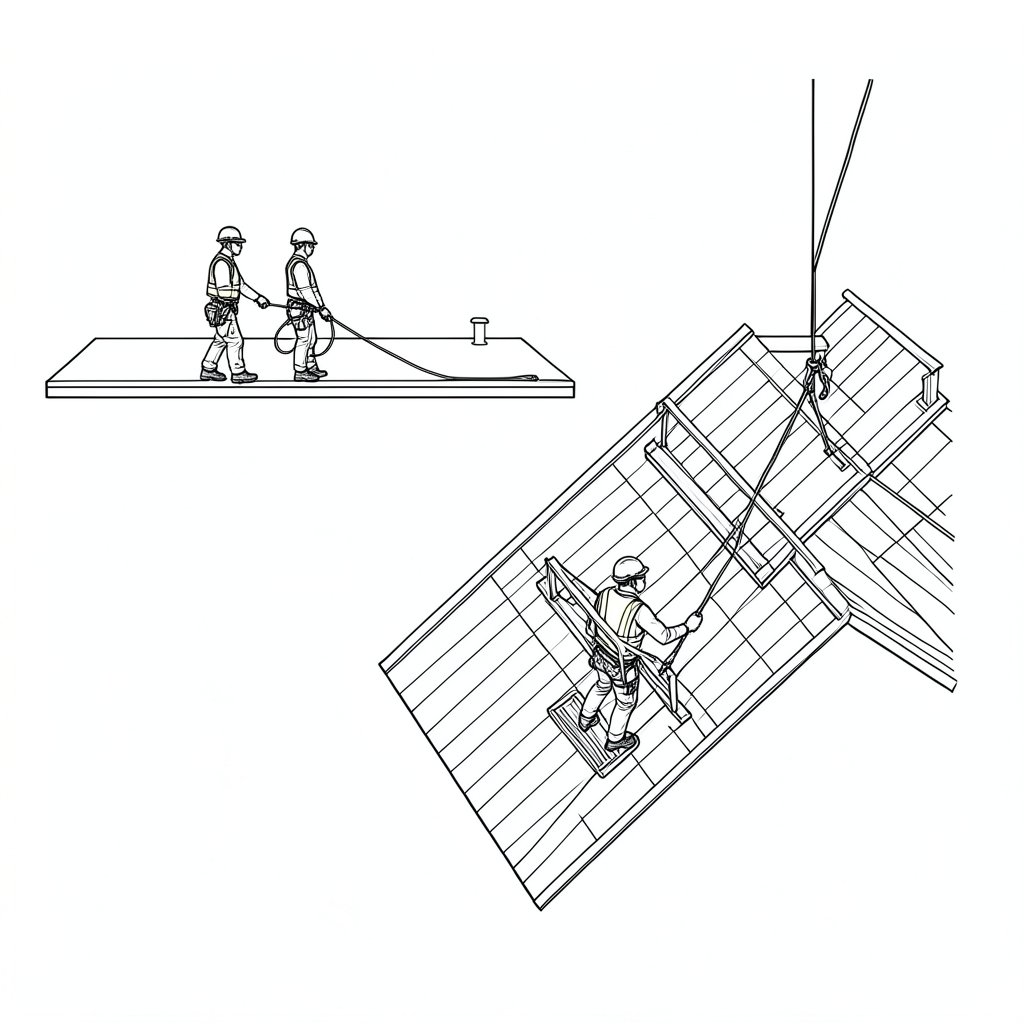
A flat roof and a steep pitched roof are not the same task wearing different clothes — the pitch itself changes what fall protection can realistically achieve, what walking on the surface even looks like, and which hazards dominate the risk assessment.
Flat and low-pitch roofs
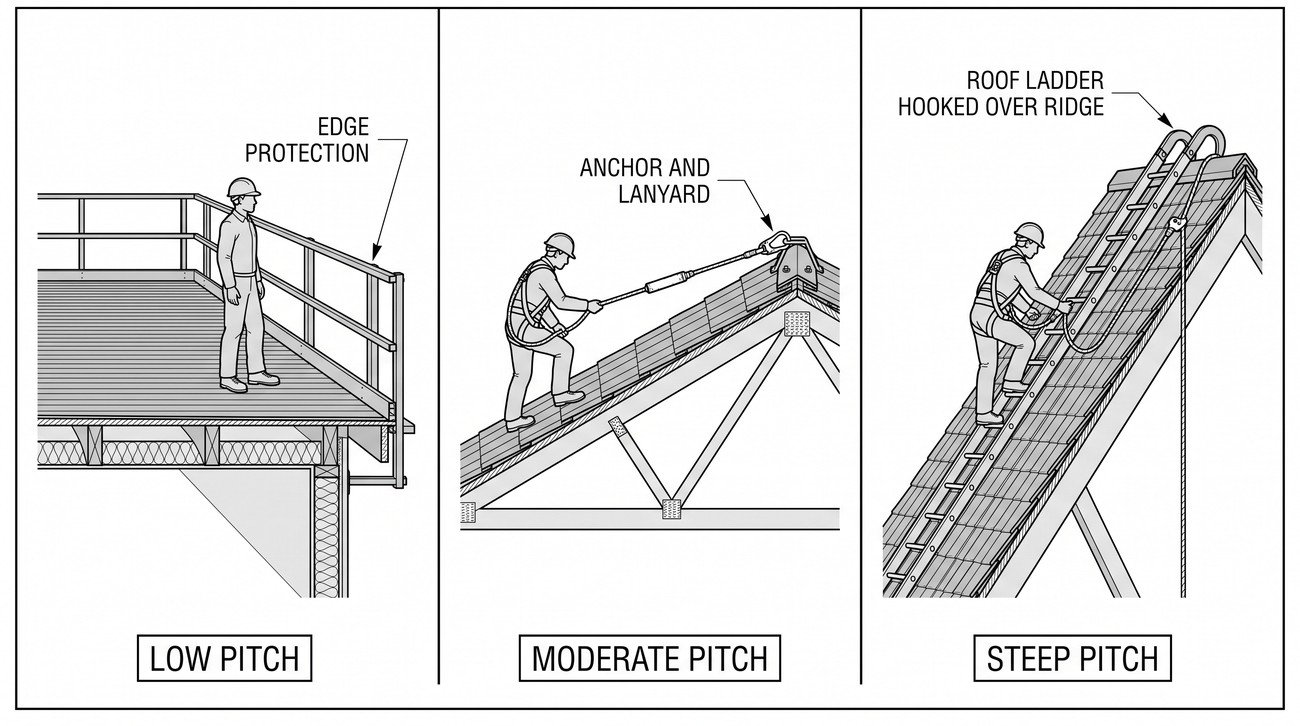
Roofs up to around 10 degrees are generally treated as flat for access purposes: a worker can stand and walk normally, and the main fall risk is at the perimeter and around openings rather than from simply losing footing on the surface itself. This makes collective edge protection — guardrails around the perimeter and openings — highly effective, since the walking surface itself does not need individual attention the way a steep pitch does.
Low pitches introduce their own quieter hazard: standing water after rain, algae growth, and membrane surfaces that can be more slippery than they look, particularly near edges where footing matters most.
Moderate pitches
As pitch increases through roughly 10 to 30 degrees, walking normally becomes progressively less stable, and the fall risk is no longer confined to the perimeter — a slip anywhere on the surface can result in a slide toward the edge. This is the range where roof ladders, crawling boards or cat ladders start to matter, distributing weight and providing secure footing and handholds across the working surface itself, not just at the edge.
Steep pitches
Above roughly 30 degrees, standing unsupported becomes impractical for most tasks, and personal fall protection connected throughout the entire time on the roof — not just near the edge — becomes the default rather than a fallback. Anchor points, rated to EN 795, need positioning to support movement across the whole working area, often via a ridge-mounted horizontal system, and roof ladders or specific footholds are frequently needed even where a harness system is also in use, since the fall-protection system and stable footing serve different purposes.
Weather sensitivity increases sharply with pitch: a surface that is merely damp on a low-pitch roof can become genuinely hazardous underfoot on a steep one, and the weather limits for the task need setting accordingly rather than applied uniformly across every roof type.
Matching the system to the actual pitch, not the assumed category
Pitch should be measured or confirmed from drawings before the access plan is finalised, not estimated by eye from ground level, since roofs frequently combine sections of different pitch and a plan built around the shallowest section can leave a steeper section under-protected. Where a roof has mixed pitches, the access and protection plan needs to address each section on its own terms.
For the anchor systems steep-pitch work depends on, see selecting a roof anchor system, and for weather-driven limits on any pitch, see weather limits for roof work.
Common errors
1Applying a flat-roof access plan to a roof that has a moderate or steep pitch section without recognising the change.
2Relying on perimeter guardrails alone on a pitch where a mid-roof slip could reach the edge before anyone intervenes.
3Underestimating slip risk on a low-pitch roof after rain or algae growth.
4Assuming a harness system alone provides adequate footing on a steep pitch without roof ladders or footholds.
Frequently asked questions
At what roof pitch does personal fall protection typically become necessary throughout the task?
Above roughly 30 degrees, standing unsupported becomes impractical for most tasks, and connecting to fall protection for the entire time on the roof, not just near the edge, becomes the default approach.
Why are flat roofs still risky despite having a stable walking surface?
The main fall risk shifts to the perimeter and around openings, and low-pitch surfaces can hide standing water, algae growth or slippery membrane conditions that are easy to underestimate.
What changes on a moderate-pitch roof compared to a flat one?
Walking normally becomes progressively less stable and a slip anywhere on the surface can slide toward the edge, which is where roof ladders or crawling boards start to matter for distributing weight and providing secure footing.
Why does weather sensitivity increase with roof pitch?
A surface that is merely damp on a low-pitch roof can become genuinely hazardous underfoot on a steep one, so weather limits need to be set according to the specific pitch rather than applied uniformly.
Why should roof pitch be measured rather than estimated by eye?
Roofs frequently combine sections of different pitch, and a plan built around the shallowest section can leave a steeper section under-protected if the pitch was only judged by eye from ground level.
Need this as a document you can issue? The template library gives you the risk assessments, permits and inspection logs in editable form — and employer plans cover a whole team with completion records.