Safety / Tips and Tricks / Roofing and work at height
Activity 02 · Roofing
Selecting a Roof Anchor System: Fixed, Temporary and Portable Options
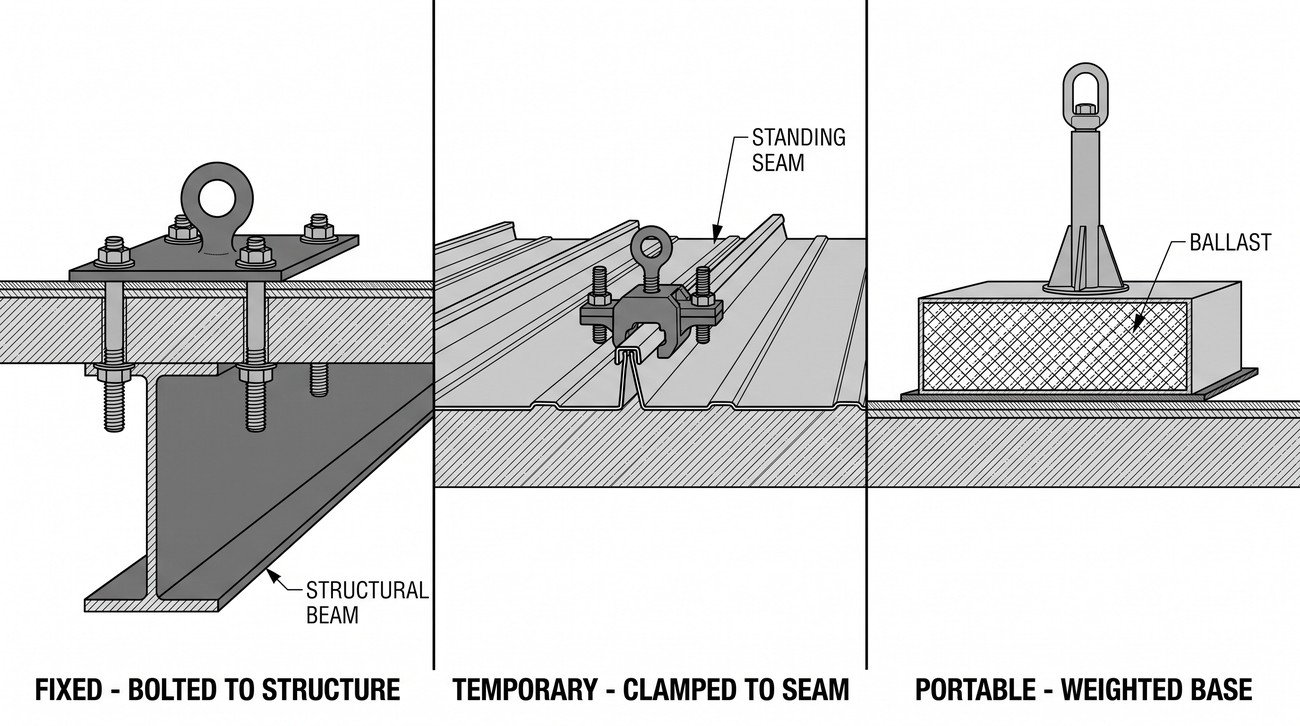
Every fall protection system on a roof, restraint or arrest, depends entirely on the anchor it is clipped to. Roof anchors come in three broad categories — fixed, temporary and portable — and choosing between them is less about preference and more about what the roof structure, the frequency of the work, and the specific task actually allow.
Fixed anchor points
A fixed anchor is permanently installed into the structural elements of the roof and intended to stay in place for the life of the building. It is normally type-tested to EN 795 Type A, but note the scope: EN 795:2012 covers devices that are removable from the structure, and under Commission Implementing Decision (EU) 2015/2181 only Types B and E are personal protective equipment. A permanently installed Type A, C or D anchor is a construction product, so ask for the installer’s fixing design, pull-test records and the structural calculation — not a PPE declaration of conformity. Fixed anchors suit roofs that are accessed regularly — for maintenance, cleaning or inspection — because the cost of proper structural installation is repaid by not having to bring rigging equipment to site every visit. Correct installation means fixing into the structure itself, not into roof covering, insulation or anything that is not load-bearing, and the installer’s certificate should specify the exact substrate the anchor was tested against.
Fixed anchors still need periodic inspection. A point that was correctly installed can still be compromised by corrosion, structural movement, or a later roof modification that changed what the anchor is actually fixed into.
Temporary anchor systems
A temporary system is installed for the duration of a specific job and removed afterward — a horizontal lifeline rigged between two structural points, a strop around a suitable structural member, or a proprietary temporary anchor device rated for the load. These suit one-off or infrequent work where installing a permanent point is not justified, but they place more responsibility on the person rigging them, since the anchor’s adequacy is being judged fresh each time rather than certified once by an installer.
A temporary anchor is only as good as the structure it is attached to. Wrapping a strop around a purlin or a roof truss member requires knowing that member is actually sized to take the load in the direction it will be pulled — something that is not always obvious from the roof surface, and worth confirming with whoever holds the building’s structural information before the first use.
Portable anchor devices
Portable anchors — weighted bases, counterbalanced devices, or systems that clamp onto a specific roof profile — do not fix into the structure at all. Their holding power comes from mass, friction or a mechanical grip on the roof material, which means their rated capacity depends entirely on being used exactly as the manufacturer specifies: the right roof surface, the right orientation, and often a minimum unobstructed area around the device. A portable anchor moved to an unsuitable surface, or used at an angle the manufacturer did not test, may hold nothing like its stated rating.
Portable devices suit short, infrequent tasks on roofs where no fixed point exists and installing a temporary anchor is not practical — but they are the anchor type most sensitive to being used slightly outside their tested conditions, so the manufacturer’s instructions need checking every time, not just the first time.
Matching the anchor type to the work
The connector joining the harness or lanyard to the anchor also needs to meet EN 362 for fall-protection connectors, regardless of which anchor type is used. Frequency of access is the first filter: regular access justifies the cost of a certified fixed point, while a single visit rarely does. Structural knowledge is the second: a temporary or portable anchor is only safe where the person rigging it genuinely knows what the roof structure underneath can take, not where they are assuming it will hold. Where that structural knowledge is not available on site, a certified fixed anchor installed by a competent installer removes the guesswork for every future visit.
Once an anchor is selected, the clearance it provides still needs checking — see calculating fall clearance for roof-mounted anchors — and for anchors covering a wider working area, see horizontal lifeline systems on roofs.
Common errors
1Treating a roof-mounted fixture — a vent stack, a railing, a satellite mount — as a fall-arrest anchor because it is convenient and looks solid.
2Using a portable anchor on a roof surface or at an angle the manufacturer's instructions do not cover.
3Wrapping a temporary strop around a structural member without confirming its rated capacity in the direction of pull.
4Skipping periodic inspection of a fixed anchor because it was certified once at installation.
Frequently asked questions
What is the difference between a fixed and a temporary roof anchor?
A fixed anchor is permanently installed into the roof's structural elements and certified for the life of the building, while a temporary anchor is rigged for a specific job and removed afterward, such as a strop around a structural member or a horizontal lifeline.
When does a portable anchor device make sense?
For short, infrequent tasks on roofs with no fixed point, where installing even a temporary anchor is not practical – provided it is used exactly on the roof surface and orientation the manufacturer tested it against.
Why do fixed anchors still need periodic inspection after installation?
Corrosion, structural movement, or a later roof modification can compromise a point that was correctly installed originally, so a one-time certificate does not guarantee the anchor remains sound indefinitely.
What is the main risk with a temporary strop anchor?
Its adequacy depends entirely on the structural member it is wrapped around actually being rated to take the load in the direction it will be pulled, which is not always obvious from the roof surface alone.
How should the anchor type be chosen for a specific roof job?
By frequency of access and available structural knowledge: regular access justifies a certified fixed point, while infrequent access with confirmed structural information can use a temporary or portable anchor instead.
Need this as a document you can issue? The template library gives you the risk assessments, permits and inspection logs in editable form — and employer plans cover a whole team with completion records.