Safety / Tips and Tricks / Roofing and work at height
Activity 02 · Roofing
Horizontal Lifeline Systems on Roofs: EN 795 Type C
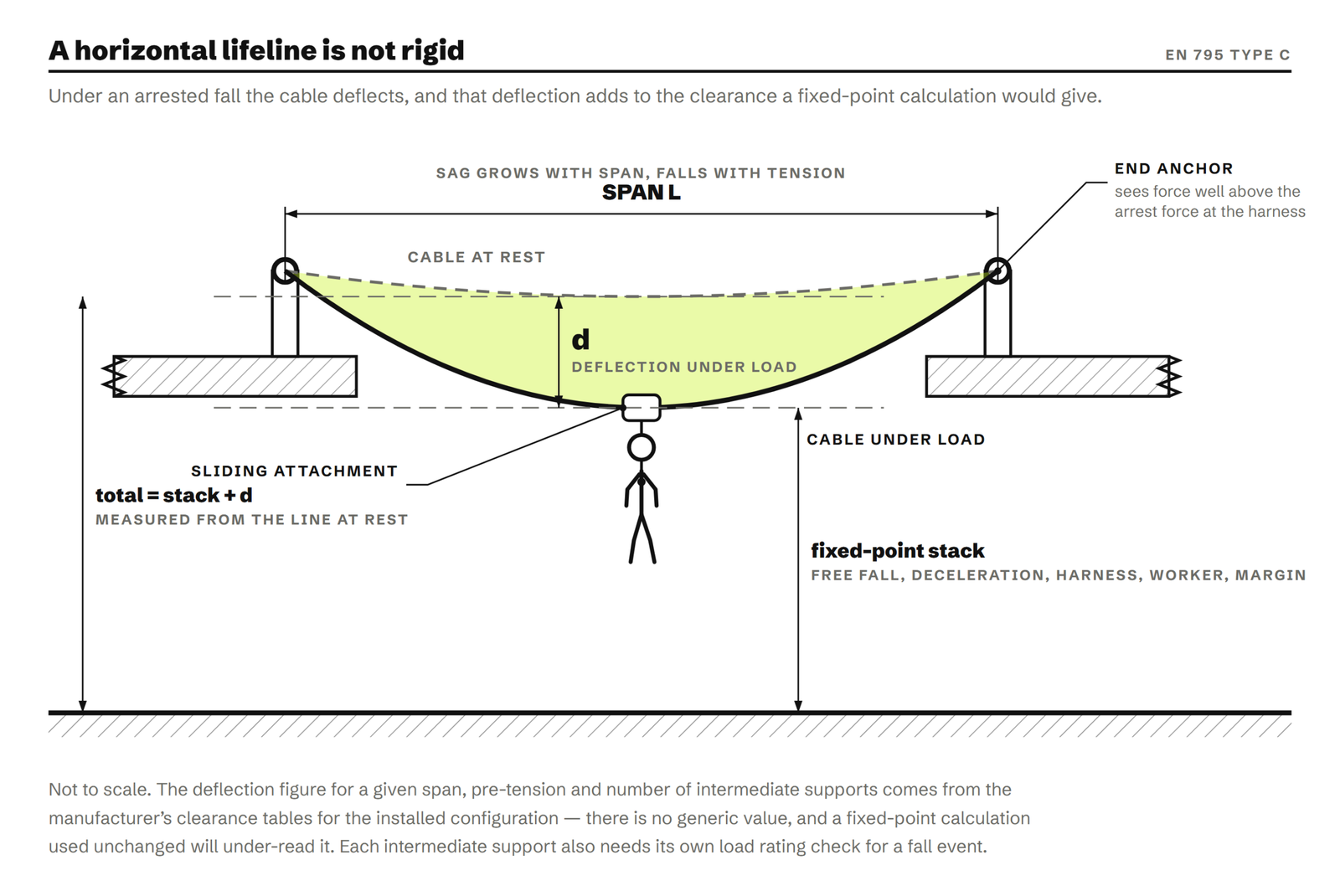
Where a task requires moving across a roof rather than working from a single fixed point, a horizontal lifeline gives continuous fall protection along a defined path without needing to disconnect and reconnect at intermediate anchors. Getting the system right depends on understanding what makes it behave differently from a single-point anchor.
What a Type C system is
EN 795 Type C covers flexible horizontal lifeline systems — a cable tensioned between two or more end anchors, sometimes with intermediate supports along its length, that a worker’s fall-arrest lanyard connects to via a sliding attachment, joined through a connector meeting EN 362, that travels with them as they move. This is distinct from a rigid rail system and from a single fixed-point anchor; a Type C line flexes and sags under load in a way that changes the fall dynamics compared with a static point.
Why sag and deflection matter
A horizontal lifeline is not rigid: under the load of an arrested fall, the cable deflects downward, adding to the total fall distance beyond what a fixed-point anchor would produce. This deflection increases with the span between anchors and decreases with tension, and manufacturers provide specific figures for how much additional clearance a given span and configuration requires. Skipping this figure and using a standard single-point clearance calculation for a horizontal lifeline underestimates the clearance actually needed.
End anchors and intermediate supports
The end anchors of a Type C system carry significant load, magnified by the cable’s angle and tension, and need rating and installation specifically for that purpose — not simply reused from a single-point anchor rated for a different load case. Intermediate supports on a long span help manage sag and allow the cable to follow a roof’s shape, but each one needs its own load rating check, since the system’s behaviour at a fall event depends on how the intermediate supports respond, not just the end anchors.
Multiple users on the same line
Type C systems are often designed to support more than one worker connected simultaneously, but this needs explicit confirmation from the system’s certification — the number of simultaneous users, and how a fall by one user affects the line’s behaviour for others connected to it, is a specific engineered parameter, not a default assumption. Systems not certified for multiple simultaneous users should not be treated as though they were, regardless of how much unused capacity the cable appears to have.
The clearance calculation this system feeds into is covered in calculating fall clearance for roof-mounted anchors, and for how this compares with fixed-point anchors, see selecting a roof anchor system.
Common errors
1Using a fixed-point clearance calculation without adding the horizontal lifeline's specific deflection distance.
2Treating end anchors as equivalent to single-point anchors without accounting for the magnified load from cable tension and angle.
3Assuming a system supports multiple simultaneous users without confirming this against its certification.
4Installing intermediate supports without checking their individual load rating for a fall event.
Frequently asked questions
What does an EN 795 Type C system consist of?
A flexible horizontal lifeline – a cable tensioned between two or more end anchors, sometimes with intermediate supports – that a worker's lanyard connects to via a sliding attachment that travels with them as they move.
Why does cable sag matter for fall clearance on a horizontal lifeline?
The cable deflects downward under the load of an arrested fall, adding to the total fall distance beyond what a fixed-point anchor would produce, and this deflection needs its own specific clearance allowance.
Why do end anchors on a Type C system need special consideration?
They carry significant load magnified by the cable's angle and tension, so they need rating and installation specific to that purpose rather than simply reusing a single-point anchor rated for a different load case.
Can multiple workers always connect to the same horizontal lifeline at once?
Only if the system's certification explicitly confirms it – the number of simultaneous users and how one person's fall affects the line for others is an engineered parameter, not a default assumption based on unused capacity.
Why do intermediate supports along a long span need their own load check?
The system's behaviour during a fall event depends on how intermediate supports respond, not just the end anchors, so each support needs verifying against the loads it may see.
Need this as a document you can issue? The template library gives you the risk assessments, permits and inspection logs in editable form — and employer plans cover a whole team with completion records.