Safety / Tips and Tricks / Roofing and work at height
Activity 02 · Roofing
Fall Restraint vs Fall Arrest for Roof Work: Choosing the Right System
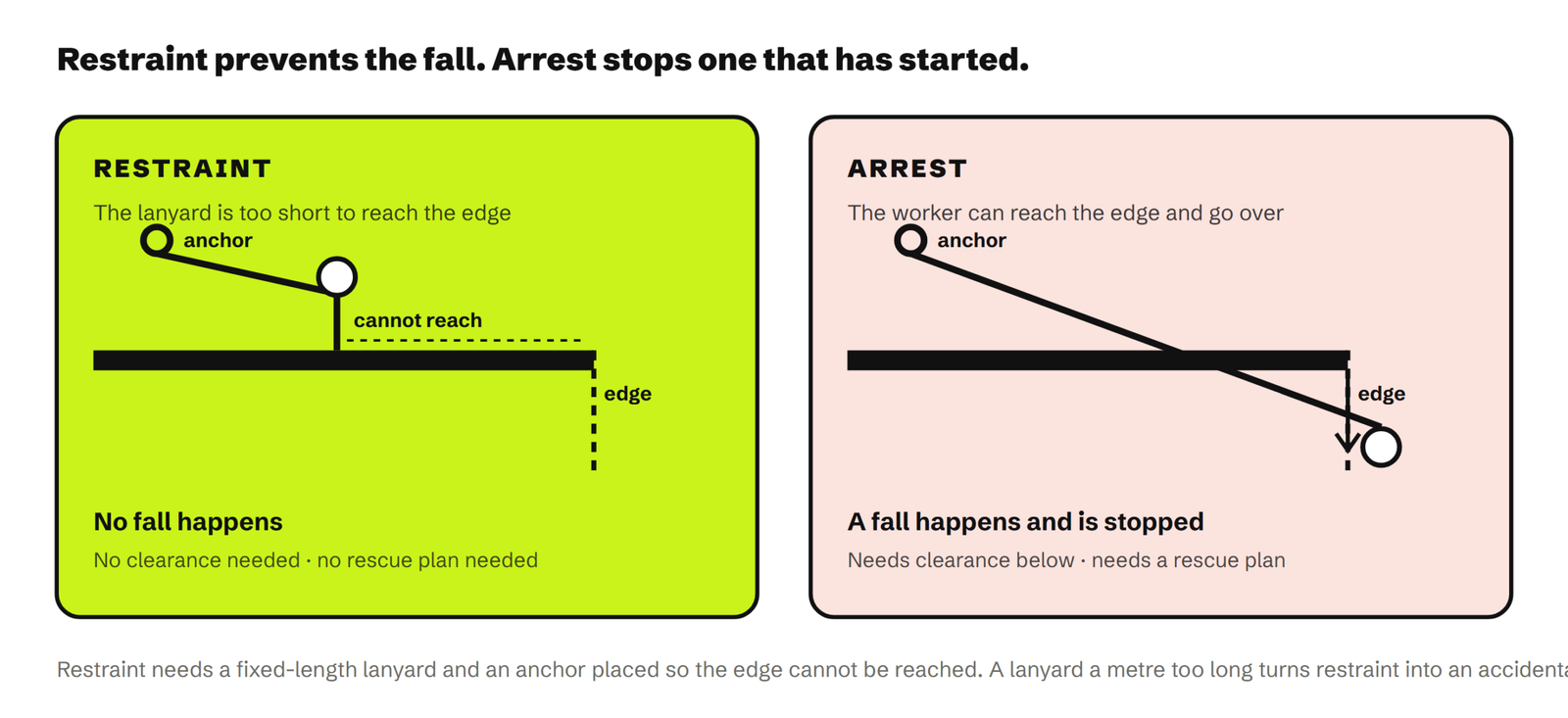
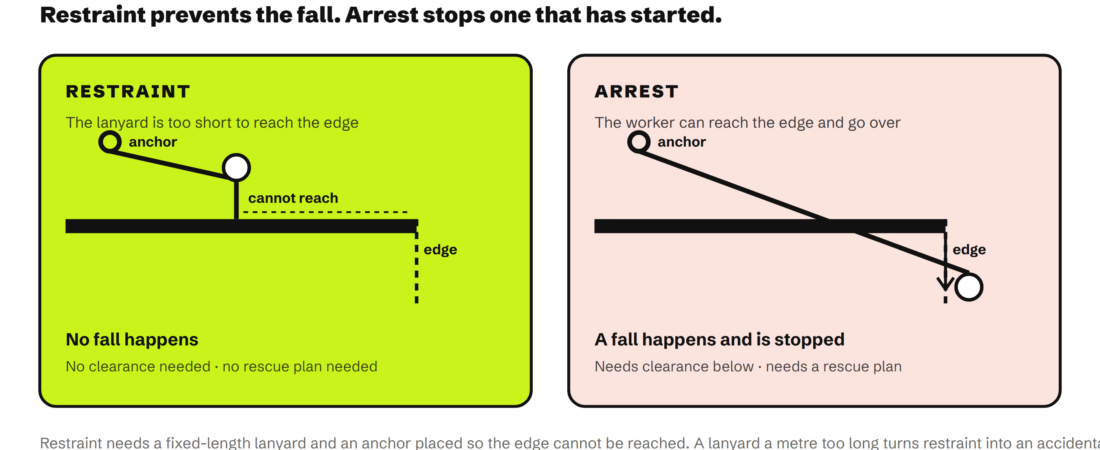
Roof work forces an early decision that shapes every piece of equipment that follows: is the system going to stop the worker reaching the edge at all, or is it going to catch them after they have already gone over it? Restraint and arrest are not two strengths of the same idea — they are different jobs, built from different equipment, and mixing them up is one of the most common ways a roof-work system fails to do what it was supposed to do.
What restraint actually does
A restraint system uses a fixed-length lanyard and an anchor positioned so that, at full stretch, the worker physically cannot reach the fall edge, a fragile roof light, or any other hazard. The lanyard is typically used with a belt meeting EN 358 for work positioning and restraint, or a full body harness to EN 361 used in restraint mode. Done correctly there is no fall to arrest — the geometry itself is the control. This makes restraint the preferred option wherever the roof layout allows it, because it removes the need for rescue planning, energy absorption and fall clearance calculations that arrest systems require.
Restraint only works if the maths is done properly. The lanyard length, the anchor position and the distance to the hazard all have to be checked together, on the actual roof, not assumed from a drawing. A lanyard that is a metre too long turns a restraint system into an accidental arrest system, with none of the shock-absorbing capacity that arrest requires.
What arrest does instead
A fall-arrest system accepts that a fall is possible and is designed to stop it safely once it has started, within a calculated clearance distance below the working position. It needs an energy absorber or a guided-type fall arrester to bring the deceleration forces within survivable limits, a full body harness meeting EN 361 — fall-arrest attachment is not permitted on a restraint-only belt to EN 358 — an anchor rated for arrest loads, and — critically — enough clear space below the anchor for the system to fully deploy before the worker hits anything.
Arrest is the correct choice wherever restraint cannot physically be achieved: roofs with no safe area far enough from the edge, work that requires approaching an opening, or tasks where the anchor position and the hazard cannot be kept apart by the lanyard length available. It is a legitimate, well-proven approach, but it carries obligations restraint does not: a rescue plan has to exist before anyone clips in, because a person left suspended after an arrest is at risk from suspension trauma within minutes.
Why the two should not be blended
A single lanyard is sometimes pressed into service as “restraint most of the time, arrest if it fails” — this does not work. A lanyard sized for restraint at a set length has no shock-absorbing element, so if the geometry is wrong and a fall does occur, the forces transmitted to the body and the anchor can be severe. Conversely, a lanyard with an integral absorber, used for restraint, may still stretch enough under its own weight and movement to let the worker reach a hazard it was meant to keep them away from. The two functions call for two different pieces of kit, chosen for the job at hand, not a single compromise item asked to do both.
Deciding which one the task needs
The decision should be made from the roof layout, not from what is already in the equipment store. Measure the actual distance from the available anchor points to the nearest fall hazard, and compare it honestly against the lanyard lengths on hand. If a restraint lanyard of a length that keeps the worker clear is available and the anchor position supports it, restraint is the answer. If the geometry does not allow it — the anchor is too close to the edge, or the task genuinely requires working near an opening — move to a properly specified arrest system with clearance calculated for the actual anchor height and the worker’s weight, not a generic assumption.
For the anchor points either system depends on, see selecting a roof anchor system, and for the clearance calculation an arrest system requires, see calculating fall clearance for roof-mounted anchors.
Common errors
1Using an arrest lanyard for restraint and assuming the extra length is automatically safe.
2Sizing a restraint lanyard from the anchor's rated distance rather than the actual measured distance to the hazard on that specific roof.
3Treating restraint as needing no rescue plan when the geometry has not actually been verified to prevent a fall.
4Choosing arrest by default because it feels more thorough, when restraint would have removed the hazard entirely and needed no rescue plan at all.
Frequently asked questions
What is the main difference between fall restraint and fall arrest?
Restraint uses a fixed-length lanyard and anchor position so a worker physically cannot reach a fall hazard, meaning no fall occurs. Arrest allows the worker to reach the hazard and is designed to stop a fall that has already started, within a calculated clearance distance.
Why is restraint generally preferred over arrest where possible?
Restraint removes the possibility of a fall entirely, which also removes the need for rescue planning, energy absorption and fall clearance calculations that an arrest system requires.
Can the same lanyard be used for both restraint and arrest?
Not safely. A lanyard sized for restraint typically has no shock-absorbing element, and a lanyard built for arrest may still allow enough movement to reach a hazard restraint is meant to prevent. Each function needs equipment chosen for that specific job.
What determines whether restraint is actually achievable on a given roof?
The measured distance from the available anchor points to the nearest fall hazard, checked against the actual lanyard length available – not assumed from a drawing or the anchor's general rating.
Why does a fall-arrest system need a rescue plan before anyone starts work?
A person left suspended after an arrest is at risk of suspension trauma within minutes, so a means of promptly reaching and lowering them must be planned and available before the task begins, not improvised afterward.
Need this as a document you can issue? The template library gives you the risk assessments, permits and inspection logs in editable form — and employer plans cover a whole team with completion records.