Safety / Tips and Tricks / Construction and demolition
Activity 09 · Construction
Safe Access, Edge Protection and Spoil Placement Around an Excavation
Once an excavation is open, most of what goes wrong happens at the edge rather than at the face: people fall in, material falls in on top of them, and vehicles run into the void because nothing physical stopped them.
Getting in and out without using the face
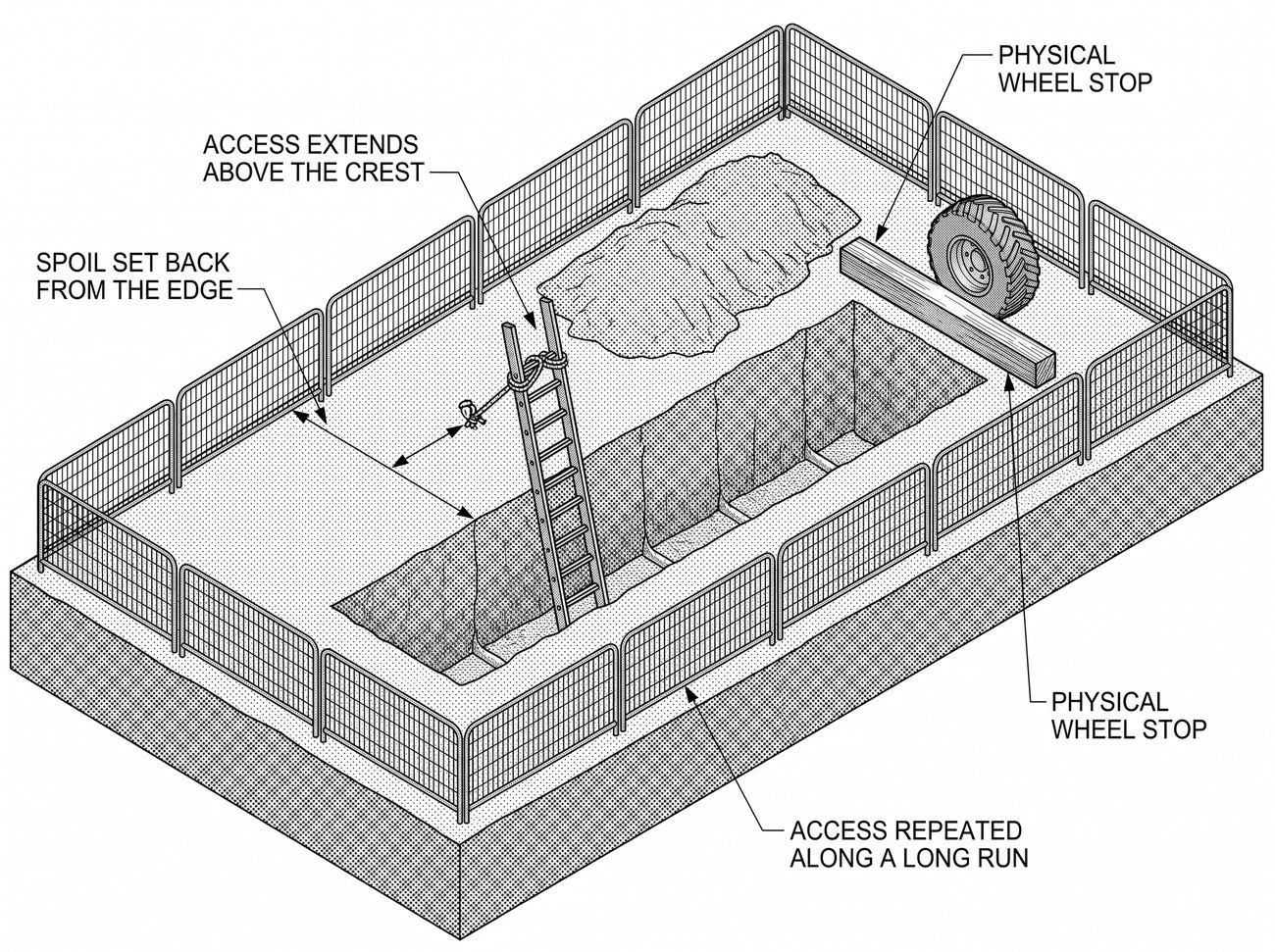
An excavation needs a dedicated means of access placed so that nobody has to climb the sides, and it has to be positioned so the distance to it from any working position is short. That second point is what gets missed: a single ladder at one end of a long trench means someone working at the far end has a long way to travel, and under time pressure they will climb out over the face instead. Access secured against movement, extending clear above the crest, and repeated along the length of a long run is what makes the correct route the easy one.
Edge protection is for people who are not doing your job
The people most at risk of falling into an excavation are usually not the ones working in it. A delivery driver walking backwards, a trade carrying a sheet of board with restricted vision, someone crossing the site in poor light — none of them are thinking about your trench. Physical barriers around the full perimeter, not just the working side, and left in place outside working hours, address the risk that people with no involvement in the work will encounter it.
Where the spoil goes
Spoil placed at the crest does two things at once, both bad: it loads the wedge of soil that wants to slide into the trench, and it provides loose material that can roll or be kicked in onto whoever is below. Setting spoil back from the edge deals with both, and it also keeps the edge visible, which matters more than it sounds when the ground is uniform in colour and the light is poor. On a confined site where there is genuinely nowhere to set spoil back to, it should be removed rather than stacked closer.
Vehicles, plant and the approach to the void
A reversing vehicle has no reliable view of a trench edge, and a barrier tape does not stop a tipper. Where vehicles operate near an excavation, a physical wheel stop or baulk set back from the crest is what actually prevents the overrun, positioned far enough back that the load from the standing vehicle is not sitting on the failure wedge. Routing vehicle movements away from the excavation entirely is better than controlling the approach to it.
Water, services and what is already down there
Water entering an excavation weakens the face and hides the floor, so pumping arrangements are part of keeping the excavation safe rather than a convenience. Buried services are the other constant: a service exposed in the face is both a hazard in itself and a sign that the ground has been dug before, which affects the stability assessment. Exposed services should be supported rather than left hanging, since an unsupported run becomes a trip hazard across the trench and can be damaged by its own weight.
For the stability assessment behind the support decision, see when an excavation needs support. For locating what is already buried, see locating and avoiding buried services.
Related standards
The standards below set the test methods and performance levels behind the protective equipment used for this work.
- EN 131 — Portable Ladders
- EN 397 — Industrial Safety Helmets
- EN ISO 20471 — High-Visibility Clothing
- EN ISO 20345 — Safety Footwear
Common errors
1Providing a single access point at one end of a long trench, so the easy route out is over the face.
2Barriering only the working side and leaving the rest of the perimeter open.
3Removing edge protection at the end of the shift when the excavation stays open.
4Stacking spoil at the crest, loading the failure wedge and providing material to fall in.
5Relying on tape rather than a physical wheel stop where vehicles reverse near the edge.
Frequently asked questions
Why does the position of the ladder matter as much as its presence?
A single access point at one end of a long trench leaves someone at the far end with a long walk, and under time pressure they will climb the face instead. Access should be repeated along a long run.
Who is most likely to fall into an excavation?
Usually people not involved in the work: a delivery driver walking backwards, a trade carrying board with restricted vision, or someone crossing the site in poor light.
Why must spoil be set back from the crest?
It loads the wedge of soil that wants to slide into the trench, and it provides loose material that can roll or be kicked onto anyone below. Setting it back also keeps the edge visible.
What stops a reversing vehicle going into a trench?
A physical wheel stop or baulk set back far enough that the standing vehicle load is not on the failure wedge. Barrier tape does not stop a tipper.
Why do exposed services need supporting?
An unsupported run sags under its own weight and can be damaged, and it becomes a trip hazard across the trench. Its presence also indicates the ground has been dug before, which affects the stability assessment.
Need this as a document you can issue? The template library gives you the risk assessments, permits and inspection logs in editable form — and employer plans cover a whole team with completion records.