Safety / Tips and Tricks / Road and highway works
Activity 11 · Road
Mobile and Short-Duration Works on a Live Road
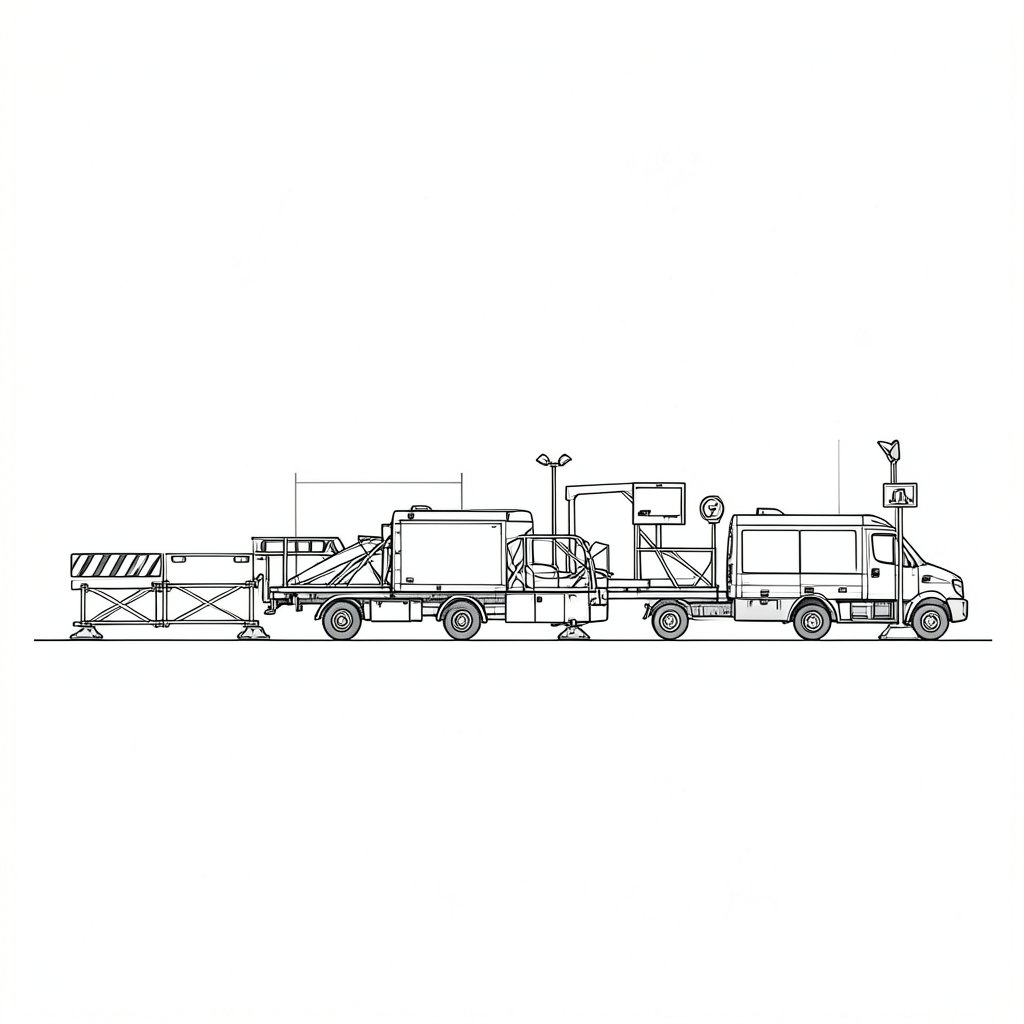
Some work cannot be given a static layout: it moves along the road, or it is over before a closure could be built. Both cases replace the layout with a moving arrangement, and both are more exposed than a fixed closure.
The vehicle becomes the layout
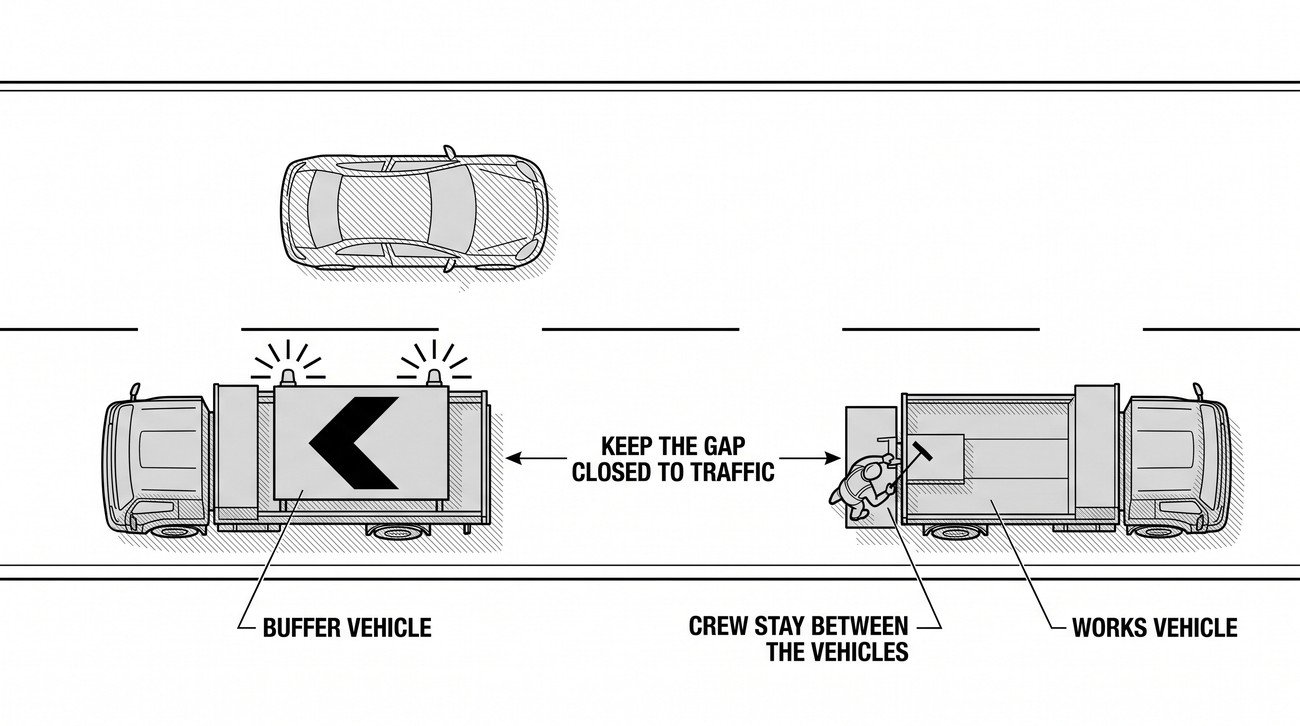
In mobile works the protection travels with the operation. A works vehicle displaying beacons and a directional arrow, and where the speed and consequence warrant it a second vehicle upstream acting as a buffer, replace the taper and the safety zone. Everything the fixed layout achieves with distance and cones has to be achieved by vehicle positioning, which makes the position of each vehicle a safety decision rather than a convenience.
Short duration is defined by exposure, not by intention
Short-duration working exists because building and removing a full closure has its own risk, and for a genuinely brief task that risk can exceed the benefit. The trap is that the definition is about how long people are exposed, not about how long the task was supposed to take. A five-minute job that turns into forty minutes has become a static works with no static layout, and the decision to upgrade has to be made at the point it overruns rather than at the end.
Nobody on foot beyond the vehicle
The rule that makes mobile works survivable is that people stay downstream of the protecting vehicle and out of the live lane. Work carried out from the vehicle, or from within the shadow it creates, keeps the arrangement intact. The moment someone walks upstream to look at something, or crosses in front, the protection has been left behind and the operation is a person standing in traffic.
Where mobile works are not appropriate
A moving arrangement depends on drivers seeing it in time and having somewhere to go. Over a crest, around a blind bend, in fog, or where the lane cannot be left because of a barrier or a narrow section, that condition is not met and the work needs a static closure or a different time of day. This is a judgement made on the road rather than in the office, and it should be as acceptable to stop and rethink as to proceed.
The convoy has to hold together
Where more than one vehicle forms the arrangement, the spacing between them is part of the design. Too close and the buffer vehicle cannot absorb an impact without striking the works vehicle; too far and drivers filter into the gap, putting a member of the public between the protection and the people. Keeping station takes deliberate effort, and it degrades quickly when the operation slows down or stops for something.
For the static arrangement this replaces, see the anatomy of a layout. For the phases where a static layout is also absent, see setting out and taking down.
Related standards
The standards below set the classification, testing and performance requirements behind the equipment used for this work.
Common errors
1Treating short duration as a description of the intended task rather than of actual exposure.
2Continuing a mobile arrangement after the job has become static.
3Walking upstream of the protecting vehicle or crossing in front of it.
4Running mobile works over a crest, on a blind bend or in fog.
5Letting the gap between buffer and works vehicle open up so traffic filters into it.
Frequently asked questions
What replaces the layout in mobile works?
The vehicles. A works vehicle with beacons and a directional arrow, and where warranted a buffer vehicle upstream, do the job the taper and safety zone do in a static closure.
What actually defines short-duration working?
How long people are exposed, not how long the task was expected to take. A five-minute job that runs to forty minutes has become static works without a static layout.
Where must people stay during mobile works?
Downstream of the protecting vehicle and out of the live lane. Walking upstream to look at something or crossing in front leaves the protection behind.
When are mobile works inappropriate?
Over a crest, around a blind bend, in fog, or where a barrier or narrow section means drivers cannot leave the lane. Those conditions remove the driver's ability to see the arrangement in time and respond.
Why does the gap between vehicles matter?
Too close and the buffer cannot absorb an impact without striking the works vehicle. Too far and drivers filter into the gap, putting a member of the public between the protection and the crew.
Need this as a document you can issue? The template library gives you the risk assessments, permits and inspection logs in editable form — and employer plans cover a whole team with completion records.