Safety / Tips and Tricks / Explosive Atmosphere
Activity 08 · Explosive Atmosphere
Housekeeping and Combustible Dust Control
Combustible dust has a failure mode nothing else in industrial safety quite matches: the settled dust layer that looks like a housekeeping nuisance is also the fuel for a secondary explosion far more destructive than whatever initial event disturbs it into the air.
The primary and secondary explosion sequence
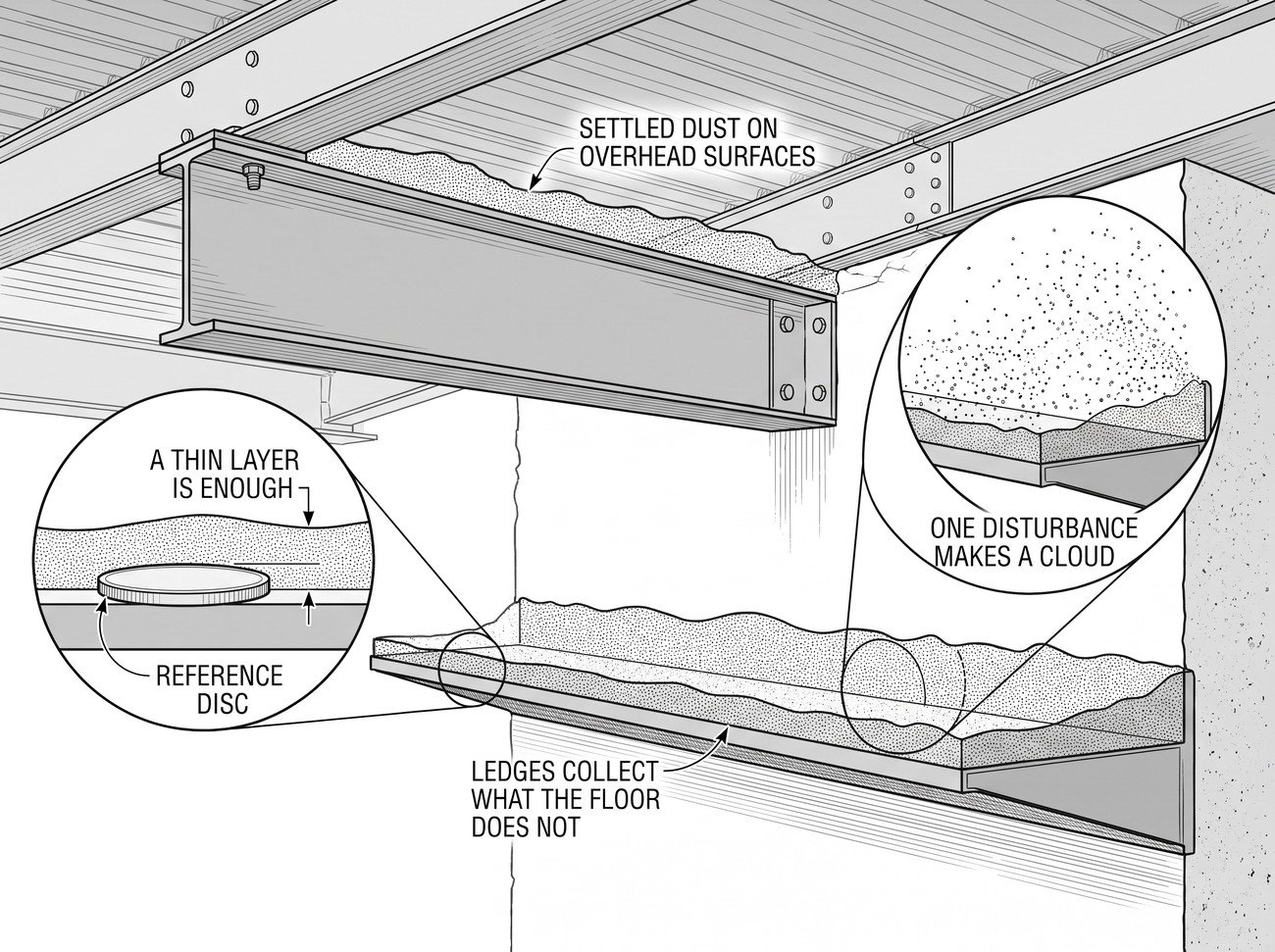
A relatively small primary event — a dust cloud igniting inside a piece of equipment, or a minor deflagration in a confined space — produces a pressure wave that lifts settled dust off beams, ledges, ductwork and floors throughout the surrounding area, creating a far larger dust cloud that then ignites from the primary event itself. The secondary explosion is typically the one that causes catastrophic structural damage and casualties, and it is fueled entirely by dust that had simply been allowed to accumulate rather than by anything about the process itself.
Why layer thickness matters more than it appears
A surprisingly thin layer of settled combustible dust across a large surface area contains enough material to create an explosive cloud when disturbed, which is why dust accumulation thresholds in guidance are measured in fractions of a millimetre rather than in visibly significant depths. A layer thin enough that the surface underneath is still visible through it can still be well past the point where it represents a genuine secondary explosion fuel load.
Elevated and concealed surfaces
Routine housekeeping tends to address floors and accessible work surfaces, while the surfaces that matter most for secondary explosion risk — overhead beams, cable trays, ductwork tops, light fittings, and the tops of equipment enclosures — are precisely the ones outside normal cleaning reach and outside normal sight lines. A facility can look genuinely clean at floor level while holding a substantial dust fuel load overhead, which is why elevated surface cleaning needs to be a scheduled task in its own right rather than something addressed opportunistically.
Cleaning methods that do not create clouds
Compressed air blowdown and dry sweeping both actively create the airborne dust cloud that housekeeping exists to prevent, converting a settled fuel load directly into an explosive atmosphere in the moment of cleaning. Vacuum systems rated for combustible dust, wet cleaning methods where the material permits, and gentle manual collection avoid this, and using compressed air to clean a combustible dust accumulation is one of the more direct ways to cause the event the cleaning was meant to prevent.
Vacuum equipment rating
An ordinary industrial vacuum used on combustible dust introduces its own ignition sources — motor brushes, static accumulation in non-conductive hose, and a dust-air mixture concentrated inside the collection vessel — and vacuum equipment used for combustible dust needs to be specifically rated for that duty, with conductive hose, bonded and grounded construction, and an appropriate motor arrangement.
For zone classification of dust areas, see understanding ATEX zone classification.
Related standards
The standards below set the test methods and performance levels behind the equipment referenced in this note.
- EN 149 — Filtering half masks (FFP1/FFP2/FFP3)
- EN 143 — Particle filters
- EN 1149 — Electrostatic properties of protective clothing
Common errors
1Judging dust accumulation by whether it looks visually significant rather than against thin-layer thresholds.
2Cleaning floors thoroughly while overhead beams, ductwork and cable trays accumulate the dust that fuels a secondary explosion.
3Using compressed air blowdown or dry sweeping, which convert a settled fuel load directly into an explosive cloud.
4Using an ordinary industrial vacuum rather than equipment specifically rated for combustible dust duty.
Frequently asked questions
What is a secondary dust explosion?
A pressure wave from a smaller primary event lifts settled dust from beams, ledges and floors into a much larger cloud that then ignites, and this secondary explosion typically causes the catastrophic damage.
Why do dust accumulation thresholds seem so thin?
A surprisingly thin layer across a large surface area contains enough material to create an explosive cloud when disturbed, so thresholds are measured in fractions of a millimetre rather than visible depths.
Which surfaces matter most for dust housekeeping?
Overhead beams, cable trays, ductwork tops, light fittings and equipment enclosure tops, which are outside normal cleaning reach and sight lines yet accumulate the dust that fuels secondary explosions.
Why should compressed air not be used to clean combustible dust?
It actively creates the airborne dust cloud that housekeeping exists to prevent, converting a settled fuel load directly into an explosive atmosphere at the moment of cleaning.
Can an ordinary industrial vacuum be used on combustible dust?
No, it introduces ignition sources through motor brushes, static in non-conductive hose, and a concentrated dust-air mixture inside the vessel; equipment specifically rated for combustible dust duty is needed.
Need this as a document you can issue? The template library gives you the risk assessments, permits and inspection logs in editable form — and employer plans cover a whole team with completion records.