Safety / Tips and Tricks / Explosive Atmosphere
Activity 08 · Explosive Atmosphere
Understanding ATEX Zone Classification: Gas and Dust
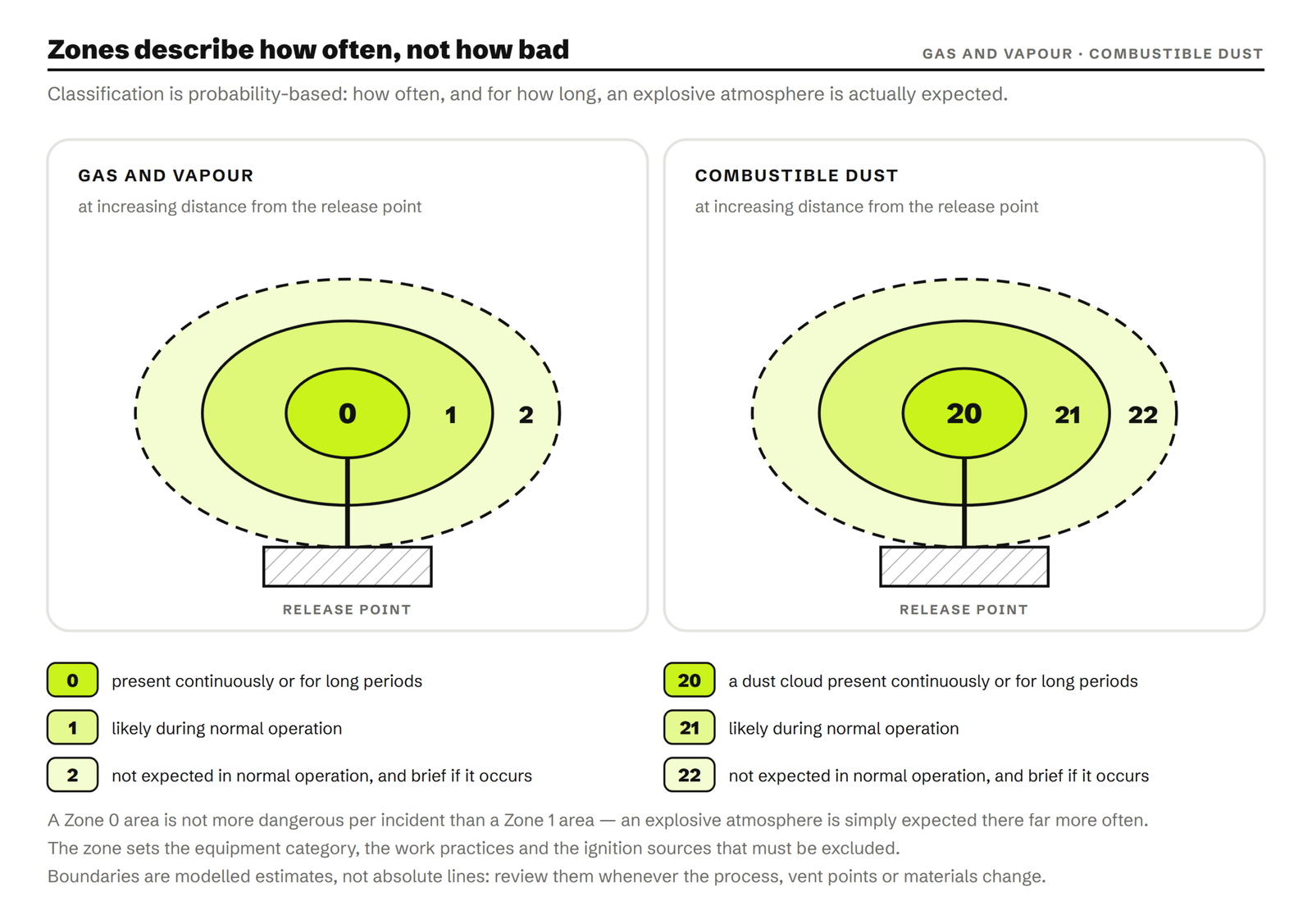
Not every part of a facility handling flammable gas or combustible dust carries the same explosion risk, and zone classification exists to make that difference explicit — matching the level of ignition-source control in any given area to how often, and for how long, an explosive atmosphere is actually likely to be present there.
Gas and vapour zones
Areas where flammable gas or vapour is handled are classified into three zones based on how frequently an explosive atmosphere is expected: Zone 0 covers areas where an explosive atmosphere is present continuously or for long periods, Zone 1 covers areas where it is likely to occur during normal operation, and Zone 2 covers areas where it is not expected during normal operation and, if it does occur, only briefly. This is a probability-based classification, not a severity-based one — a Zone 0 area is not necessarily more dangerous per incident than a Zone 1 area, but an explosive atmosphere is expected there far more often.
Dust zones
Combustible dust areas use a parallel classification — Zone 20, 21 and 22 — following the same continuous, likely, and unlikely-but-possible logic as the gas zones, but applied to a combustible dust cloud rather than a gas or vapour. Dust hazards are frequently underestimated relative to gas hazards because dust does not disperse and reappear the way a gas leak does; instead it settles, accumulates, and can be redistributed into an explosive cloud by something as simple as a passing air current or vibration disturbing a settled dust layer.
Why zone boundaries are not fixed forever
A zone classification reflects the process and equipment as they exist at the time of assessment, and any change — a new vent point, a modified process, different material handling — can shift where the actual zone boundaries should sit, whether that means expanding a zone or, sometimes, allowing it to be reduced. Treating zone drawings as a fixed, one-time document rather than something reviewed whenever the underlying process changes lets the classification drift out of step with the actual physical risk.
What zone classification actually controls
The zone assigned to an area determines what equipment category is required there, what work practices apply, and what ignition sources must be excluded, which is why zone classification is the foundational document that every other explosive atmosphere control — equipment selection, hot work permitting, personal ignition source control — ultimately depends on. Working in a zone without knowing its actual classification means working without knowing which of these controls actually apply.
Unclassified and adjacent areas
Areas immediately adjacent to a classified zone are not automatically safe simply because they fall outside the marked boundary, since gas can disperse beyond a drawn boundary under certain wind or ventilation conditions, and dust can be tracked or blown into adjacent spaces on equipment, clothing, or footwear. Treating a zone boundary as an absolute, unchangeable line rather than a modeled estimate based on typical conditions misses this margin.
For the equipment standards that zone classification determines, see selecting ATEX-rated electrical equipment.
Related standards
The standards below set the test methods and performance levels behind the equipment referenced in this note.
- EN 1149 — Electrostatic properties of protective clothing
- EN ISO 13688 — General requirements for protective clothing
- EN ISO 20345 — Safety footwear
Common errors
1Assuming zone classification reflects severity rather than the likelihood and duration of an explosive atmosphere being present.
2Treating dust hazards as automatically lower-risk than gas hazards because dust does not visibly disperse the same way.
3Continuing to rely on zone drawings that have not been reviewed since a relevant process or equipment change.
4Assuming an area just outside a marked zone boundary carries no residual risk under all conditions.
Frequently asked questions
What is the difference between Zone 0, 1 and 2 for gas and vapour areas?
They reflect how often an explosive atmosphere is expected: Zone 0 continuously or for long periods, Zone 1 likely during normal operation, and Zone 2 not expected during normal operation and only briefly if it does occur.
Is zone classification based on how severe an explosion would be?
No, it is a probability-based classification reflecting how often and for how long an explosive atmosphere is present, not the severity of any single event.
Why is combustible dust risk often underestimated compared to gas?
Dust does not disperse and reappear like a gas leak; instead it settles and accumulates, and can be redistributed into an explosive cloud by something as simple as a passing air current or vibration.
Why does zone classification need to be reviewed periodically?
A new vent point, modified process, or different material handling can shift where the actual zone boundaries should sit, so treating the classification as a one-time document lets it drift out of step with actual risk.
Is an area just outside a marked zone boundary automatically free of risk?
Not necessarily; gas can disperse beyond a drawn boundary under certain conditions, and dust can be tracked or blown into adjacent spaces, so the boundary is a modeled estimate, not an absolute line.
Need this as a document you can issue? The template library gives you the risk assessments, permits and inspection logs in editable form — and employer plans cover a whole team with completion records.