Safety / Tips and Tricks / Rope access and confined space
Activity 01 · Rope access
Wire Strop Inspection: What to Check Before Every Lift
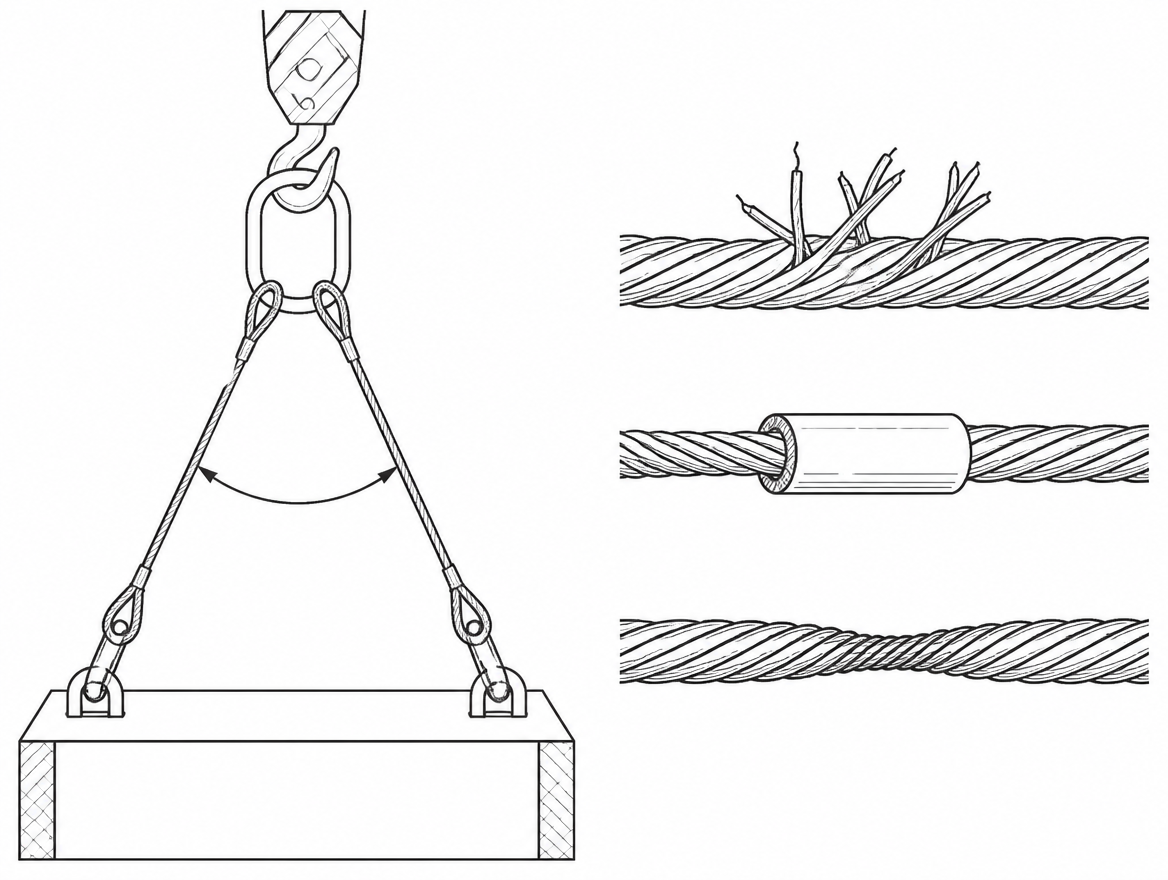
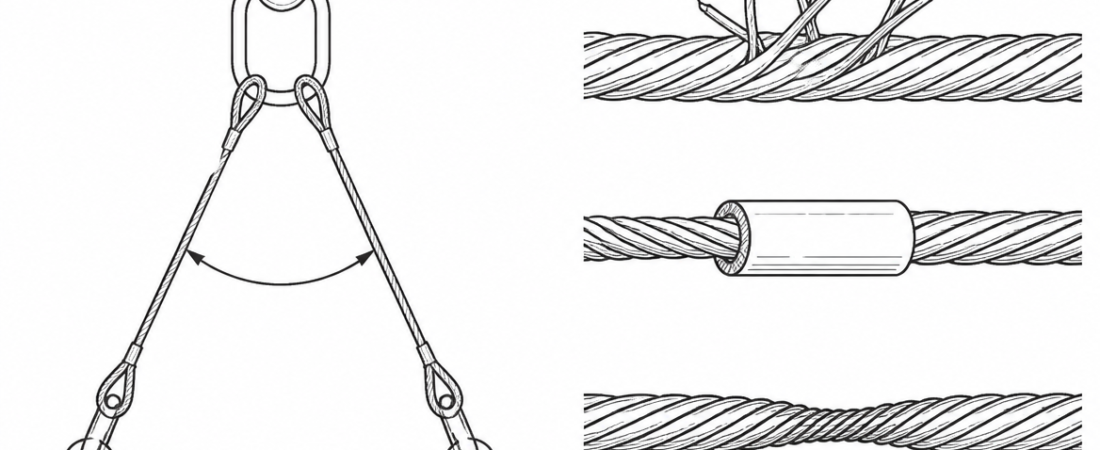
A wire strop that is about to fail almost always shows it first: a handful of broken wires standing proud of a strand, a ferrule that has crept along the rope, a local reduction in diameter where the core has collapsed. The pre-use wire strop inspection exists to catch exactly those signals. It takes well under a minute for a 2 m single-leg sling, needs no tools beyond gloves, a rag and adequate light, and it is the responsibility of the person about to use the sling – not something discharged by the examination certificate in the site office.
This article covers single- and multi-leg steel wire rope slings for general lifting service, with ferrule-secured or hand-spliced soft eyes, thimble eyes, or forged fittings. It sets out what to look at, in what order, and what the recognised discard indicators are.
The standards a wire strop is built and judged against
Knowing which document governs which part of the sling makes the inspection faster, because it tells you what should be there in the first place.
- EN 13414-1 – steel wire rope slings for general lifting service: construction, rating and identification requirements.
- EN 13414-2 – the information for use and maintenance the manufacturer must supply with the sling. The binding discard criteria for a specific sling live here and in the manufacturer’s accompanying documentation; where they differ from generic guidance, they take precedence.
- EN 13414-3 – grommets and cable-laid slings, if that is what is on the hook.
- EN 12385-4 – stranded steel wire ropes for general lifting applications.
- EN 13411 series – terminations: thimbles, spliced eyes in wire rope slings, ferrules and ferrule-securing, and wire rope grips, each in its own part.
- EN 1677 series – forged steel components such as master links and hooks fitted to multi-leg assemblies.
- Directive 2006/42/EC (Machinery Directive) – a sling is a lifting accessory: CE marked, supplied with a Declaration of Conformity. Regulation (EU) 2023/1230 replaces the Directive from 20 January 2027.
- Directive 2009/104/EC – the use of work equipment, including the requirement for inspection by competent persons. Interval requirements come from each member state’s implementing legislation, not from the directive text itself.
Start with the identification, not the rope
If the sling cannot be identified, nothing else about the inspection matters. A strop rated to EN 13414-1 carries durable identification giving, as a minimum, the working load limit, the identification number that traces back to its examination record and Declaration of Conformity, the manufacturer, and the standard it was made to. Multi-leg assemblies also carry rated capacities for the permitted angle ranges.
Two failures at this stage put the sling out of service immediately:
- Identification missing, unreadable, or detached – the working load limit cannot be verified, and the sling cannot be matched to its records.
- Identification present but the rating does not cover the intended use – a choker hitch and a basket hitch do not share the WLL of a straight pull, and multi-leg capacity falls as the included angle opens. Read the rating for the hitch and angle actually planned, not the largest number on the tag.
Laying out and handling the strop so damage is actually visible
Most missed defects are missed because the sling was inspected while coiled, greasy, or in poor light. The method matters:
- Uncoil the strop to its full length on a clean, dry surface, in good light. Damage frequently sits in the section that normally rests inside a hook or against a load edge.
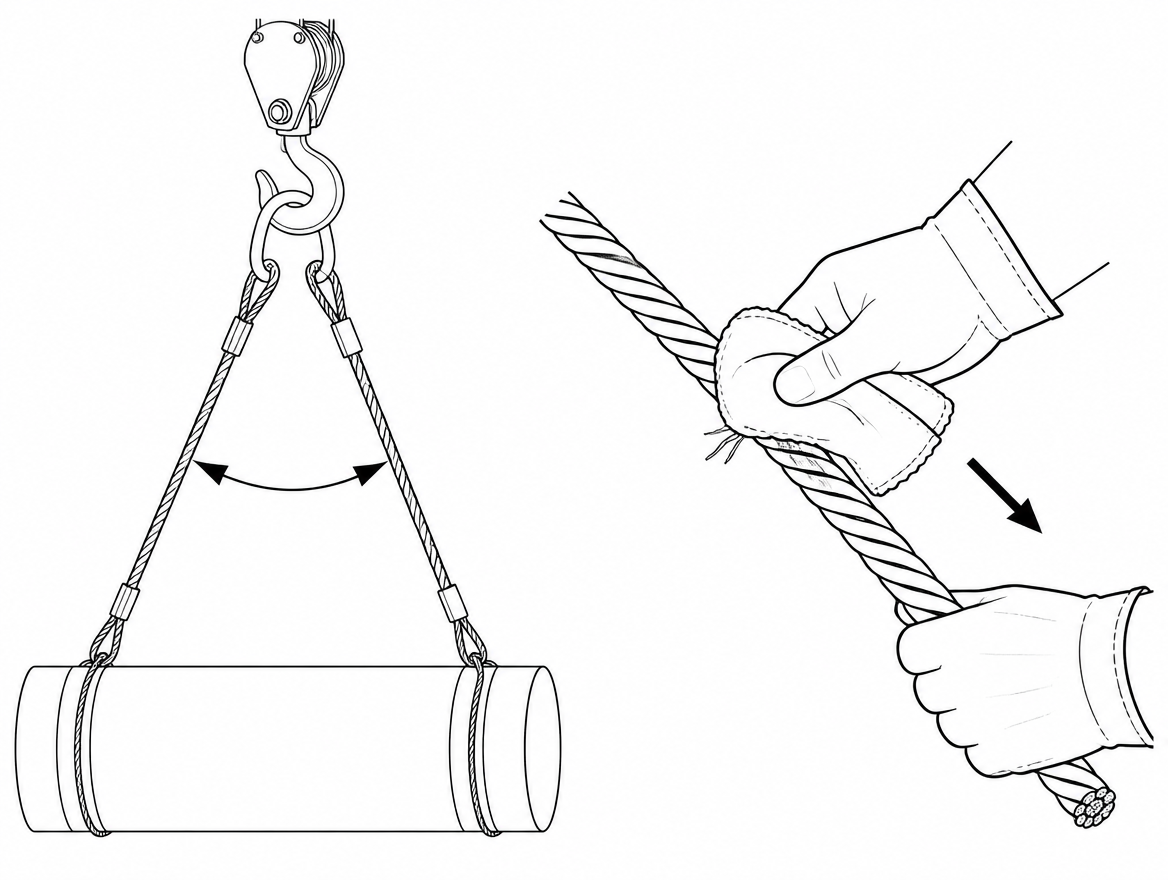
- Wipe off surface grease and dirt with a rag so that broken wires and pitting are visible. Do not degrease the rope aggressively – the lubricant is part of its corrosion and wear protection.
- Wear gloves. To find broken wires, draw a folded cloth slowly along the rope: protruding wire ends snag the cloth. Never run a bare hand along a wire rope.
- Rotate the rope as you go so all sides are seen, and inspect the full length of every leg plus both terminations.
Broken wires and the one-lay-length rule
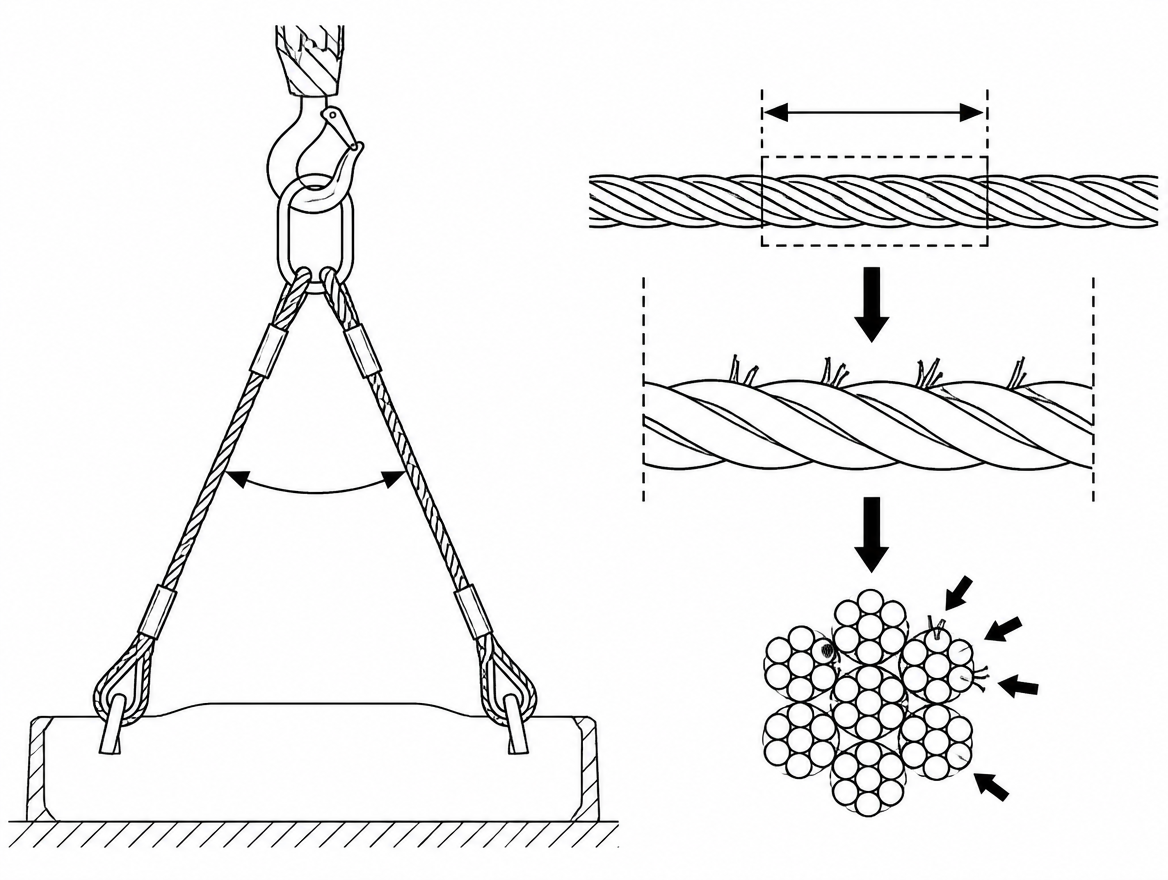
Broken wires are counted within one rope lay length: the distance along the rope in which one strand makes a complete turn around the rope axis. Clusters matter more than totals, because a group of breaks in one strand indicates a localised loss of section rather than general wear.
Two thresholds are widely applied to wire rope slings in EU practice: ten randomly distributed broken wires within one rope lay length, or five broken wires within a single strand in one lay length. Confirm the exact figures against the information supplied with the sling under EN 13414-2, because construction and application affect them.
Regardless of the count, treat these as discard conditions:
- Any broken wire at, or within one lay length of, a ferrule, splice or socket.
- Broken wires concentrated at a point where the rope regularly bends over an edge or a hook saddle.
- Wires that have broken and are protruding as a loop rather than as ends – that indicates internal disturbance, not surface wear.
Diameter reduction, crown wear and localised thinning
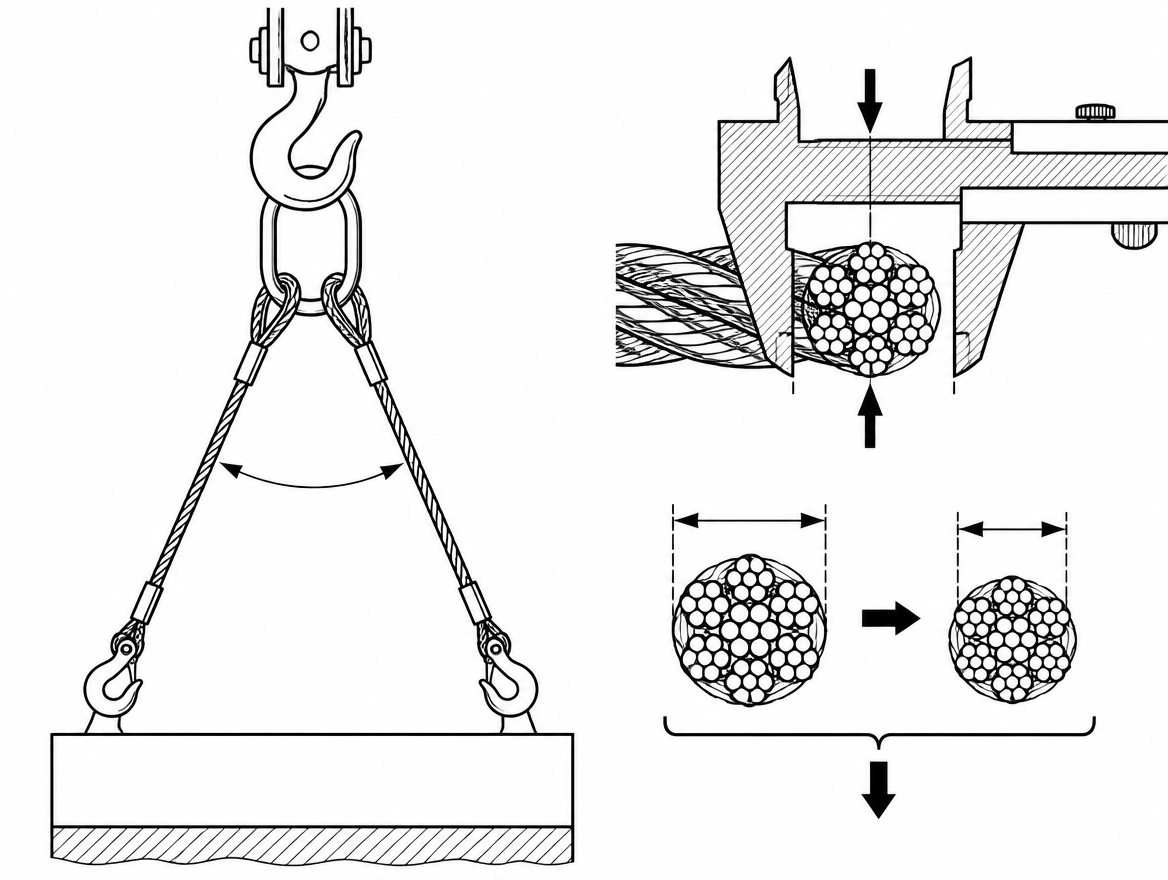
Measure across the crowns of two opposite strands with calipers fitted with jaws broad enough to bridge them, at several points along the length, and compare against the nominal diameter or, better, the actual diameter recorded when the sling was new. A reduction of more than 10 % of nominal diameter is the reduction figure commonly applied as a discard criterion for wire rope slings; again, the manufacturer’s information governs.
Look at the pattern as well as the number:
- Uniform flattening of the crown wires along a working length is external abrasive wear. It reduces metallic cross-section directly.
- A localised reduction over a short length, often with the strands appearing tighter, usually means core failure or internal corrosion beneath an intact-looking surface. Withdraw the sling.
- Diameter increase at a point is equally significant: it points to core protrusion or strand displacement.
Deformations: kinks, birdcaging, crushing and core protrusion
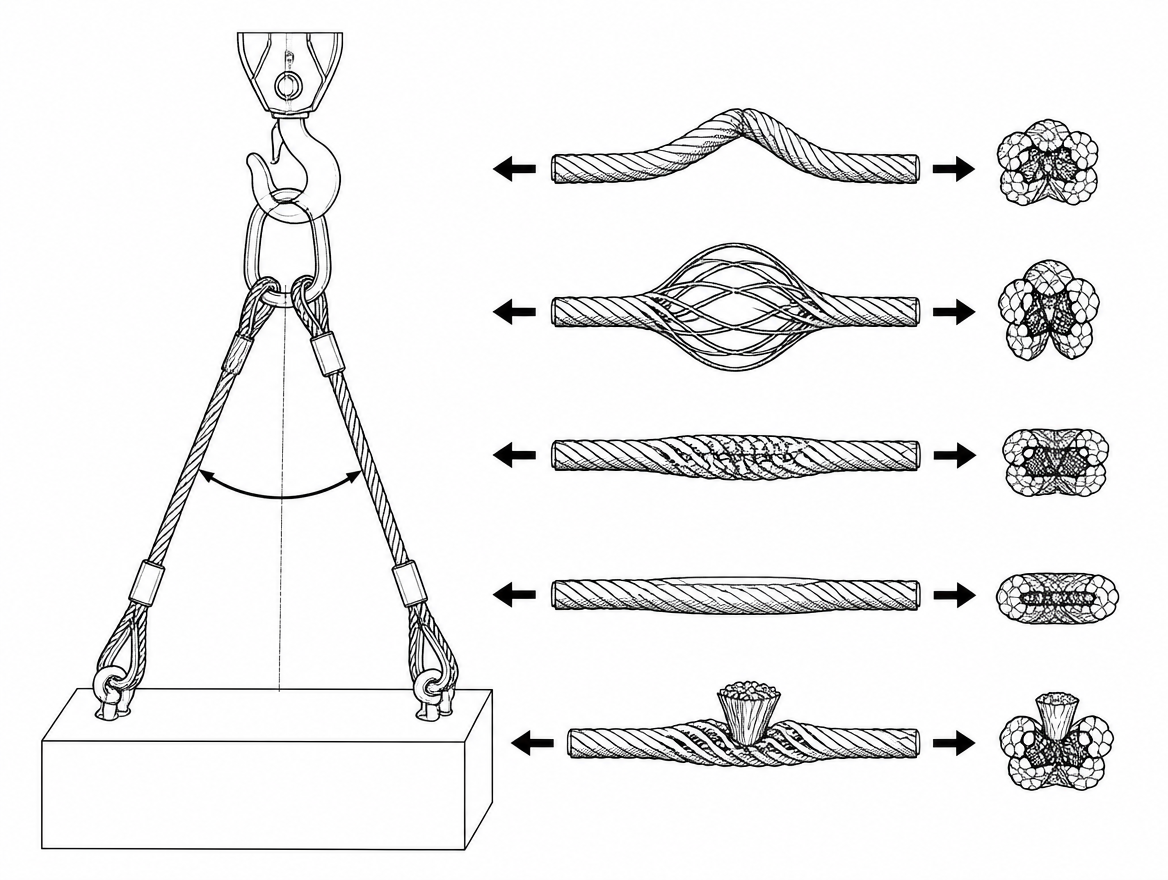
Permanent deformation means the rope’s strands no longer share load as designed. None of the following can be worked out, straightened, or dressed back into shape in the field – each is a withdrawal condition:
- Kinks and sharp bends – a tight bend that has set into the rope, typically from dragging a loaded sling around a corner or pulling out a loop under tension.
- Birdcaging – outer strands ballooning away from the core, usually after shock loading, sudden release of tension, or rotation of a free load.
- Crushing and flattening – the rope pressed into an oval where a load has borne down on it, often on the underside of a basket hitch.
- Core protrusion – core material pushed out between two strands.
- Waviness – the rope no longer lies straight when slack but follows a corkscrew form.
- Strand distortion or displacement – strands standing proud, loose, or unevenly spaced.
Corrosion, lubrication and heat or chemical damage
Surface rust bloom on an otherwise well-lubricated rope is not automatically a discard condition, but pitting is: corrosion pits reduce wire diameter and create crack initiation points. Rope that has become dry, stiff, and rust-coloured deep between the strands should be assumed to be corroded internally, where it cannot be measured, and withdrawn.
Also withdraw a strop showing:
- Discolouration from heat – blue or straw tempering colours, scorched or burnt-off lubricant, or the fibre core of a fibre-cored rope charred.
- Arc strikes or weld spatter, including damage from a welding return current path passing through the sling. Local melting destroys the wire properties at that point.
- Suspected contact with acids, alkalis, or acid fumes, which can embrittle wires with little visible change.
Heat and chemical exposure cannot be assessed by eye alone. Refer the sling to a competent person rather than deciding on site.
Terminations, ferrules, thimbles and fittings
The terminations are the highest-stress region of the assembly and the place where a defect is least forgiving. Inspect each end individually.
Ferrule-secured eyes
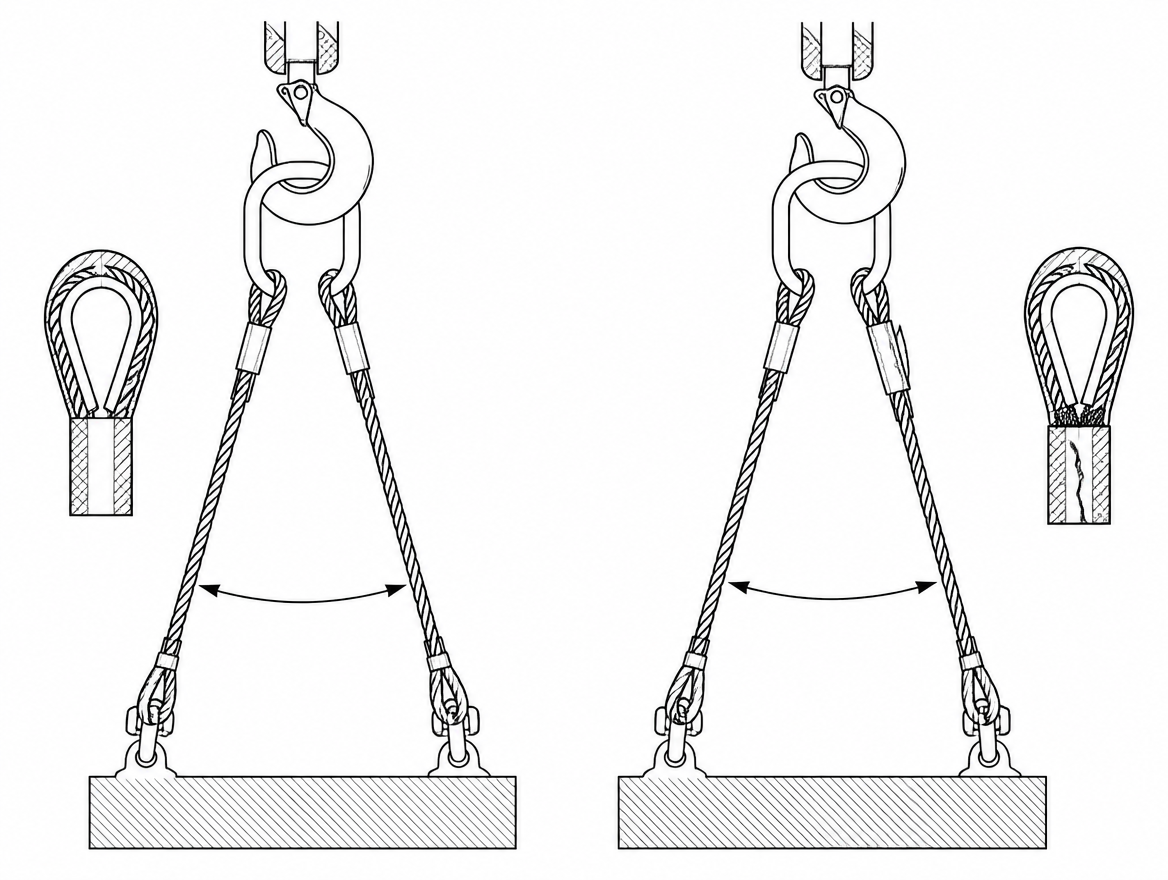
- Cracks, splits, or corrosion of the ferrule body.
- Any sign that the ferrule has moved along the rope: the rope tail protrusion beyond the ferrule differing from the other end, or a clean band of unweathered rope emerging at the ferrule mouth.
- Deformation, gouging, or hammer marks from the ferrule being used as a wear point.
- Broken wires where the rope enters the ferrule, and the rope legs no longer parallel where they leave it.
Hand-spliced eyes
- Tucks that have pulled, lifted, or unlaid; serving that has come loose exposing the splice.
- Broken wires within the splice or immediately alongside it.
Thimbles and forged fittings
- Thimble distorted, worn thin at the point, or loose in the eye.
- Hooks: increase in throat opening, twist out of plane, wear in the saddle, a latch that does not close and seat, or a self-locking mechanism that does not engage.
- Master links and intermediate links: elongation, flat wear areas at the bearing points, nicks, and cracks.
- Any component whose own identification is missing when the assembly rating depends on it.
What to do with a strop that fails the check
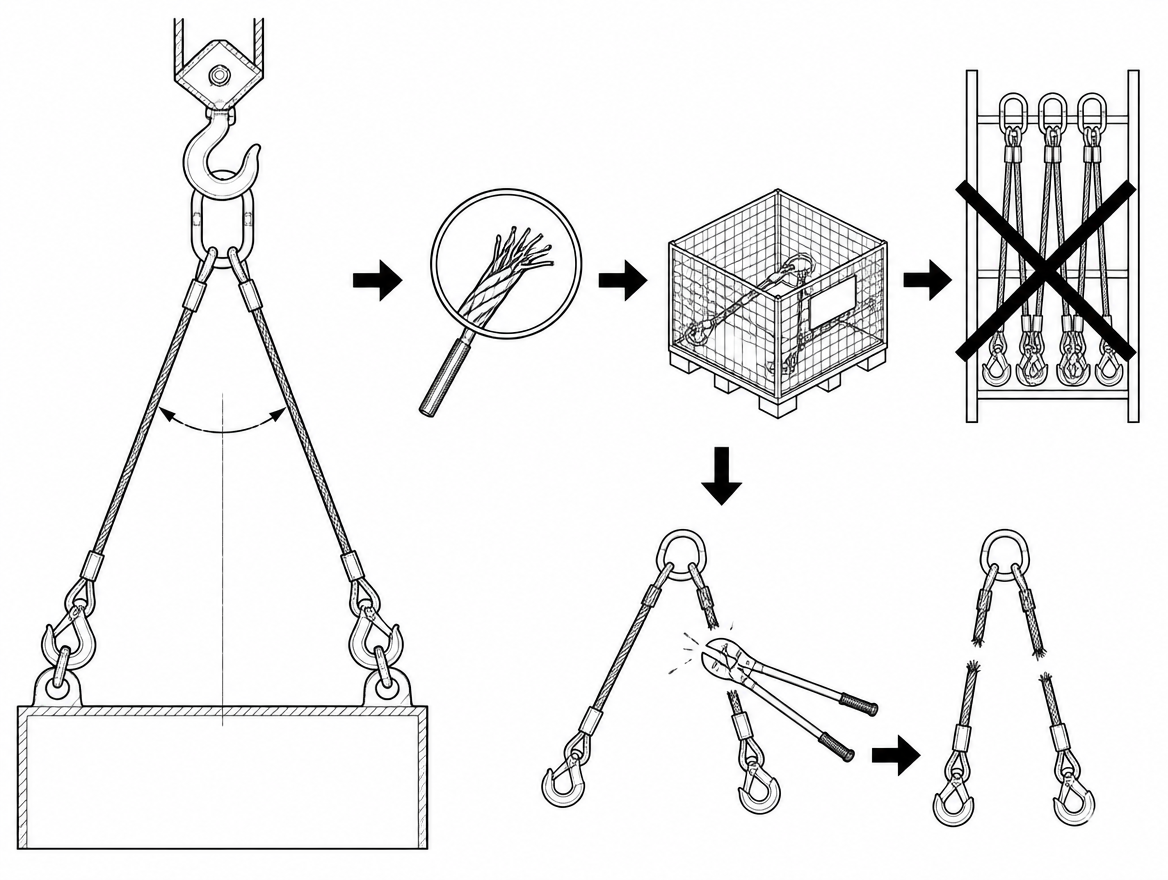
A sling withdrawn from service must not be able to find its way back onto a hook. Hanging it back on the rack with a verbal warning is how failed slings get reused on the next shift.
- Remove the sling from the work area immediately.
- Segregate it physically – a dedicated quarantine container or cage, not the general rigging rack.
- Report it and record it against the sling identification number in the lifting accessory register.
- Have a competent person decide between destruction and referral to the manufacturer. Where the outcome is scrapping, destroy the assembly so it cannot be recovered and reused.
Field repair of a wire strop is not an option. Re-swaging, welding, heating, replacing a ferrule, knotting the rope, or shortening a leg with wire rope grips or a knot all invalidate the rated capacity and the conformity of the accessory.
How the pre-use check relates to periodic thorough examination
The two are separate and neither replaces the other. Periodic inspection by a competent person is required under national law implementing Directive 2009/104/EC, and the interval – commonly six or twelve months for lifting accessories depending on the member state and the duty – is set by that national legislation and by the risk assessment for the equipment’s use. That examination is documented and traceable to the sling identification.
The pre-use wire strop inspection is a visual and tactile check by the user, immediately before the lift, covering the period since the sling was last handled. Severe service, elevated temperatures, chemical exposure, or any suspected overload or shock load are triggers for re-examination outside the normal cycle, whatever date is on the certificate.
The one-minute pre-use sequence
- Identification present, legible, and rated for the planned hitch and angle.
- Full length uncoiled, wiped, and in good light.
- Cloth drawn along the whole length of each leg for broken wires; count within one lay length.
- Diameter checked at the worn and working sections; look for local thinning or swelling.
- Whole length scanned for kinks, birdcaging, crushing, core protrusion, and waviness.
- Corrosion pitting, dryness, heat colours, and arc strikes checked.
- Both terminations examined: ferrule or splice condition, ferrule movement, thimble, hooks, links, latches.
- Protection planned for every edge the rope will bear against, so today’s lift does not create tomorrow’s defect.
Next step
Take the manufacturer’s information supplied with each sling under EN 13414-2 out of the file and check its stated discard criteria against the thresholds your riggers actually apply – they are the criteria that count in a dispute. Then confirm that the rigging loft has a quarantine container that is genuinely separate from the in-service rack, and that the lifting accessory register lists every strop by identification number with its last examination date.
Frequently asked questions
Who is responsible for the pre-use inspection of a wire strop?
The person about to use the sling. It is not discharged by the examination certificate held in the site office. The check takes well under a minute for a 2 m single-leg sling and needs no tools beyond gloves, a rag and adequate light.
What must the identification on a wire rope sling show?
A strop rated to EN 13414-1 carries durable identification giving, as a minimum, the working load limit, the identification number that traces back to its examination record and Declaration of Conformity, the manufacturer, and the standard it was made to. Multi-leg assemblies also carry rated capacities for the permitted angle ranges. If the identification is missing, unreadable or detached, the sling goes out of service immediately because the working load limit cannot be verified and the sling cannot be matched to its records.
How should the strop be laid out and handled during inspection?
Uncoil it to its full length on a clean, dry surface in good light, since damage frequently sits in the section that normally rests inside a hook or against a load edge. Wipe off surface grease and dirt with a rag, but do not degrease aggressively because the lubricant is part of the rope's corrosion and wear protection. Wear gloves, draw a folded cloth slowly along the rope so protruding wire ends snag it, rotate the rope so all sides are seen, and inspect the full length of every leg plus both terminations. Never run a bare hand along a wire rope.
How are broken wires counted, and what are the common discard thresholds?
Broken wires are counted within one rope lay length, the distance along the rope in which one strand makes a complete turn around the rope axis. Two thresholds are widely applied in EU practice: ten randomly distributed broken wires within one rope lay length, or five broken wires within a single strand in one lay length. The exact figures should be confirmed against the information supplied with the sling under EN 13414-2, because construction and application affect them.
Which broken-wire conditions mean discard regardless of the count?
Any broken wire at, or within one lay length of, a ferrule, splice or socket; broken wires concentrated at a point where the rope regularly bends over an edge or a hook saddle; and wires that have broken and are protruding as a loop rather than as ends, which indicates internal disturbance rather than surface wear.
Need this as a document you can issue? The template library gives you the risk assessments, permits and inspection logs in editable form — and employer plans cover a whole team with completion records.