Safety / Tips and Tricks / Rope access and confined space
Activity 01 · Rope access
Wearing a Helmet Without the Chinstrap: What Retention Actually Does
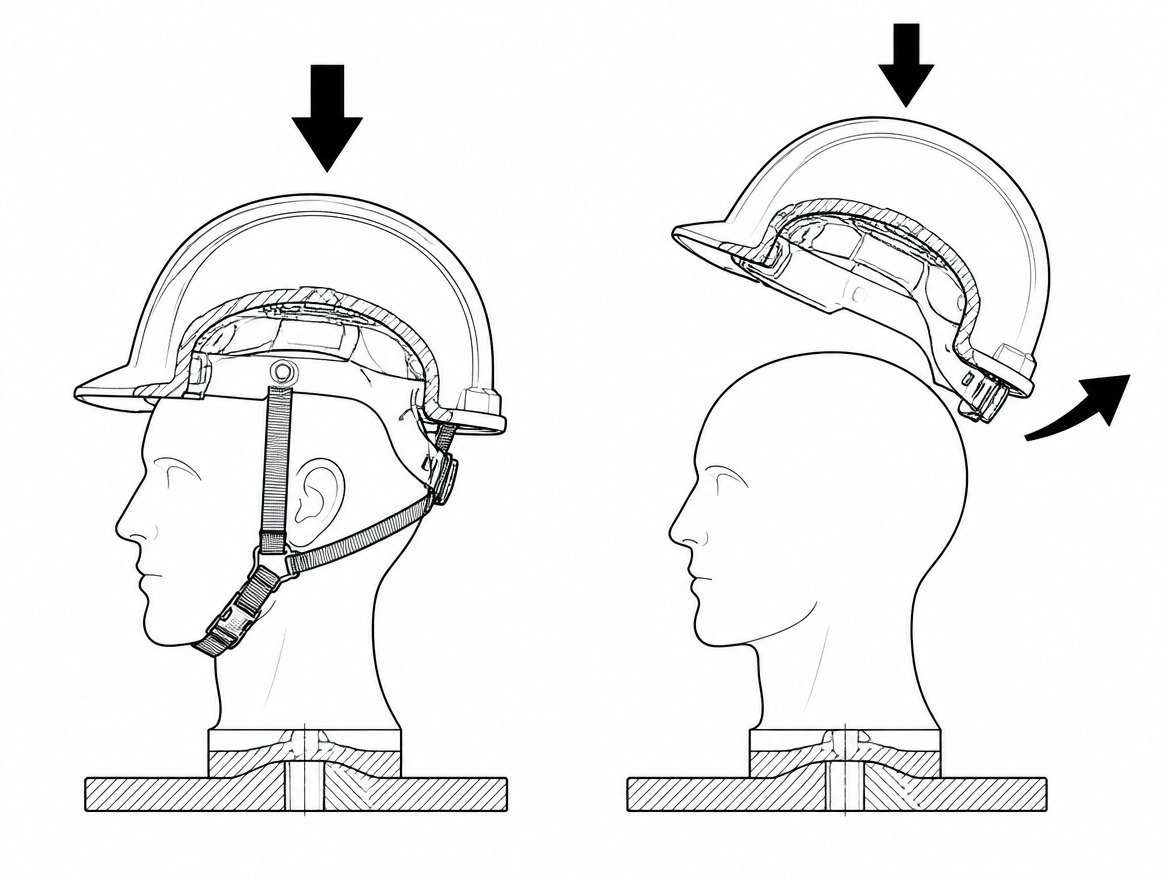
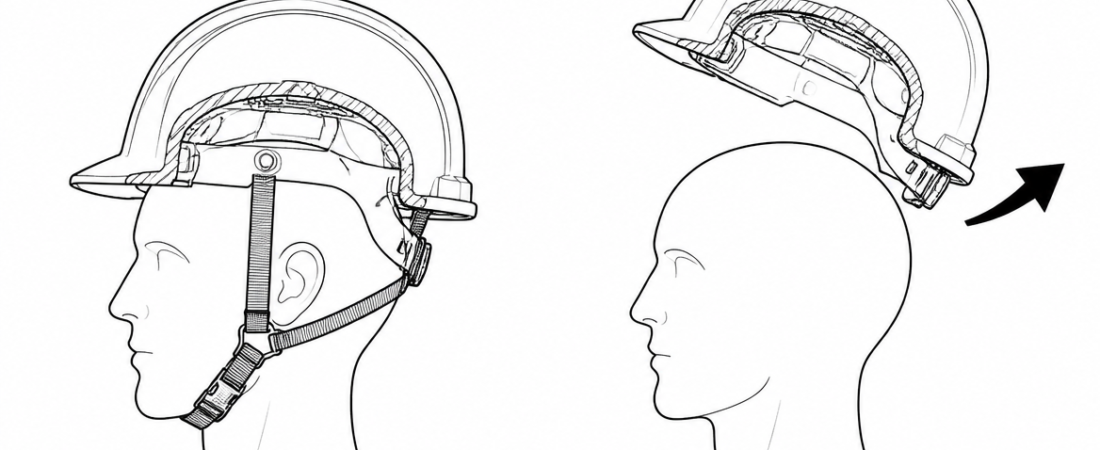
A safety helmet only protects the head it is still on. Every impact-attenuation figure in EN 397 or EN 12492 is measured with the helmet correctly positioned on a headform — crown centred, shell level, suspension loaded as designed. A helmet that has rotated backwards, slid forward over the eyes, or left the head entirely a fraction of a second before the impact is not attenuating anything. On site, the most common cause of that displacement is the simplest one: the chinstrap is hanging loose under the jaw, or has been removed from the shell altogether.
This article sets out what helmet chinstrap retention is designed to do, what the EN standards actually require (and don’t require), where the strap stops being optional, and how to check and adjust it so it works.
What EN 397 says about chinstraps — and why people misread it
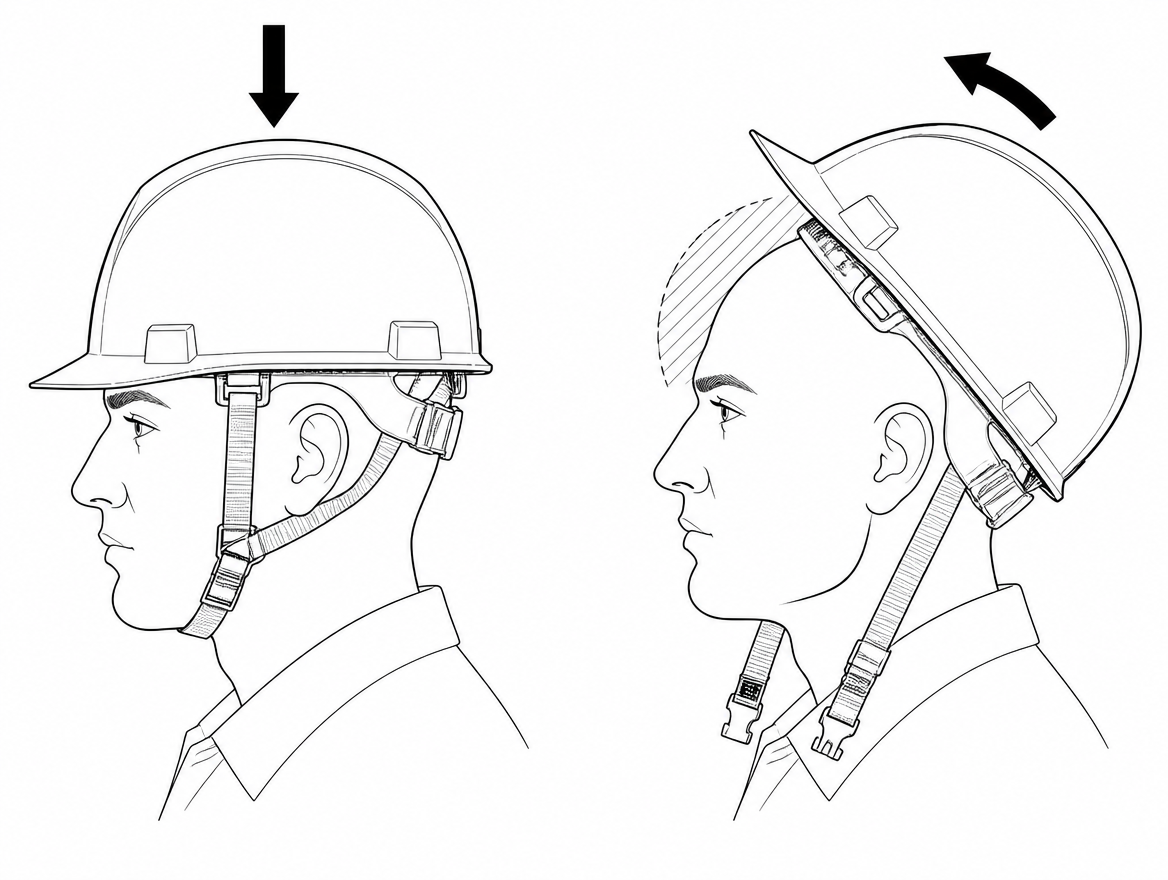
EN 397, the standard for industrial safety helmets, treats the chinstrap as an optional feature. A helmet can be fully compliant with EN 397 without one. That single fact is the source of most of the argument on site, because it is often repeated as “the standard says you don’t need a chinstrap.”
What EN 397 actually says is narrower. If a chinstrap is fitted, it must meet a defined performance requirement: the strap or its anchorage must release at a force of not less than 150 N and not more than 250 N. That is a deliberate upper limit. An industrial helmet is expected to be worn in environments with rotating shafts, conveyors, moving loads and drum machinery, where a strap that held indefinitely would become a strangulation or entanglement hazard. The release value is the standard’s answer to that risk — not evidence that retention is unimportant.
Two consequences follow, and both matter for how you write your rules:
- The presence of a chinstrap on an EN 397 helmet is a decision for the employer’s risk assessment, not something the standard makes for you.
- An EN 397 chinstrap is a positioning device that keeps the helmet on the head during normal movement and minor snags. It is not designed to hold the helmet in place during a fall arrest event.
The related test methods for head protection — including retention system strength and retention system effectiveness (the roll-off test) — sit in the EN 13087 series, which the product standards call up. If you need the exact test conditions for a specific helmet, the manufacturer’s information supplied under Regulation (EU) 2016/425 is the authoritative source, and it must be provided with the product.
Where the chinstrap stops being optional
Several standards and several task types remove the choice:
- EN 12492 — helmets for mountaineering, and the standard normally specified for work at height and rope access. Here the retention system is mandatory and is required to hold: it must not release below 500 N, with limited elongation, and the helmet must pass a roll-off test in which force is applied to pull it forward and backward off the headform. EN 12492 also addresses impacts to the front, sides and rear of the shell, not the crown alone — which only makes sense if the helmet is still on the head after a fall or swing.
- EN 14052 — high-performance industrial helmets, which are required to be supplied with a chinstrap. Check the manufacturer’s instructions for the release characteristics of the specific model rather than assuming they match EN 397.
- EN 50365 — electrically insulating helmets for work on low-voltage installations. The retention question here is practical: if the helmet can shift or drop off while the wearer is working in close proximity to live parts, the insulating shell is not where it needs to be.
Independently of the standard on the shell, a chinstrap should be treated as mandatory in the task risk assessment wherever the head or the helmet is likely to be moved unexpectedly. Typical triggers:
- work at height, on ladders, scaffolds, steelwork, or in a MEWP basket — including the travel and elevation phases;
- work where the wearer must bend, kneel, look down, or work overhead for sustained periods;
- confined-space entry and any work involving crawling or restricted headroom, where the shell is repeatedly knocked against structure;
- exposed sites in high wind, and open vehicle or plant operation;
- any position from which a displaced helmet becomes a dropped object for people working below.
That last point is frequently missed. A 400–500 g shell falling from a scaffold lift is a dropped-object incident in its own right, and it is not covered by the tethering arrangements most sites apply to tools.
What happens in an impact when the helmet is not retained
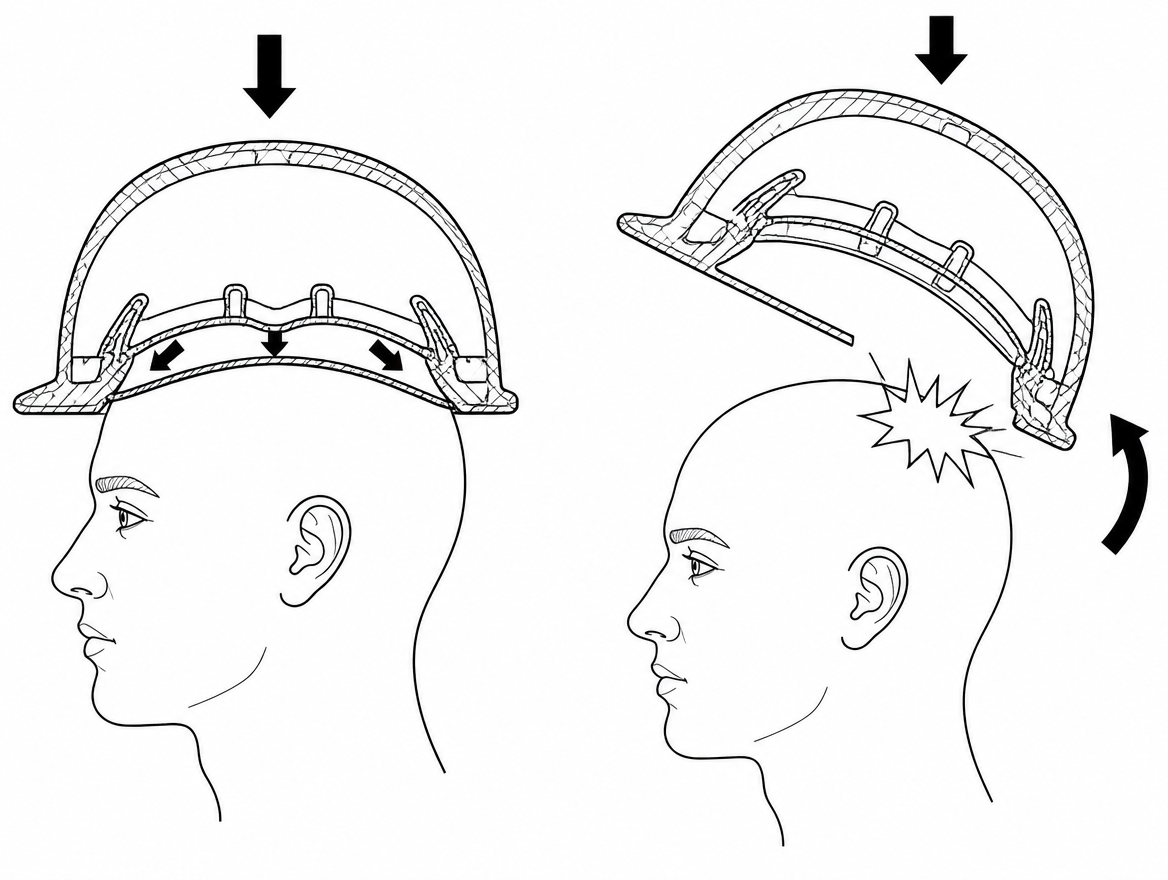
An EN 397 helmet’s shock absorption is measured with a striker dropped onto the crown of a correctly positioned helmet, with the force transmitted to the headform limited to 5 kN. The protective system is a shell that spreads and deflects the load and a suspension harness that holds a clearance gap between shell and skull, absorbing energy as it deforms.
Remove retention and three things change:
- Position at the moment of contact. A helmet sitting high on the back of the crown, as an unstrapped helmet tends to after a few hours of movement, presents the brim and the shell edge to a falling object instead of the reinforced crown. The load path the shell was designed around no longer applies.
- Loss of the shell during the event. A glancing blow, a snag on scaffold tube, or the first part of a fall will remove an unstrapped helmet. Secondary impacts — head against structure, against the ground, against the basket rail — then happen bare-headed. In falls from height, the secondary impact is very often the one that causes the head injury.
- Rotation instead of retention. Front, side and rear impacts rotate an unstrapped shell off the head rather than being resisted by it. This is precisely why EN 12492 pairs its off-crown impact requirements with a load-bearing retention system.
Two-point and four-point retention are not interchangeable
A two-point strap anchors at the sides of the shell and runs under the chin. It stops the helmet lifting straight off, but does relatively little to prevent the shell tipping forward or back around those two anchor points.
A four-point system splits the webbing into a Y on each side — typically one leg forward of the ear and one behind, meeting at the nape — so that forward and rearward rotation are both resisted. This is the geometry used on helmets intended for work at height, and it is the reason an EN 12492 helmet stays oriented during a swing or roll.
If a task risk assessment calls for retention during a fall, a two-point strap on an EN 397 shell does not satisfy it. Specify the helmet type, not just “a helmet with a chinstrap.”
The strangulation objection, and why the release force is the answer
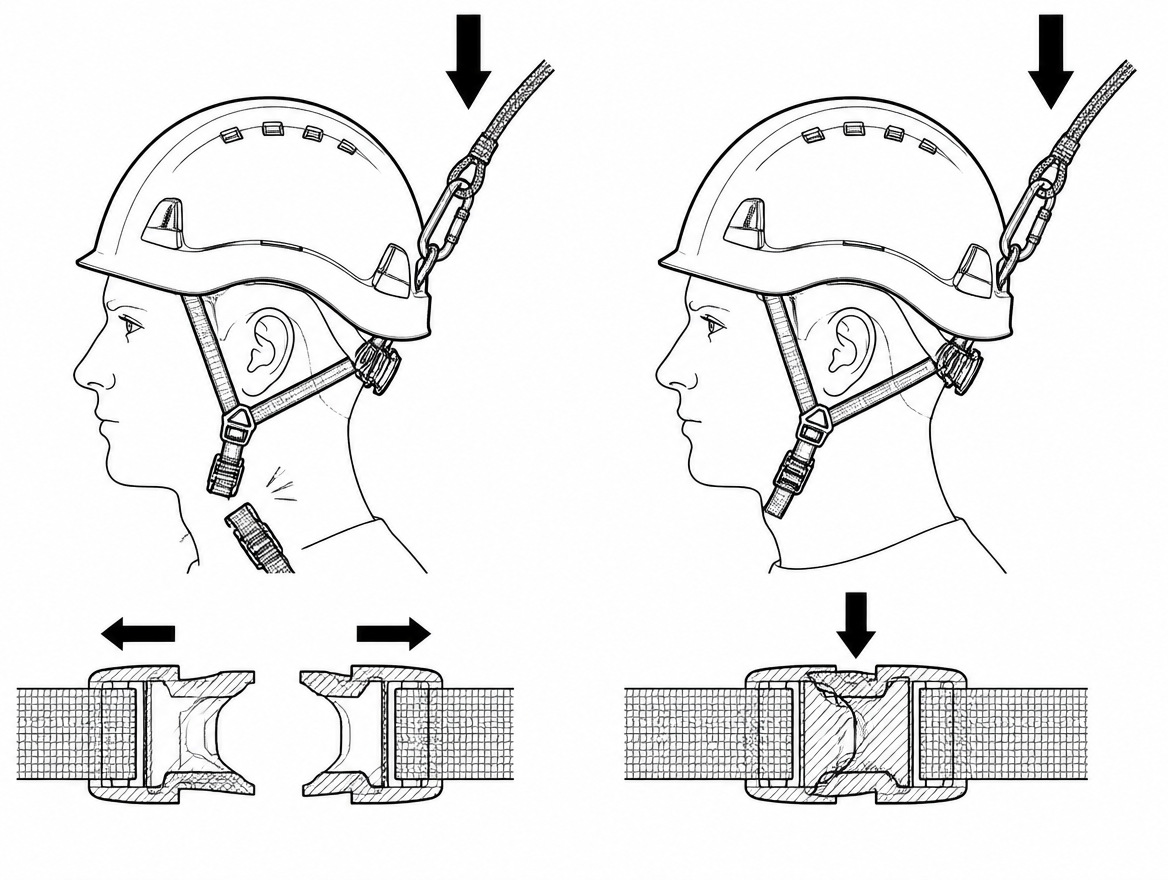
The objection raised by experienced workers is legitimate and should not be dismissed: a strap that will not let go near rotating machinery is a hazard. The EN framework answers it by separating the two cases rather than compromising on both.
- EN 397: release between 150 N and 250 N. The strap holds the helmet in place during normal work and lets go before it can load the wearer’s neck.
- EN 12492: no release below 500 N. The strap is a structural part of the protection and is intended to hold.
The two requirements are mutually exclusive in a single strap, which is why an EN 12492 helmet should not be selected by default for work whose dominant hazard is entanglement in machinery, and why an EN 397 chinstrap should not be relied on to keep a helmet on during fall arrest. Some helmets carry dual certification, and manufacturers achieve this in different ways — interchangeable buckles, a separable break-away element, or certification to one standard with stated exclusions. Read the declaration of conformity and the instructions for use for the specific model rather than assuming the strap does both jobs at once.
Adjusting it so it actually retains
A fastened but slack strap is close to no strap at all. Set the helmet up in this order:
- Headband circumference. Adjust the harness or ratchet so the helmet sits firm without pressure points. It should stay put with the strap unfastened when the head is upright.
- Height of the harness in the shell, where the model allows it. This sets the clearance between skull and shell — the gap the suspension needs in order to deform. Do not fit the harness at its lowest position simply because the helmet feels more stable.
- Nape or rear adjuster. On a four-point system, bring the junction of the rear straps low on the nape, below the occipital bulge. Too high and the shell can still tip forward.
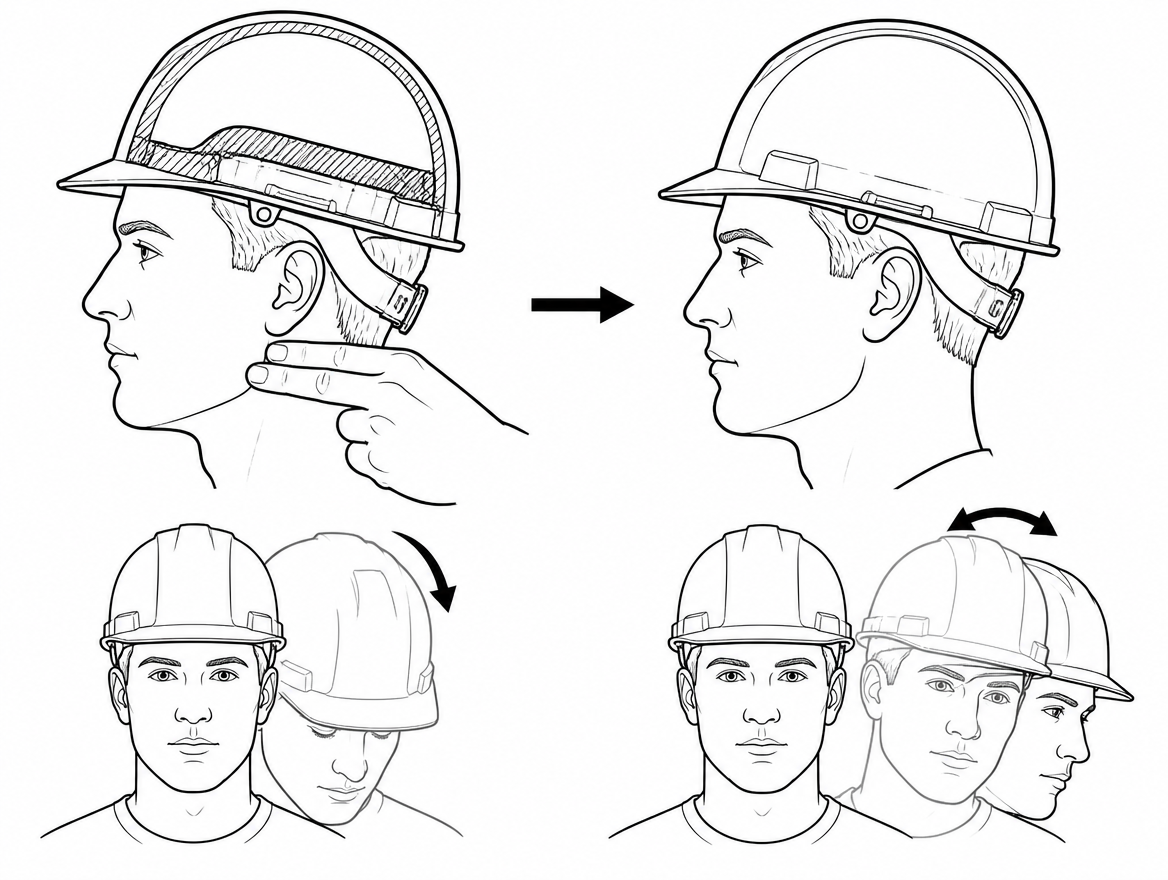
- Chinstrap tension. Snug against the underside of the jaw. A useful working check: no more than roughly two fingers’ thickness of slack between strap and throat, and the strap should not sit across the point of the chin.
- Confirm with a movement check. With the strap fastened, nod fully forward and back, shake the head side to side, and try to push the shell forward off the brow and backward off the crown with the flat of one hand. The shell should return to level and should not expose the forehead or lift clear of the crown.
Two fit issues come up repeatedly and both defeat retention: worn hoods, balaclavas and knitted caps under the shell, which change the harness geometry and let the helmet slide; and long hair tied high on the crown, which lifts the shell off its designed seat. Where thermal or flame-resistant liners are needed, use liners the helmet manufacturer states are compatible, and re-do the fit check with the liner in place.
Inspecting the retention system, not just the shell
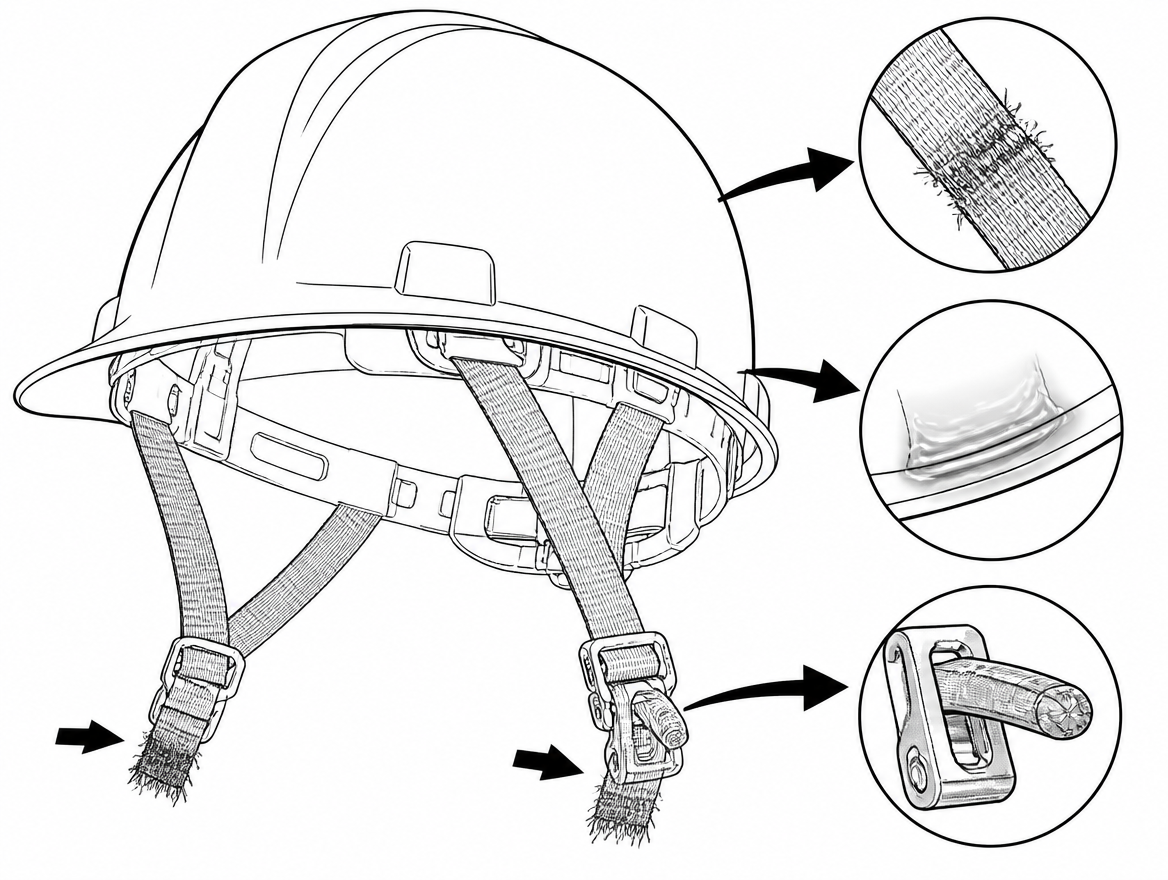
Pre-use checks routinely cover the shell for cracks, gouges, chalking and deformation, then stop. The retention system needs the same attention, because it is the part exposed to sweat, sunscreen, solvents, UV and daily handling.
- Webbing: abrasion, cut or fraying edges, fuzzed fibres, glazing or hardening from heat, stiffness from contamination, chemical staining.
- Buckle: hairline cracks in the latch arms, worn or rounded engagement surfaces, a buckle that opens under light thumb pressure, or one that no longer clicks positively closed.
- Adjusters: slippage under load — pull the strap and confirm the setting holds.
- Anchorages: elongated or torn slots in the shell, missing clips, straps refitted through the wrong slots after cleaning.
- Break-away elements on EN 397 straps: any strap that has already released in service should be inspected and replaced in line with the manufacturer’s instructions, not simply clipped back together.
Withdraw the helmet from service after any significant impact, even where the shell shows no visible damage, and follow the manufacturer’s stated service life for shell and harness — these are given in the instructions for use and differ between models and materials.
Getting the requirement into writing
Because EN 397 leaves the chinstrap optional, “chinstrap fastened” is only enforceable on site if the organisation has decided it and recorded it. Under Directive 89/656/EEC, the employer assesses PPE for suitability against the actual hazards of the work; ISO 45001 puts the same obligation in the language of operational controls and competence. In practice that means:
- the head-protection section of the risk assessment names the helmet standard required for each task type — EN 397, EN 14052, EN 12492, EN 50365 — and states whether a chinstrap is required and whether it must be four-point;
- procurement specifies the strap with the helmet, so the strap is not a separate accessory nobody orders;
- induction and toolbox talks cover the fit check and the reason for the 150–250 N release value, so the entanglement objection is answered rather than argued about;
- supervisors treat an unfastened strap the same way they treat an unclipped lanyard — as a control that is either in place or is not.
Practical takeaway
Retention is not a comfort setting. It determines whether the helmet is in its designed position at the moment it is needed. For general industrial work, an EN 397 chinstrap keeps the shell seated and releases before it can load the neck. For work at height and rope access, an EN 12492 four-point system is part of the protection and is required to hold. Choosing between them is a risk-assessment decision; wearing whichever one has been chosen, fastened and adjusted, is not.
Next step: pull the instructions for use for the helmet models actually in circulation on your site, confirm which retention system each one is supplied with and what release performance the manufacturer declares, then check that your head-protection risk assessment matches what people are wearing.
Frequently asked questions
Does EN 397 require a chinstrap?
No. EN 397 treats the chinstrap as an optional feature, and a helmet can be fully compliant without one. That does not mean retention is unimportant — whether a chinstrap is fitted and worn is a decision for the employer's risk assessment, not something the standard makes for you.
Why does an EN 397 chinstrap release instead of holding?
If a chinstrap is fitted to an EN 397 helmet, the strap or its anchorage must release at a force of not less than 150 N and not more than 250 N. The upper limit is deliberate: industrial helmets are worn around rotating shafts, conveyors, moving loads and drum machinery, where a strap that held indefinitely would become a strangulation or entanglement hazard. It is a positioning device, not a system designed to hold the helmet during a fall arrest event.
Which standards make the retention system mandatory?
EN 12492 — helmets for mountaineering, normally specified for work at height and rope access — requires a retention system that must not release below 500 N, with limited elongation, and the helmet must pass a roll-off test with force applied to pull it forward and backward off the headform. EN 14052 high-performance industrial helmets are required to be supplied with a chinstrap; check the manufacturer's instructions for that model's release characteristics rather than assuming they match EN 397.
When should a chinstrap be treated as mandatory in the risk assessment?
Wherever the head or the helmet is likely to be moved unexpectedly. Typical triggers are work at height, on ladders, scaffolds, steelwork or in a MEWP basket (including travel and elevation phases); work requiring sustained bending, kneeling, looking down or overhead work; confined-space entry and crawling or restricted headroom where the shell is repeatedly knocked against structure; exposed sites in high wind and open vehicle or plant operation; and any position from which a displaced helmet becomes a dropped object for people below.
What changes in an impact if the helmet is not retained?
EN 397 shock absorption is measured with a striker dropped onto the crown of a correctly positioned helmet, with transmitted force limited to 5 kN, relying on the shell spreading the load and the suspension deforming across a clearance gap. Without retention, an unstrapped helmet tends to sit high on the back of the crown, presenting the brim and shell edge instead of the reinforced crown, so the designed load path no longer applies. A glancing blow, a snag on scaffold tube or the first part of a fall can also remove the helmet entirely, leaving secondary impacts — against structure, the ground or a basket rail — taken bare-headed.
Need this as a document you can issue? The template library gives you the risk assessments, permits and inspection logs in editable form — and employer plans cover a whole team with completion records.