Safety / Tips and Tricks / Rope access and confined space
Activity 01 · Rope access
Helmet Standards: EN 397 and EN 12492
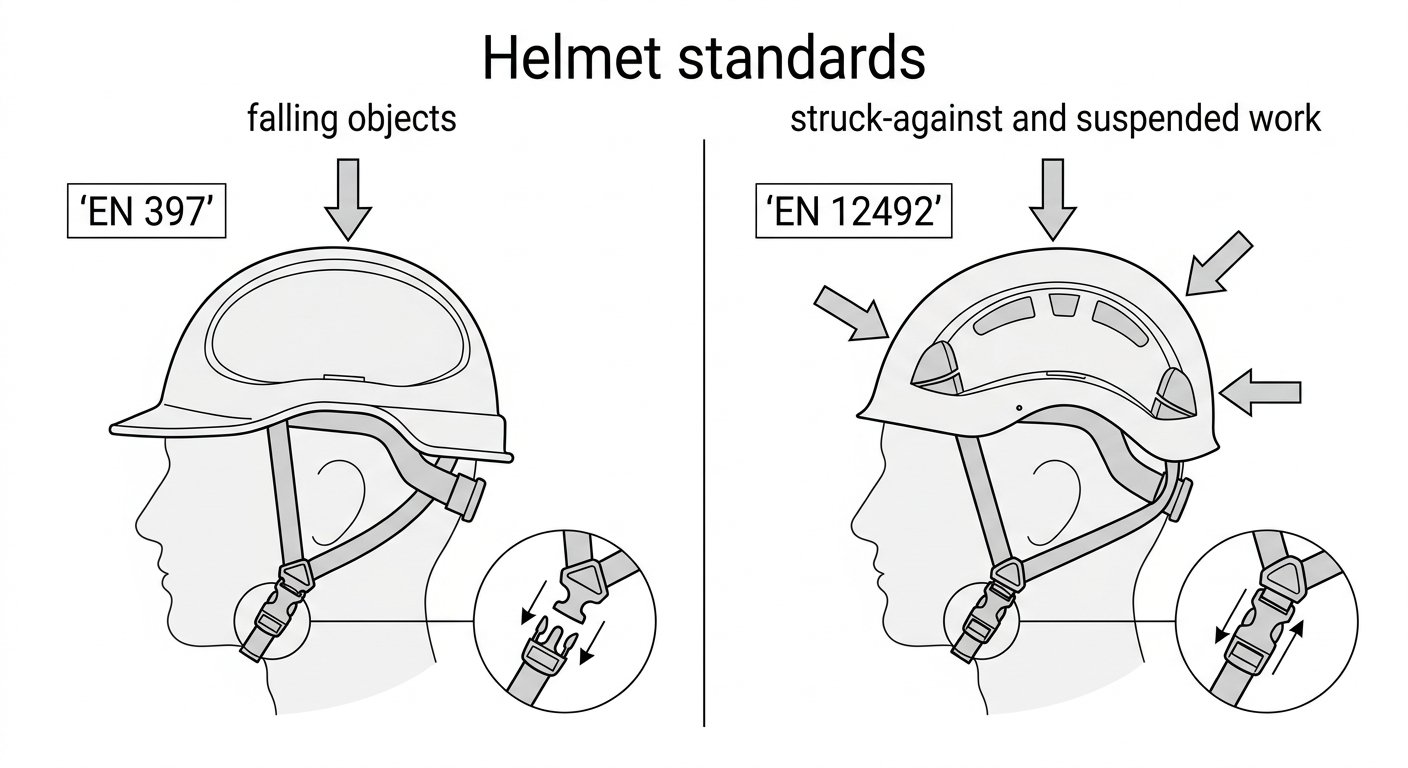
Two helmet standards dominate rope access and confined space work in Europe, and they were written for different accidents. EN 397 is an industrial safety helmet standard built around objects falling onto the head of someone standing below. EN 12492 is a mountaineering helmet standard built around a person who is moving, suspended, or falling — where the head can strike structure from the side or the rear, and where the helmet coming off is itself the failure. Choosing between them, or choosing a helmet marked with both, comes down to which of those two accidents the job actually presents.
What each standard is for
EN 397 specifies industrial safety helmets. Its mandatory tests cover shock absorption from a vertical (crown) impact, resistance to penetration by a pointed striker, flame resistance of the shell, and the behaviour of the chin strap anchorage. It also defines a set of optional performance requirements that a manufacturer may claim and mark: very low temperature, very high temperature, electrical insulation, lateral deformation and molten metal splash.
EN 12492 specifies helmets for mountaineers, and by extension the helmets widely used for rope access, work at height on ropes, and technical rescue. Its tests cover shock absorption from the crown and from the front, sides and rear, resistance to penetration, and the retention system — both its strength and its ability to keep the helmet on the head. EN 12492 contains no flame resistance, electrical insulation, lateral deformation or molten metal clauses; those exist only on the EN 397 side.
Impact test zones: the most visible difference
Under EN 397 the shock absorption test is applied vertically, to the crown, with the transmitted force to the headform limited to a relatively low threshold — commonly quoted as 5 kN. The scenario being reproduced is a tool or component dropped from above onto a worker who is upright on the ground.
EN 12492 applies impacts from four directions: crown, front, rear and lateral. The crown impact energy is higher than EN 397’s and the permitted transmitted force is correspondingly higher (commonly quoted as 10 kN), while the front, side and rear impacts are lower-energy tests that EN 397 does not require at all. The scenario being reproduced is a person swinging into a beam, being drawn into a structure during a pendulum, or falling and striking their head on the way.
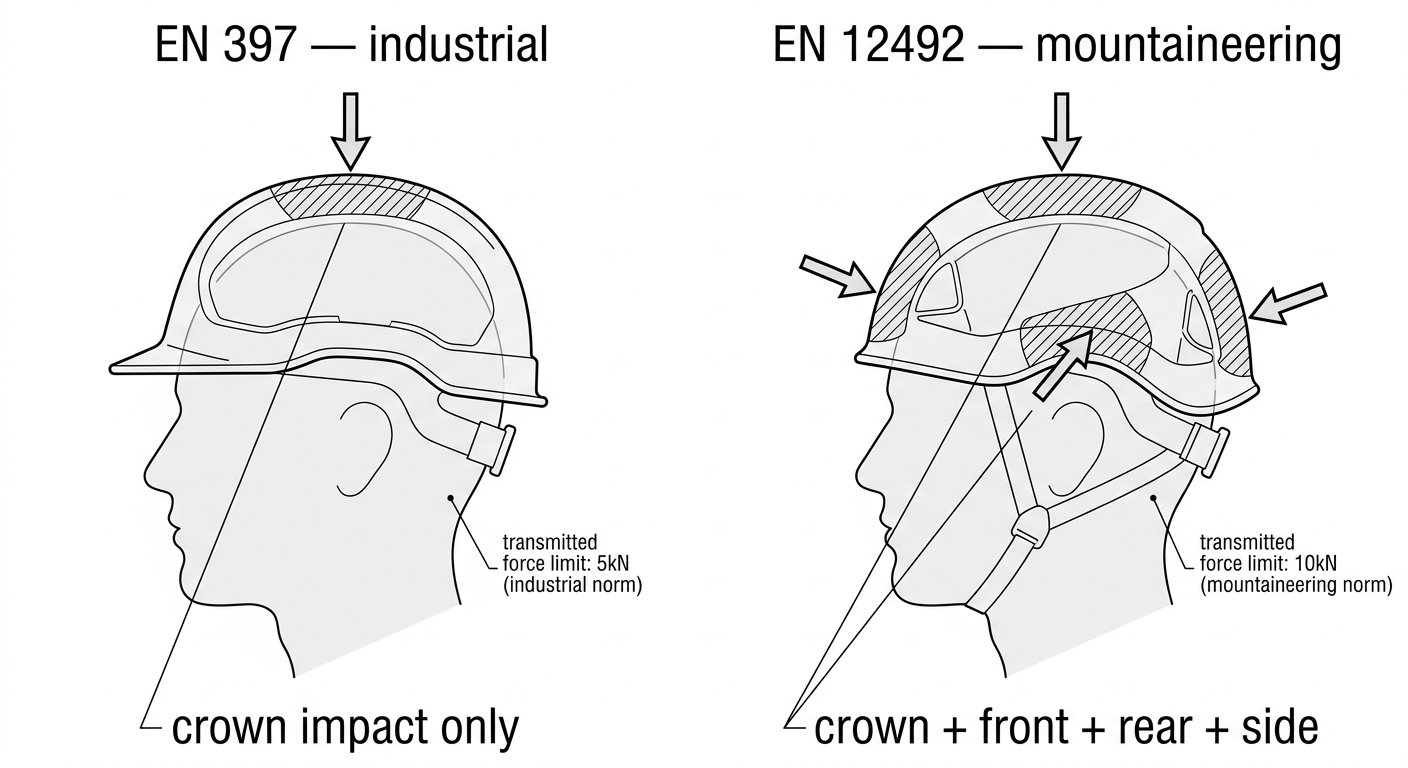
The practical consequence is straightforward: an EN 397-only helmet has been assessed for protection from directly above, and nothing has been demonstrated about a blow to the temple or the back of the head. An EN 12492-only helmet has been assessed all round, but has not been assessed against the industrial hazards EN 397 covers — flame contact, hot particles, or electrical contact.
The chin strap: where the two standards genuinely conflict
This is the clause that decides most selection arguments, and it is worth understanding precisely because the two standards ask for opposite behaviour.
- EN 397 requires that, where a chin strap is fitted, its anchorage releases under a modest load — the range usually cited is 150 N to 250 N. The reasoning is a strangulation hazard: if the helmet snags on machinery, a ladder cage or a rotating shaft while the wearer keeps moving, the strap must let go.
- EN 12492 requires the opposite. The retention system must not fail below a substantially higher load — commonly quoted as 500 N — and must not elongate beyond a small limit, typically given as 25 mm. There is also an effectiveness test in which the helmet must stay on a headform rather than roll off forward or backward. The reasoning is that a suspended worker who loses the helmet during a fall or a rescue has lost all head protection at the exact moment it is needed.
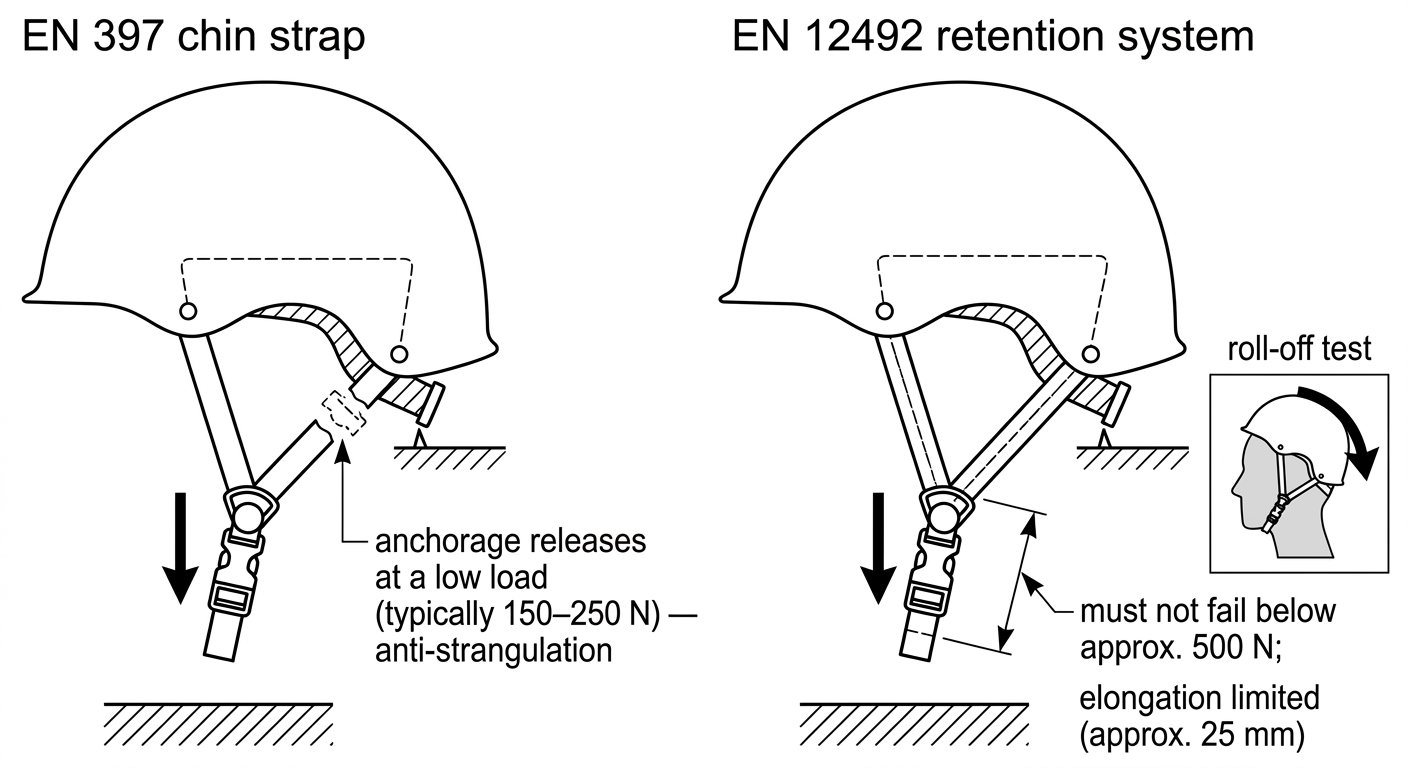
A single fixed chin strap cannot satisfy both clauses. Manufacturers resolve this in one of a few ways: by declaring conformity to EN 397 with the chin strap release requirement explicitly excluded and stated as such in the instructions; by supplying interchangeable retention systems; or by fitting a dual-mode buckle that the user can configure for either behaviour. If a helmet carries both marks, read the notice — it will say which chin strap behaviour applies and under what configuration.
For work on rope, the EN 12492 retention behaviour is normally what is wanted, because the helmet has to remain in place through a fall arrested by a harness. That logic is the same one that governs how the rest of the system is set up; see the notes on EN 361 full body harnesses and on adjusting a full body harness correctly.
Reading the markings before trusting the helmet
Every certified helmet carries its claims on the shell or on a label under the brim. What to look for:
- The standard number, and its edition or amendment where marked (for example EN 397 with its amendment, or EN 12492).
- Manufacturer and model.
- Head size range, in centimetres.
- Mass of the helmet.
- Date of manufacture — usually a moulded clock or a printed month and year.
- Shell material designation.
- Optional performance codes, where claimed under EN 397: −20 °C or −30 °C for very low temperature, +150 °C for very high temperature, 440 V a.c. for electrical insulation, LD for lateral deformation, MM for molten metal splash.
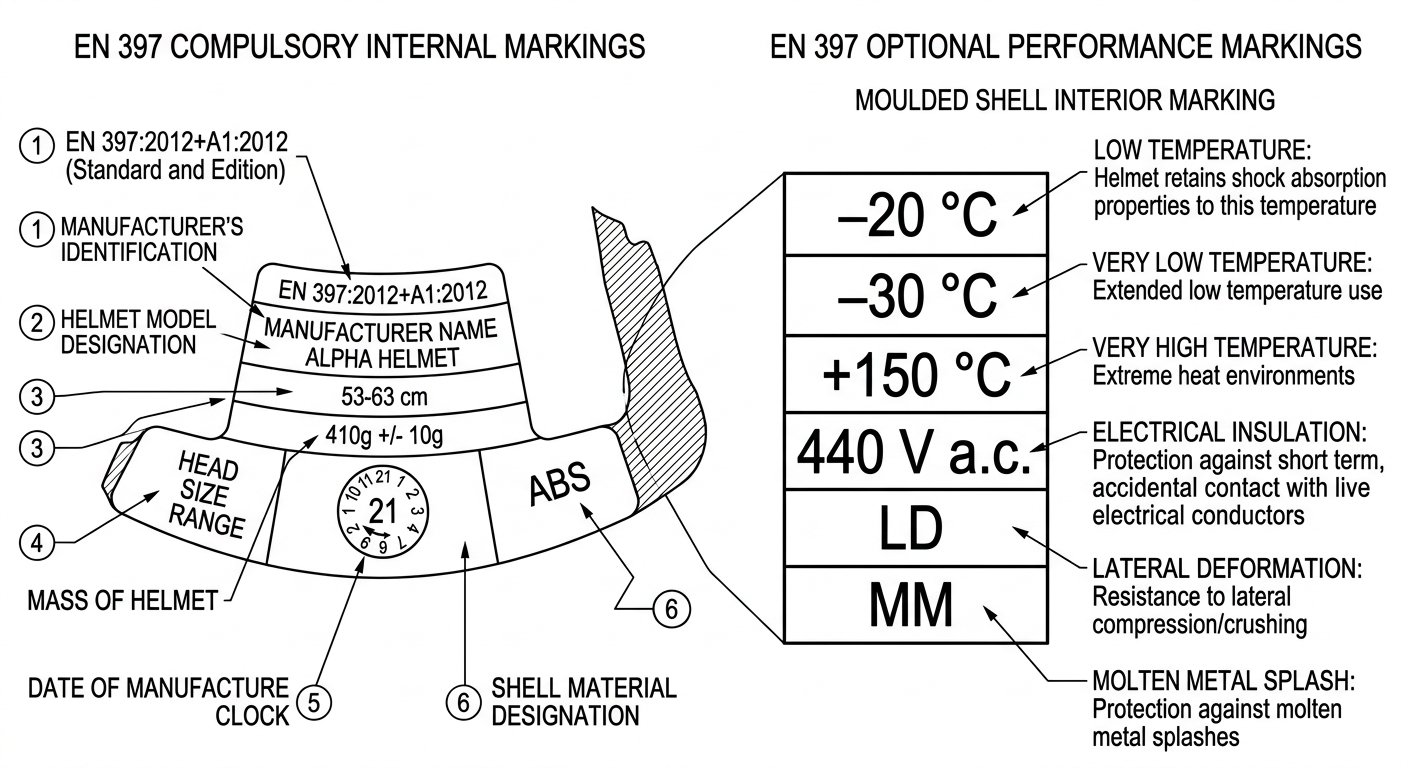
Those optional codes matter operationally. A helmet without MM should not be relied on near molten metal or hot slag; a helmet without 440 V a.c. makes no electrical claim, and live low-voltage work is typically covered by a separate insulating-helmet standard rather than by EN 397 alone. Absence of a code means the property was not tested or not claimed — not that it fails.
Matching the standard to the task
A short version of the selection logic:
- Ground-level or platform work under an overhead drop hazard, no suspension: EN 397 addresses the dominant hazard, including the strangulation-release feature that makes sense on foot around plant and machinery.
- Rope access, work positioning, tower and structure work: EN 12492 addresses the multi-directional impacts and the retention performance that suspended work demands. Related device and system notes are collected on the rope access and confined space technique notes hub.
- Confined space entry: retention and profile usually dominate. A low-profile shell without a projecting peak passes through a manhole and turns inside a vessel; a retention system that holds keeps the helmet on during an awkward extraction. This is covered in detail in the note on selecting a helmet for confined space work.
- Mixed sites — rope access inside an operating industrial plant: a dual-marked helmet is the usual answer, with the chin strap configured for the mode that matches the dominant hazard of the shift.
Compatibility decides real-world performance
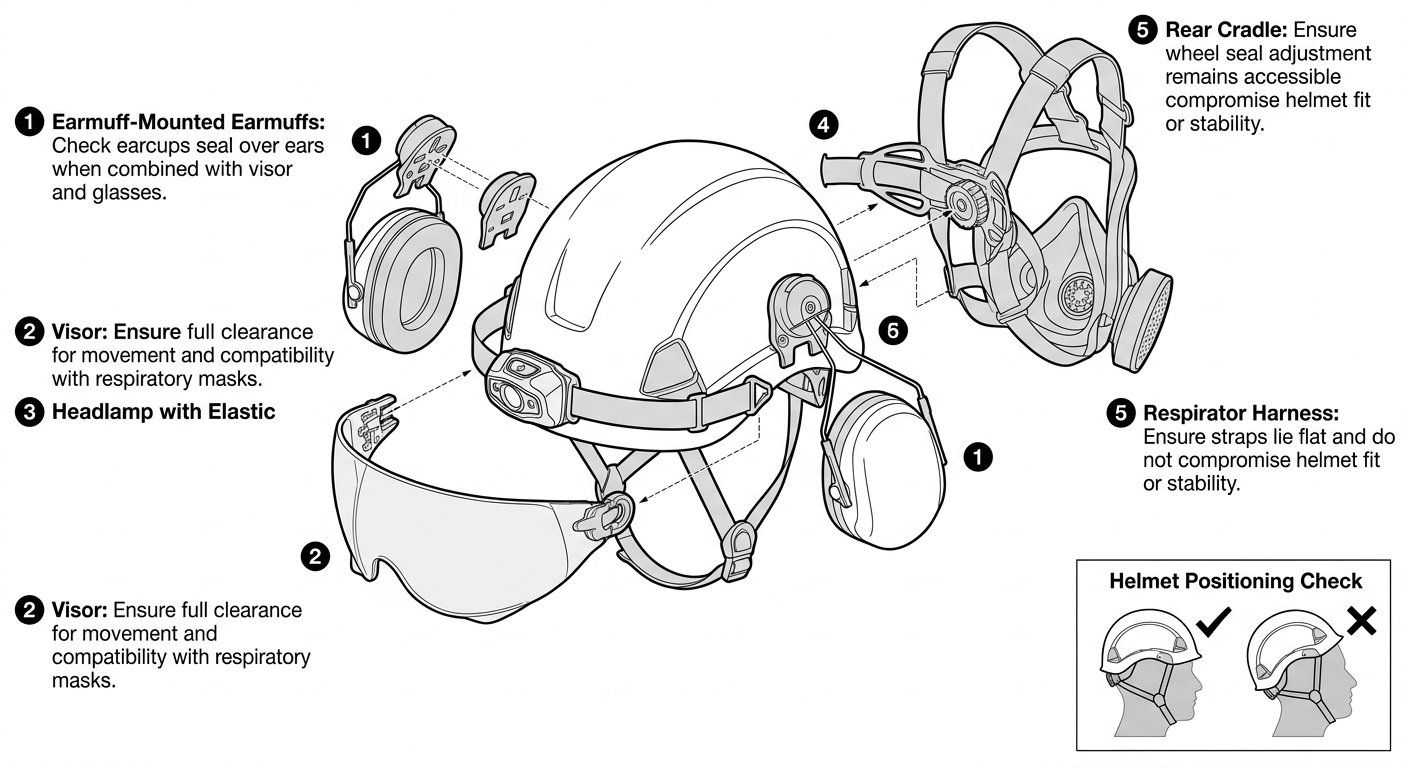
A certified helmet only performs as tested if it is on the head, correctly adjusted, with accessories that do not interfere with the shell or the retention system. Points worth checking before a helmet is issued:
- Headband and cradle adjustment. The helmet should sit level, not tipped back, with no movement when the head is shaken. Front-to-back rocking is the usual sign of an under-tightened cradle or a size mismatch.
- Hearing protection. Helmet-mounted earmuffs are only rated as an assembly on the specific helmet models listed by the manufacturer. Substituting an unlisted shell invalidates the attenuation data — see the note on EN 458 hearing protector selection.
- Eye protection and visors. Slot-mounted visors and integrated eye shields are certified with the helmet, not independently of it.
- Headlamp. Elastic on hooks or clips, routed so it cannot lift the shell or interfere with the chin strap. Adhesive-mounted fixings on the shell should follow the manufacturer’s instructions only.
- Respirators. A full-face mask or a supplied-air hood has its own head harness. Check that the helmet cradle and the mask straps do not fight each other, and that the seal is unaffected with the helmet on.
Inspection and retirement
Helmets are inspected before use and periodically, following the manufacturer’s instructions. The recurring findings are cracks and crazing in the shell, deep gouges, deformation, degraded or discoloured plastic from UV exposure, cut or frayed retention webbing, seized or cracked buckles, and a cradle that no longer holds its adjustment. Any helmet that has taken a significant impact is withdrawn, whether or not damage is visible, because the energy-absorbing behaviour of the shell and cradle may already have been used up.
Manufacturers also state a maximum service life from the date of manufacture, and often a shorter one from first use. Solvents, paint, adhesives and stickers outside the manufacturer’s own accessories can attack the shell and should not be applied. The general principles for logging, condition assessment and end-of-life decisions are the same ones set out in the note on service life and retirement criteria for textiles — with the difference that a helmet’s shell, not just its webbing, ages.
Takeaway
EN 397 protects against a drop from above and is designed for the chin strap to release; EN 12492 protects from four directions and is designed for the chin strap to hold. Neither is a superset of the other. Decide which failure the job actually presents — struck by falling object, or struck-against and suspended — and then read the shell markings and the manufacturer’s notice to confirm the helmet in hand carries the mark, and the chin strap configuration, that matches.
Frequently asked questions
Can one helmet be certified to both EN 397 and EN 12492?
Yes, dual-marked helmets are common, but the chin strap clauses conflict, so the manufacturer has to resolve that explicitly. Typical approaches are declaring EN 397 conformity with the chin strap release requirement excluded and stated in the instructions, supplying interchangeable retention systems, or fitting a dual-mode buckle. Always read the notice supplied with the helmet to see which behaviour applies in which configuration.
Why does EN 397 want the chin strap to release?
Because the hazard model is a worker on foot around plant, machinery and ladder cages, where a helmet that snags while the wearer keeps moving creates a strangulation risk. Releasing the anchorage at a relatively low load lets the helmet come away instead. The trade-off is that the helmet is not designed to stay on the head during a fall.
Is an EN 12492 helmet acceptable for general industrial work?
Not automatically. EN 12492 includes no flame resistance, electrical insulation, lateral deformation or molten metal splash requirements, all of which exist on the EN 397 side, and its crown impact criteria are set for a different scenario. Where those industrial hazards are present, the helmet needs to carry the relevant EN 397 marking or claim, or an appropriate separate standard.
Which standard applies to confined space entry?
The regulations set the duty; the standard is chosen from the hazards. In practice retention and shell profile dominate confined space work, so EN 12492 retention performance combined with a low-profile, peakless shell is the usual choice, and a dual-marked helmet is often specified when the surrounding plant also presents overhead or thermal hazards.
Does a helmet have to be withdrawn after any impact?
After a significant impact, yes — the shell and cradle absorb energy by deforming, and that capacity may already be spent even where nothing is visible from outside. Follow the manufacturer's instructions, which normally require withdrawal after a substantial impact regardless of appearance. Routine pre-use inspection also looks for cracks, crazing, deformation, cut webbing and buckles that no longer hold.
Can helmet-mounted earmuffs be fitted to any slotted helmet?
No. Helmet-mounted hearing protectors are tested and rated as an assembly with specific helmet models, and the manufacturer lists the combinations that were assessed. Fitting them to an unlisted shell means the published attenuation data no longer applies, even if the slots physically accept the arms.
Need this as a document you can issue? The template library gives you the risk assessments, permits and inspection logs in editable form — and employer plans cover a whole team with completion records.