Safety / Tips and Tricks / Rope access and confined space
Activity 01 · Rope access
Service Life and Retirement Criteria for Textiles: Age Limits, Condition Checks and When to Cut the Sling
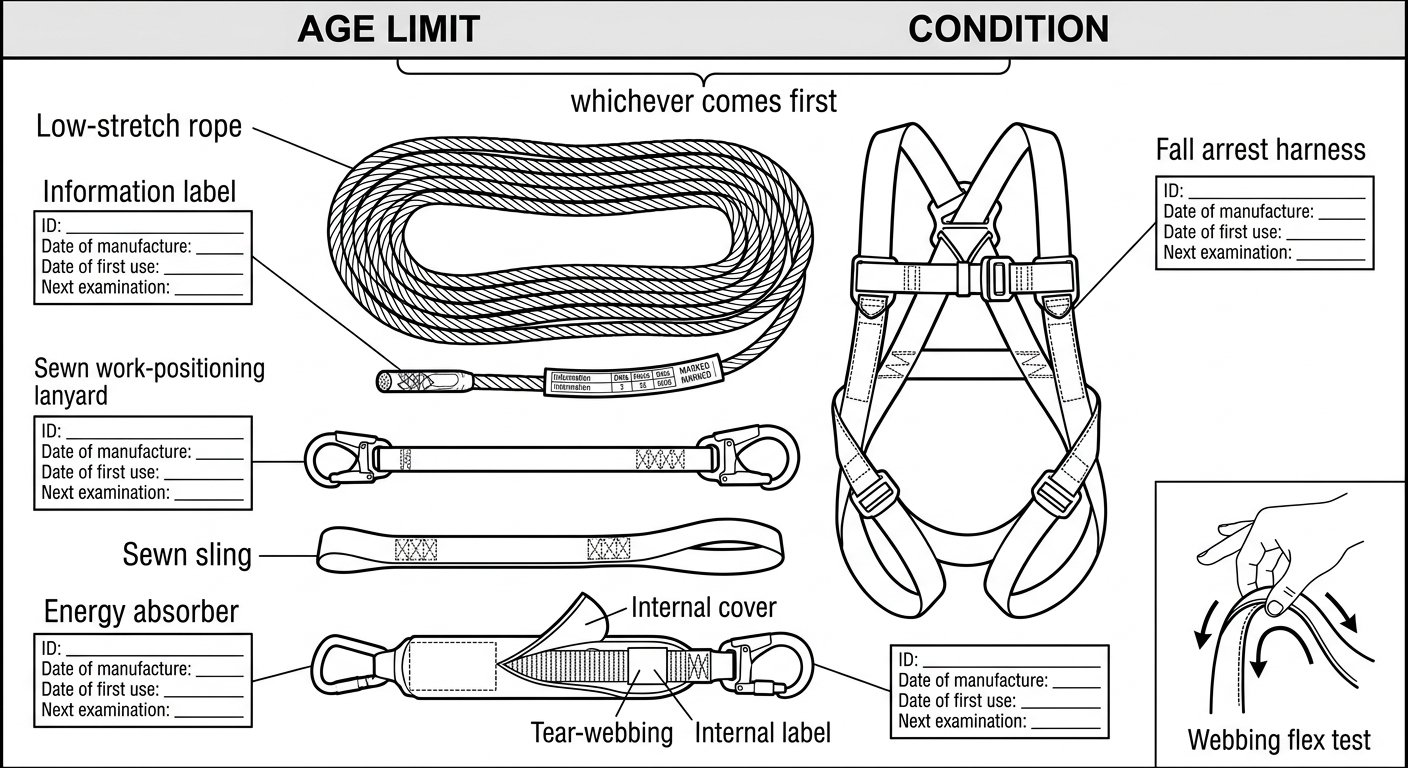
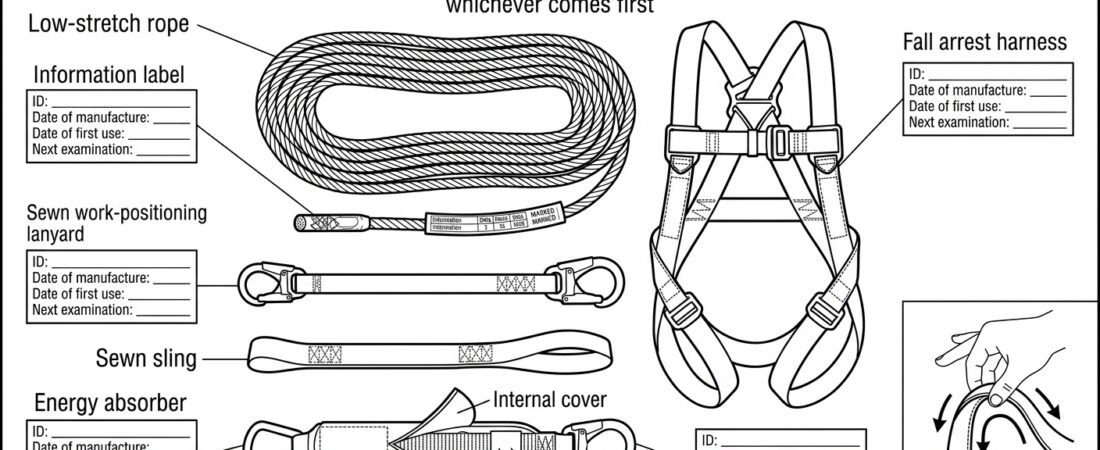
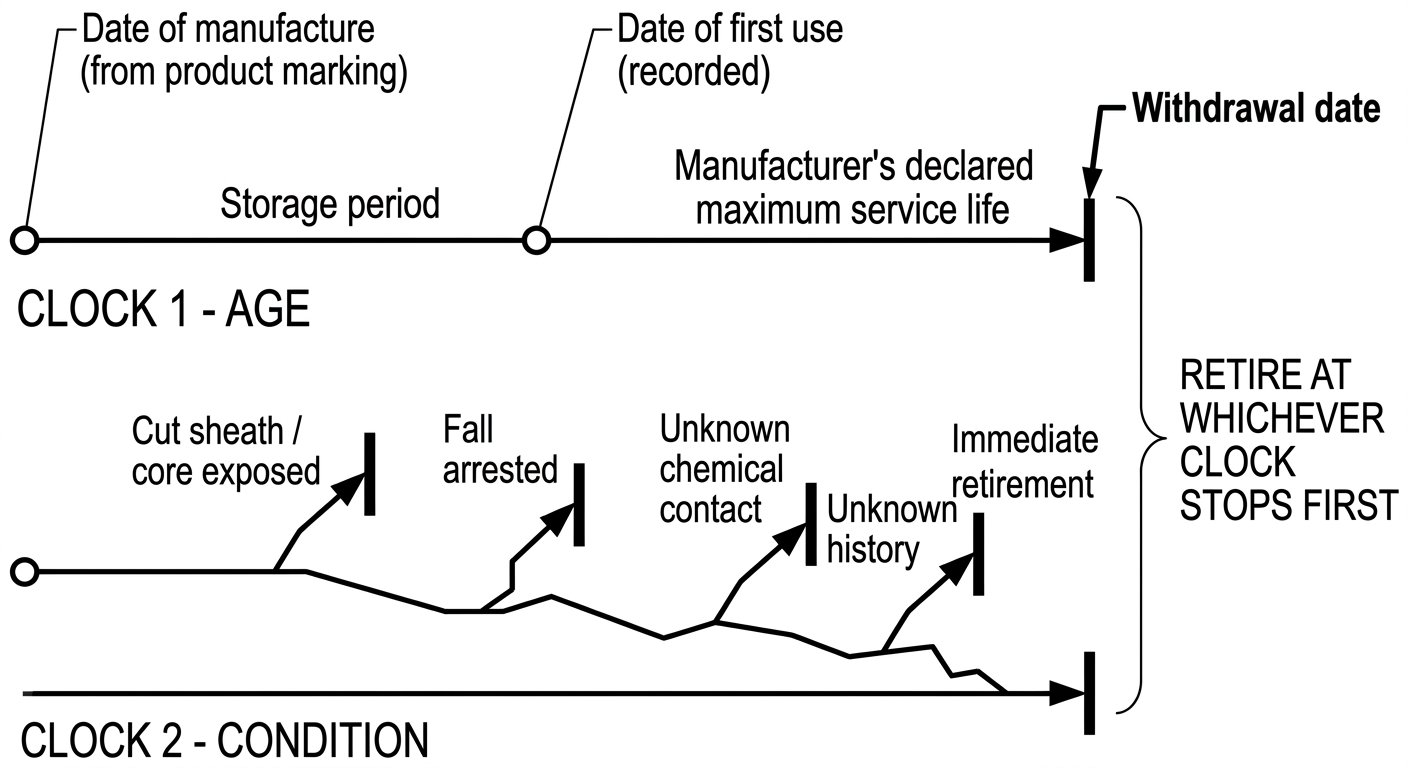
Every textile item in a rope-access or confined-space kit — rope, harness, positioning belt, lanyard, energy absorber, sling, anchor strap, accessory cord — leaves service for one of three reasons: it reached the maximum service life declared by its manufacturer, an inspection found damage that meets a retirement criterion, or a single event happened to it that inspection cannot clear. On site, the practical consequence is that "it looks fine" is never sufficient grounds to keep a textile item in use, and "it's only two years old" is never sufficient grounds to ignore a cut sheath. Two clocks run at the same time, and the item is retired when the first of them stops.
What counts as a textile item
For service-life purposes, treat as textile anything whose load path passes through synthetic fibre: low-stretch and dynamic rope, sewn slings and lanyards, harness and belt webbing including its stitching, energy absorbers, rope-access work-positioning lanyards, sewn rope terminations, and the webbing parts of rescue kits and stretcher bridles. Products that combine textile and plastic components — a harness with plastic attachment-point stiffeners, a sewn sling with a plastic keeper — are governed by the shorter of the applicable limits, which in practice means the textile limit.
Metal hardware ages differently: it has no fibre to oxidise or photodegrade, and is usually retired on condition (wear, deformation, corrosion, cracking) rather than on age. That difference is why a harness and its connectors do not necessarily leave service together.
The two clocks: declared service life and condition
The first clock is age. Manufacturers of fall-protection textiles commonly declare a maximum service life of around ten years from the date of manufacture, often with a stated limit on how long the item may sit in storage before it is first put into service. The exact figures, and how storage time counts against the total, vary between manufacturers and product families — the number that applies is the one printed in the instructions for use supplied with that specific item, not a general rule of thumb.
The second clock is condition, and it can stop at any moment. A rope pulled over a sharp concrete edge on day one is retired on day one. In practice, most textile items in regular rope-access use are retired on condition well before they reach a declared age limit; the age limit exists to catch the opposite case — lightly used or stored equipment, such as a rescue kit or a rescue harness conforming to EN 1497, that has aged in a cupboard without ever accumulating visible wear.
The dates that have to be traceable
An age-based limit is unenforceable without dates, so the paperwork is part of the safety function, not an administrative extra. For each textile item, the record should carry:
- a unique identification (serial number, or an added ID on a non-load-bearing label or tag);
- the date of manufacture, taken from the product marking;
- the date of first use, entered when the item is taken out of storage and put into service;
- the intended withdrawal date derived from the manufacturer’s declared limits;
- a log of periodic examinations, with the examiner’s name and outcome;
- notes of any event relevant to service life — fall arrest, shock load, chemical contact, unusual heat, loan to another site.
Mark identification only where the manufacturer permits it. Solvent-based inks and paint markers on load-bearing webbing or a rope sheath can attack the fibre, and an unreadable or self-inflicted marking problem often ends with an item retired for lack of traceability rather than for wear.
Pre-use check versus periodic examination
Two levels of inspection feed the condition clock. The pre-use check is done by the user, on every item, before every use: a visual and tactile pass over the full length of a rope or lanyard and the whole webbing surface of a harness, plus a functional check of buckles and adjusters. It takes minutes and its purpose is to catch damage that appeared since the last use.
The periodic detailed examination is done by a competent person at an interval set by risk assessment — typically at least once every twelve months, and more frequently for intensive use, abrasive environments, chemical exposure or rescue equipment held ready for use. It is a documented, item-by-item examination against the manufacturer’s criteria, with the item taken out of the system, opened up, and every seam and adjuster examined. Neither level replaces the other.
What retires a rope
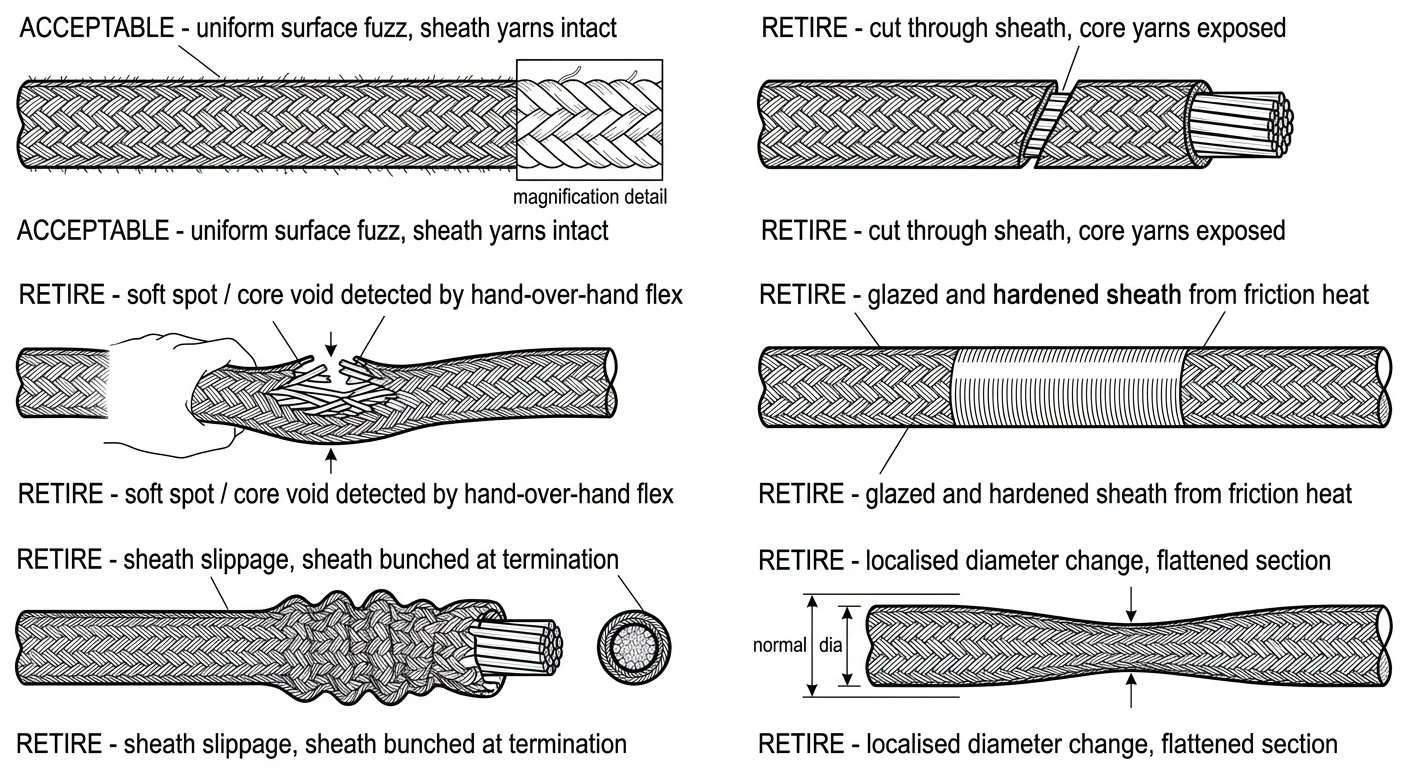
Work along the whole length, hand over hand, flexing the rope so the sheath opens slightly. Retire the rope for:
- Sheath damage exposing the core, or a cut, tear or burst that severs sheath yarns rather than fuzzing them.
- A soft spot, void or lump in the core felt through the sheath — evidence of core rupture or displacement.
- Sheath slippage, where the sheath moves along the core or bunches at a termination.
- Glazing, hardening or melted fibre from friction or heat, typically where a descender has run under load or where the rope has contacted a hot surface.
- Localised diameter change — a flattened, thinned or swollen section.
- Stiffness, chalky or powdery fibre, or marked colour loss suggesting UV or chemical degradation.
- Any chemical contact whose nature or concentration is unknown.
- Damage to a sewn termination: cut, abraded or broken stitching, or a displaced protective sleeve.
Uniform surface fuzzing is not in itself a retirement criterion — it is what a working sheath looks like. What matters is whether load-bearing yarns are cut, and whether the rope still feels consistent along its length. Note also that a used rope does not behave like a new one in a device: diameter, stiffness and surface friction all shift with use, which is why the performance differences between new and used ropes are worth understanding before a worn rope is judged only on appearance.
Shortening a rope to remove a damaged end is legitimate only if the manufacturer permits it, the remaining length is re-terminated correctly, and the record and marking are updated with the new length. The date of manufacture does not reset.
What retires a harness, belt, lanyard or sling
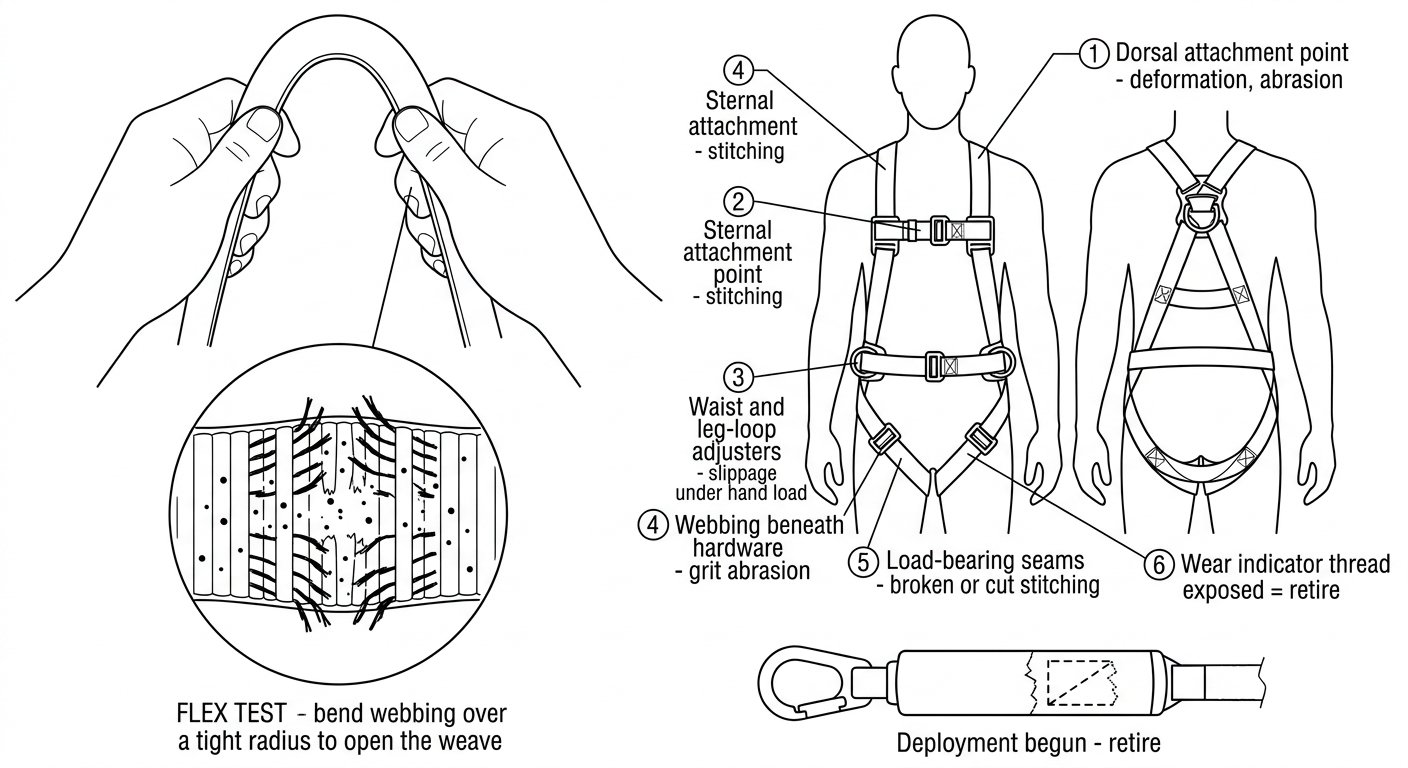
Webbing hides damage better than rope does, because the weave closes over cut yarns. The standard field method is to flex the webbing over a tight radius — bend it into a sharp U between thumbs and forefingers and work along its length — which opens the weave and makes broken fibres, embedded grit and internal cuts visible. Retire the item for:
- Cut, pulled or broken load-bearing yarns, including edge damage that has gone beyond surface fuzz into the woven structure.
- Broken, cut, abraded or loose stitching in any load-bearing seam, or an exposed wear-indicator thread where the manufacturer provides one.
- Heat damage: glazed, shiny, hardened or fused webbing, or weld spatter burns.
- Chemical contamination or unexplained staining, including cement, resin, paint, battery electrolyte or unidentified fluids.
- Deformed, cracked or corroded attachment points, D-rings, buckles or adjusters, or an adjuster that no longer holds its setting under hand load.
- An energy absorber that has begun to deploy — a torn tell-tale, a broken cover stitch, or any elongation of the absorbing element.
- Rodent damage, mould, or long-term damp storage with stiffened or discoloured fibre.
On a full body harness the areas that repay the closest attention are the dorsal and sternal attachment points, the leg-loop and waist adjusters, and the webbing that passes under hardware, where grit acts as an abrasive under load. Those are the same contact areas that a correct fit governs, so a detailed examination pairs naturally with a re-check of harness adjustment and the common fit errors, and against the marking and construction requirements for full body harnesses under EN 361.
Single events that retire an item regardless of appearance
Some events end an item’s service life immediately, because the damage they cause is not reliably visible:
- Arrest of a fall, or any significant shock load, on a harness, lanyard, absorber, sling or rope, whether or not the absorber shows deployment.
- Contact with an aggressive chemical. Polyamide is notably vulnerable to acids, polyester to strong alkalis, and both to some solvents and oxidising agents. Strength loss can occur with no change in appearance until the fibre is flexed and crumbles.
- Exposure to heat beyond the manufacturer’s stated limit, or any contact with flame, hot metal or welding spatter.
- Unknown history. Equipment found on site, borrowed with no records, or recovered from a store without traceable dates cannot be inspected back into service; the age clock is unreadable.
- Any doubt the examiner cannot resolve. Doubt is itself a retirement criterion.
Storage, cleaning and the things that quietly shorten life
Most premature textile retirement in rope access traces back to storage and handling rather than to work loads. Store dry, out of direct sunlight, away from heat sources, batteries, fuels, solvents and cement dust, loosely coiled or bagged rather than compressed, and away from sharp hardware that can abrade webbing in transit. Grit is the main hidden abrasive: fine particles worked into a sheath or a webbing weave cut fibres from the inside under every subsequent load cycle.
Wash with clean water and, where needed, a mild soap at low temperature — typically no warmer than about 30 °C — rinse thoroughly, and dry in the shade away from any direct heat source. Never use solvents, bleach, high-pressure washers or a tumble dryer. The same handling logic applies to a new rope: see the note on washing a low-stretch rope before first use.
What is not a retirement criterion
Over-retirement has a real cost: it drains kit budgets, encourages informal substitution of whatever is left in the van, and trains users to treat retirement decisions as arbitrary. The following, on their own, do not retire an item:
- uniform surface fuzz on a rope sheath or webbing face;
- general dirt, dust or dried mud that washes out;
- cosmetic marks, scuffs or fading that do not coincide with fibre damage;
- an item that has simply passed its previous examination date, provided a competent person examines it before it returns to service.
The distinction to hold onto is between wear (progressive, uniform, monitored) and damage (localised, structural, disqualifying).
Quarantine, destruction and closing the record
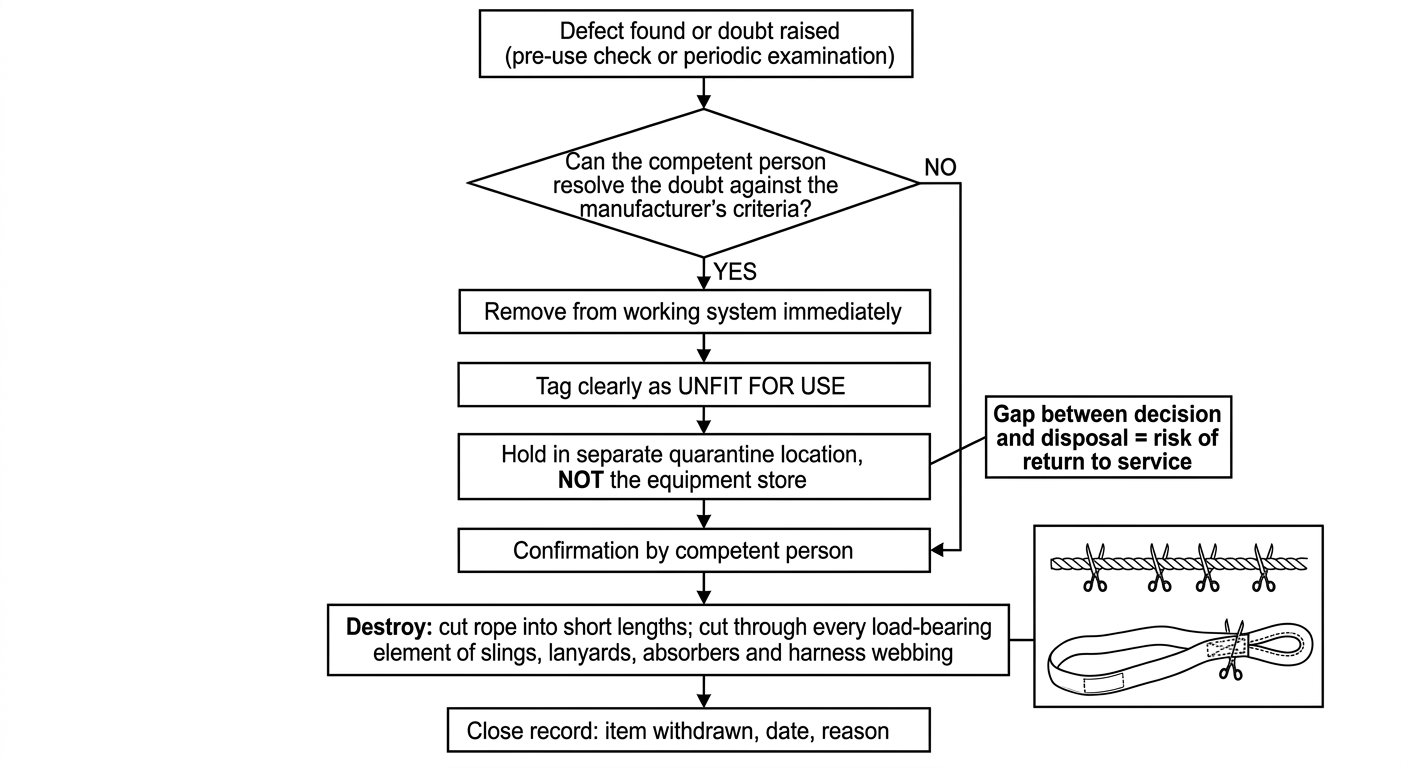
The riskiest moment in the whole process is between the decision and the disposal, because a tagged-but-untouched item in a store will eventually be picked up by someone in a hurry. Handle it as a sequence with no gaps: remove the item from the working system immediately, tag it clearly as unfit, hold it in a physically separate quarantine location — not the equipment store — pending confirmation by the competent person, then destroy it so it cannot return to service. For textiles that means cutting the rope into short lengths and cutting through slings, lanyards, absorbers and harness webbing at every load-bearing element. Finally, close the record: mark the item withdrawn, with date and reason.
Recording the reason matters beyond compliance. A store’s retirement log is the clearest available evidence of which edges are cutting rope, which storage habits are destroying webbing, and which tasks need rope protection or a change of technique.
Takeaway
Run both clocks. Take the age limit from the instructions supplied with each specific item and record the manufacture and first-use dates so that limit is enforceable; run condition-based retirement continuously through pre-use checks and documented periodic examinations by a competent person. Retire on the first of the two, and treat fall arrest, chemical contact, heat damage, unknown history and unresolved doubt as immediate. Then destroy and log the item on the same day the decision is made.
For related inspection and selection notes, see the full set of rope access and confined space technique notes.
Frequently asked questions
Is there a fixed service life for all textile PPE?
No. Manufacturers of fall-protection textiles commonly declare a maximum of around ten years from the date of manufacture, often with a separate limit on storage time before first use, but the exact figures vary by manufacturer and product family. The applicable limit is the one stated in the instructions for use supplied with that specific item, and condition-based retirement can end its life much earlier.
Does the age limit start at manufacture or at first use?
Most declared limits are counted from the date of manufacture, with a stated maximum period the item may spend in storage before it is put into service. This is why both the manufacture date and the date of first use must be recorded: without them, the age clock cannot be read and the item has to be withdrawn for lack of traceability.
Does a harness always have to be retired after arresting a fall?
Yes. A harness, lanyard, energy absorber, sling or rope that has arrested a fall or taken a significant shock load is retired, whether or not damage is visible. Fibre and stitching damage from a shock load is not reliably detectable by inspection, and an energy absorber that has begun to deploy has already used its function.
Is surface fuzz on a rope sheath a reason to retire it?
Uniform surface fuzz on its own is normal wear, not a retirement criterion. What matters is whether load-bearing yarns are cut, whether the core feels consistent hand over hand, and whether the diameter and stiffness are uniform along the length. Localised cuts, soft spots, glazing, sheath slippage and diameter change do require retirement.
How often does textile PPE need a detailed examination?
The interval is set by risk assessment and by the manufacturer's instructions, and is typically at least once every twelve months for equipment in service. More frequent examination is normal for intensive use, abrasive or chemically contaminated environments, and rescue equipment held ready for use. This is in addition to a user pre-use check before every use.
What should be done with an item once it is retired?
Remove it from the working system at once, tag it as unfit, and hold it in a quarantine location separate from the equipment store until the competent person confirms the decision. Then destroy it — cut rope into short lengths and cut through every load-bearing element of webbing items — and record the withdrawal with its date and reason.
Can equipment with no records be inspected and returned to service?
No. An item with unknown history cannot have its age limit verified and may have been shock loaded, heat damaged or chemically contaminated without visible signs. Equipment found on site or borrowed without traceable identification and dates is retired rather than reinstated.
Need this as a document you can issue? The template library gives you the risk assessments, permits and inspection logs in editable form — and employer plans cover a whole team with completion records.